

From Medieval Poetry to the Construction of an Enduring Archetype
Among the most profound transformations within medieval Italian culture is the changing conception of woman.
No longer merely an earthly presence.
Not simply the object of love.
Not merely a courtly figure.
With the Dolce Stil Novo, woman gradually assumes a higher function: she becomes a mediator between human experience and the spiritual dimension.
It is one of the most important shifts in the history of Western sensibility.
Woman is not simply celebrated.
She is transformed into a sign.
A presence capable of elevation.
A figure carrying light, knowledge, salvation, disturbance and transcendence.
From this transformation emerges one of the most powerful archetypes in Italian culture: the Donna Angelo, the Angel Woman.
Before the Stil Novo
Medieval love poetry did not begin with Dante.
Before the Dolce Stil Novo, there was already a long tradition.
Troubadour poetry.
Courtly lyric.
The Sicilian School.
Tuscan poetry.
Within these traditions, woman often appears as the object of desire, admiration, loyalty and service.
Love may ennoble.
Discipline.
Transform behaviour.
But with the Dolce Stil Novo, something further occurs.
Woman no longer merely improves the lover morally.
She becomes almost a mediation between the human and the divine.
Guido Guinizzelli and a New Idea of Nobility
One of the decisive stages appears in the poetry of Guido Guinizzelli.
Here, love is connected with inner nobility.
True nobility does not depend solely on blood.
It depends on the quality of the soul.
Authentic love can arise only in a heart capable of receiving it.
This idea profoundly alters the meaning of the amorous relationship.
Love is no longer merely emotion.
It becomes a force capable of revealing the spiritual quality of the individual.
And woman, consequently, becomes the point through which such elevation may become visible.
Woman as Apparition
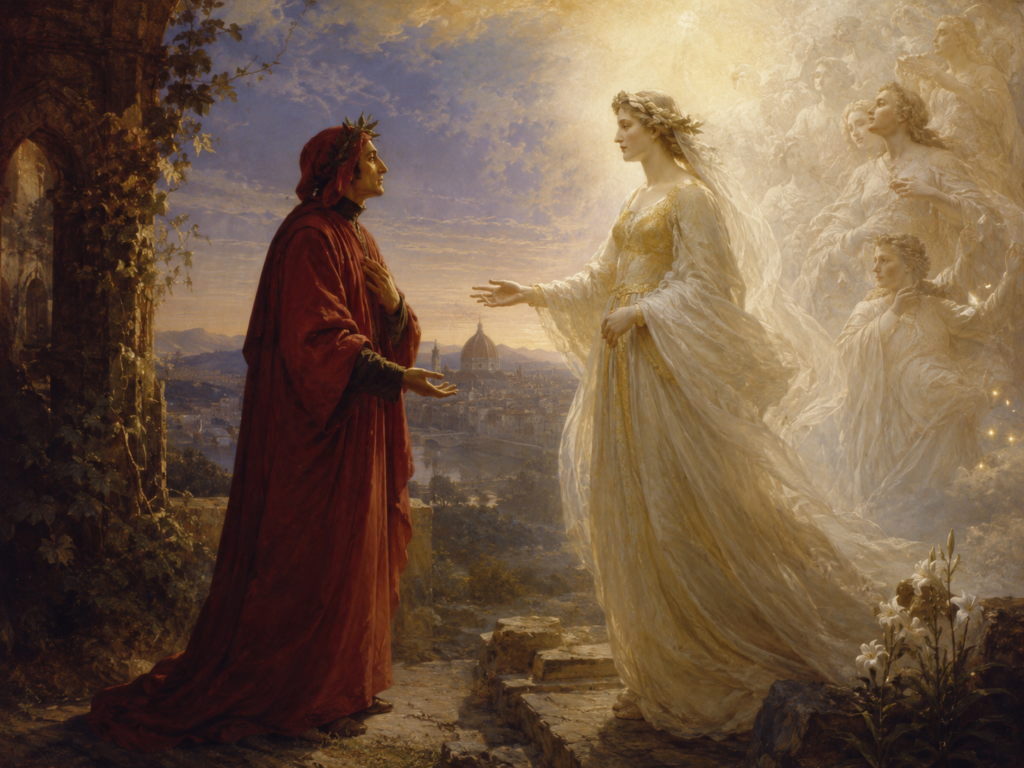
Within Stilnovist language, woman is often described as something that exceeds ordinary presence.
She appears.
Passes.
Greets.
Looks.
Her presence produces change.
She need not perform an extraordinary action.
Her very appearance transforms space.
This idea is fundamental.
Woman becomes almost an event.
The world before her presence is not identical to the world after she has passed.
Poetry records this transformation.
The Greeting
One of the most significant elements within Stilnovist poetry is the greeting.
An apparently simple gesture.
Yet charged with meaning.
The woman’s greeting may produce elevation.
Joy.
Disorientation.
It may become almost a form of grace.
An everyday action therefore acquires symbolic dimension.
And precisely this movement — from the real gesture to spiritual meaning — helps define the importance of the Dolce Stil Novo.
Beauty and Interior Life
The beauty of the Stilnovist woman is not described only as a physical quality.
It is beauty that appears to emerge from within.
Face.
Gaze.
Bearing.
Light.
Beauty becomes the visible manifestation of something invisible.
This idea will have enormous consequences.
Not only for poetry.
But also for painting, spirituality and later figurative culture.
Beauty can become a language of the soul.
Dante and Beatrice
With Dante Alighieri, this transformation reaches one of its highest expressions.
Beatrice is not merely the beloved woman.
She gradually becomes a figure of knowledge.
A guide.
A presence capable of leading Dante beyond the limits of ordinary experience.
In the Vita Nova, her presence is already placed within a symbolic structure.
In the Divine Comedy, her role becomes even more explicit.
Beatrice is no longer simply amorous memory.
She becomes a guide towards a higher dimension.
From Beloved Woman to Guide
This passage is extraordinary.
The amorous relationship changes function.
It does not simply lead towards possession of the beloved.
It leads towards knowledge.
Woman becomes the point through which man may understand something greater than himself.
Beauty does not terminate in the body.
It becomes a path.
This is one of the central reasons the Donna Angelo would become such a powerful archetype.
Woman as Light
Within Stilnovist culture, light plays a central role.
Woman may be perceived as luminous.
Her face.
Presence.
Gaze.
Light is not simply aesthetic effect.
It carries meaning.
External luminosity suggests inner quality.
Poetry therefore constructs a relationship between:
beauty;
light;
virtue;
elevation.
This relationship will later become crucial within the visual arts as well.
The Gaze
The gaze represents another decisive element.
Medieval love frequently passes through the eyes.
The gaze enters.
Strikes.
Transforms.
Within Stilnovist poetry, seeing is not neutral.
It is an experience.
The woman’s gaze may destabilise the man.
Reveal something.
Force him to confront his own interiority.
Once again, a physical element becomes a spiritual event.
Guido Cavalcanti and the Shadow of Love
The Dolce Stil Novo does not speak with a single voice.
With Guido Cavalcanti, love often assumes more troubled tones.
It does not always elevate.
It may wound.
Destabilise.
Become almost a force capable of placing identity itself in crisis.
This difference matters because it demonstrates that the feminine figure is not necessarily linked to reassuring spirituality.
She may produce disturbance.
Become a threshold between desire and loss.
Knowledge and pain.
This ambivalence makes the Stilnovist model even richer.
Donna Angelo Does Not Mean Simple Perfection
Reducing the Donna Angelo to an idealised, conflict-free figure would be a mistake.
Her power comes precisely from complexity.
She may be:
salvation;
desire;
absence;
memory;
pain;
elevation;
disturbance.
Woman thus becomes an image capable of containing different tensions.
And this complexity makes the archetype far more modern than it might initially seem.
Body and Spirit
One of the great themes of the Stil Novo is the relationship between body and spirit.
The woman is visible.
She has a face.
Walks.
Looks.
Greets.
Yet at the same time, her presence becomes invested with meanings exceeding the body.
Physicality is not erased.
It is transformed.
The body becomes threshold.
The visible becomes access to the invisible.
This principle would have a long history within European culture.
Woman as Symbol
With the Dolce Stil Novo, a particular way of constructing the feminine figure therefore becomes consolidated.
Woman is no longer merely character.
She is symbol.
She may represent:
virtue;
knowledge;
love;
grace;
elevation;
memory;
desire;
transformation.
This ability to concentrate different meanings within a single figure allows the Donna Angelo to travel across centuries.

From Poetry to Painting
When an archetype is sufficiently powerful, it does not remain confined to the language in which it originated.
The Donna Angelo moves from poetry into the figurative imagination.
The feminine face progressively becomes a site of symbolism.
Light.
Purity.
Pain.
Sacredness.
Mystery.
Religious painting, the Renaissance, Symbolism, Romanticism and certain Pre-Raphaelite experiences will develop different forms of this feminine centrality.
Not always with the same meaning.
But often through a comparable structure.
Woman as a presence exceeding individual identity.
The Pre-Raphaelites and the Symbolic Woman
Many centuries after Dante, the Pre-Raphaelites would once again construct female figures of extraordinary symbolic intensity.
Real women.
Recognisable models.
Yet transformed into:
heroines;
biblical figures;
literary characters;
tragic women;
visionary presences.
The individual face becomes invested with larger meanings.
In this sense, despite the completely different historical context, a logic close to the Stilnovist transformation reappears:
the real woman becomes symbolic figure.
Beatrice Beyond Dante
Beatrice herself would eventually become far more than a biographical character.
She becomes image.
Cultural memory.
Painted figure.
Symbol.
This process demonstrates how an individual may become archetype through literature.
The real person enters history.
The symbol exceeds her.
The Spiritualisation of Beauty
One of the deepest effects of the Stil Novo is the idea that beauty may possess a cognitive dimension.
Beauty is not understood only as visual pleasure.
It may reveal.
Elevate.
Force thought.
This idea would become central within many later traditions.
And it returns today whenever painting attempts to use beauty not as decoration, but as an instrument of meaning.
The Donna Angelo Today
Why should this archetype remain meaningful in contemporary culture?
Because the questions it contains have not disappeared.
What is the relationship between image and identity?
Between beauty and power?
Body and spirituality?
Desire and knowledge?
Idealisation and reality?
Gaze and interior life?
The Donna Angelo allows these questions to be approached through a language rooted in history yet permanently open to reinterpretation.
Neo-Stilnovism and the Transformation of the Archetype
Within Neo-Stilnovism, the Donna Angelo is recovered precisely as a structure to be transformed.
Not as a copy of the medieval Stilnovist woman.
Not as a figure required to be pure or abstract.
But as a contemporary archetype.
She may be saint.
Queen.
Mother.
Warrior.
Sibyl.
Visionary.
Dark figure.
Wounded woman.
Her spirituality does not eliminate complexity.
It contains it.
Woman as Narrative Centre
Within Neo-Stilnovist painting, woman often becomes the centre of the narrative.
Around her may appear:
symbols;
weapons;
veils;
crowns;
books;
roses;
mirrors;
light;
shadow.
Each element expands meaning.
The figure does not simply represent a person.
It constructs a condition.
Cultural Continuity
It is precisely here that the relationship with Dante and the Dolce Stil Novo becomes particularly interesting.
Not because the present should imitate the Middle Ages.
But because certain symbolic structures may still remain fertile.
The idea of woman as a presence capable of transforming the meaning of an image continues to possess force.
Tradition therefore becomes a tool of continuity.
Not a cage.
An Italian Archetype
The Donna Angelo is also one of the archetypes most specifically connected to Italian culture.
It emerged within a poetic experience that contributed profoundly to the formation of Italian language and literary sensibility.
To place it once again at the centre of contemporary painting means reopening a dialogue with a fundamental part of that memory.
Between Memory and Future
Every age inherits symbols.
It may forget them.
Repeat them.
Or transform them.
The real problem is not preserving the past unchanged.
It is understanding what can still generate meaning.
The Donna Angelo represents precisely this possibility.
An image born in medieval poetry may still become a space for contemporary reflection on femininity, beauty, spirituality and knowledge.
Dante and the Endurance of Symbol
Perhaps the most powerful legacy of Dante and the Stil Novo therefore lies not only in the texts themselves.
It lies in their capacity to create mental images capable of surviving centuries.
Beatrice is one of them.
The Donna Angelo is one of them.
When a cultural image can be continually reinterpreted without losing its deepest identity, it ceases to belong only to its own time.
It becomes heritage.
And it is precisely in this passage — from poetry to memory, from woman to archetype — that the Dolce Stil Novo continues to speak to the present.

Other Articles
The Donna Angelo: The Central Archetype of Neo-Stilnovism