
Artworks, archives, rights, documentation and institutions: how an artistic career can be organised so that it remains identifiable, researchable and protected beyond the present.
An artistic career may extend across decades.
During that time, paintings, drawings, photographs, catalogues, certificates, correspondence, contracts, exhibition records, museum documents, professional valuations, sales records and working materials gradually accumulate.
As long as the artist is present, much of this history may seem easy to reconstruct.
The artist remembers.
Recognises.
Explains.
Confirms a title.
Identifies a date.
Recalls where an artwork was exhibited.
Explains why a work belongs to a particular cycle.
But individual memory is not permanent.
Eventually, personal knowledge must become organised knowledge.
This is where the idea of the artist’s estate begins.
An artistic legacy does not begin when an artist disappears. It begins much earlier, when artworks, documents, rights and information are organised so that they can survive beyond the present.
An artistic estate is more than a group of artworks
Owning a large number of paintings does not automatically create a structured artistic patrimony.
A coherent patrimony requires identity.
Each artwork should ideally be connected to precise information:
title, date, medium, support, dimensions, archive number, photographs, known provenance, exhibitions, publications, conservation history and relevant documentation.
Together, these elements transform a collection of physical objects into an intelligible body of work.
This distinction becomes increasingly important as time passes.
A painting may survive perfectly well as an object while part of its history disappears.
The role of documentation is to prevent that separation.
The artwork and its documentary life
Every artwork possesses at least two histories.
The first is material.
It concerns the object itself: canvas, panel, paper, pigment, frame, signature and condition.
The second is documentary.
The artwork may have been exhibited.
Published.
Sold.
Loaned.
Donated.
Restored.
Photographed.
Entered into a museum collection.
Included in a catalogue.
Professionally valued.
Each of these events adds another layer to its biography.
Protecting an artistic legacy therefore means preserving not only the work, but also the evidence surrounding the work.
The first pillar: the archive
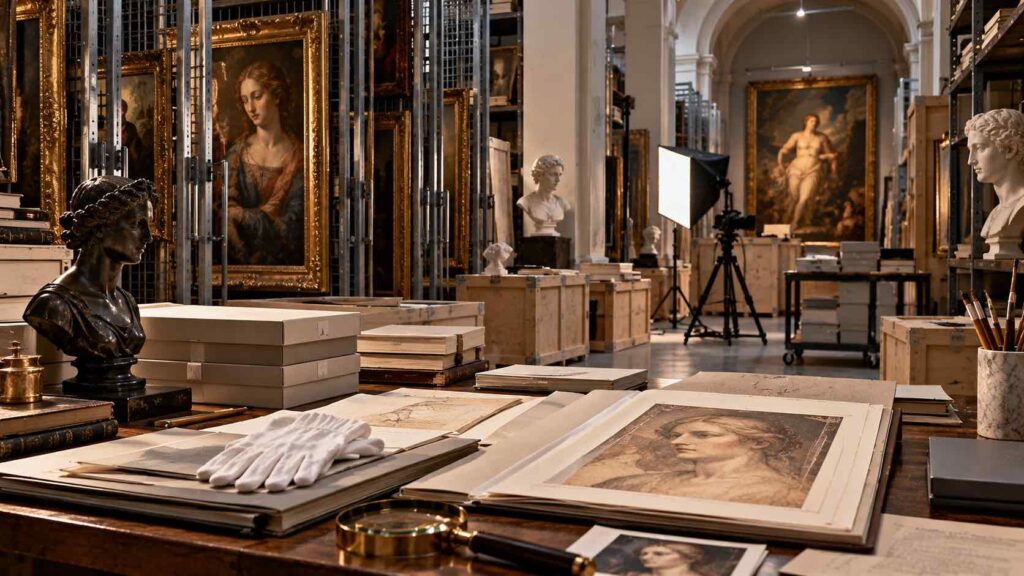
The archive is one of the foundations of long-term artistic continuity.
It should not be conceived simply as a folder containing photographs.
A serious archive creates relationships.
The artwork connects to its record.
The record connects to photographs.
The photographs connect to certificates.
The certificate connects to an archive number.
The archive number can then connect to exhibitions, publications, provenance and other documentation.
Museum provenance research shows how sale catalogues, private papers, inventories, inscriptions, labels, stamps and other records can become essential decades or even centuries later when the history of an artwork must be reconstructed. The Getty defines provenance as the ownership history of an artwork from its creation onward and treats archival evidence as central to that research.
What appears to be an administrative document today may become a historical source tomorrow.
The patrimonial inventory
An artist’s archive and a patrimonial inventory are closely related, but they should not be confused.
The archive attempts to document the artist’s production.
The patrimonial inventory identifies which artworks and other assets are actually owned by the artist, estate, foundation or other responsible entity at a particular moment.
An artist may have created one thousand artworks during a lifetime while retaining only a fraction of them.
Others may already belong to private collectors, galleries, museums or institutions.
A professional system should therefore distinguish between:
works produced;
works still owned;
works sold;
works donated;
works on loan;
works deposited elsewhere;
works whose present location is unknown.
This distinction becomes essential when a career must later be administered as a patrimony rather than remembered only as a biography.
Documenting value without manufacturing it
Professional valuations, appraisals and documented quotations should also be preserved when they exist.
They should not be treated merely as promotional language.
They are documents produced at a particular moment, in relation to particular works and according to a particular professional assessment.
Preserving them chronologically makes it possible to reconstruct the documented patrimonial history of an artistic corpus.
The principle should remain simple:
do not invent what does not exist, and do not erase what does.
A serious estate preserves evidence rather than replacing it with retrospective claims.
Provenance begins early
Provenance is often associated with Old Masters, auction houses and museum research.
But provenance begins much earlier.
For a living artist, it may initially be as simple as:
artist’s studio → first collector.
If this transition is properly documented, the first link in the ownership chain already exists.
If it is lost, a researcher fifty years later may have to reconstruct information that could once have been recorded immediately.
Getty documentation defines provenance broadly as the ownership and collecting history of a work from its creation to the present, including transfers, dealers, public sales and locations where known.
Contemporary documentation is therefore not bureaucracy for its own sake.
It is a responsibility toward the future.
The physical artwork and intellectual rights
An important distinction must also be made between ownership of a physical artwork and copyright.
A collector who owns a painting owns the physical object.
That does not automatically mean that every intellectual-property right connected with the image has also been transferred.
Copyright may concern reproduction, publication, licensing and other forms of exploitation.
Within the European Union, copyright protection for an artistic work generally lasts for the author’s lifetime and 70 years after the author’s death. EU guidance also distinguishes economic rights from moral rights associated with authorship and integrity. European Union
The management of an artistic estate may therefore concern much more than paintings kept in storage.
It may involve:
reproductions;
books and catalogues;
image licensing;
digital uses;
documentaries;
authorised products;
editorial projects;
online archives.
The specific succession or transfer of these rights must always be handled according to the applicable law and appropriate legal documentation.
The artist’s resale right
Visual art also possesses another particular legal dimension in Europe: the artist’s resale right, commonly known as droit de suite.
Under the European framework, qualifying subsequent sales of original artworks involving art-market professionals may generate a royalty for the artist and, according to the applicable rules, for entitled successors after the artist’s death.
This demonstrates once again that an artistic legacy cannot be reduced simply to physical possession.
It may include economic and intellectual rights that continue beyond the first sale of the work.
Who will know how everything works?
This is one of the most important questions an artist can ask.
Who understands the archive?
Who knows where the documents are?
Who can identify the works?
Who can respond to a museum?
Who can answer a scholar?
Who will manage requests for reproduction?
Who knows which certificates correspond to which paintings?
Who controls the official website?
Who has access to the digital archive?
Who knows the passwords?
Who understands the logic behind the inventory?
Without a structure, decades of artistic activity may leave behind thousands of objects and files but no central system capable of interpreting them.
Heirs, archives and foundations are not the same thing
These roles must be distinguished.
An heir belongs to the field of succession law.
An archive is a documentary structure.
A foundation is a legal organisation that may, depending on its statutes and applicable law, pursue objectives such as preservation, study, research and cultural promotion.
They may work together.
They are not interchangeable.
Ownership of artworks does not automatically create scholarly authority.
Likewise, the existence of an organisation bearing an artist’s name does not automatically make its archive authoritative.
Authority must be earned through method.
Documentation.
Consistency.
Transparency.
Research.
The foundation as a guardian of continuity
When properly organised, a foundation can become an important instrument for protecting an artistic legacy.
It may preserve works.
Maintain an archive.
Promote research.
Collaborate with museums and universities.
Organise exhibitions.
Publish catalogues.
Develop educational projects.
Protect documentary continuity.
But institutional credibility does not arise simply from the word “foundation”.
It arises from what that foundation actually does.
Its procedures.
Its records.
Its professionalism.
Its verifiable relationships with other institutions.
Its ability to preserve evidence over time.
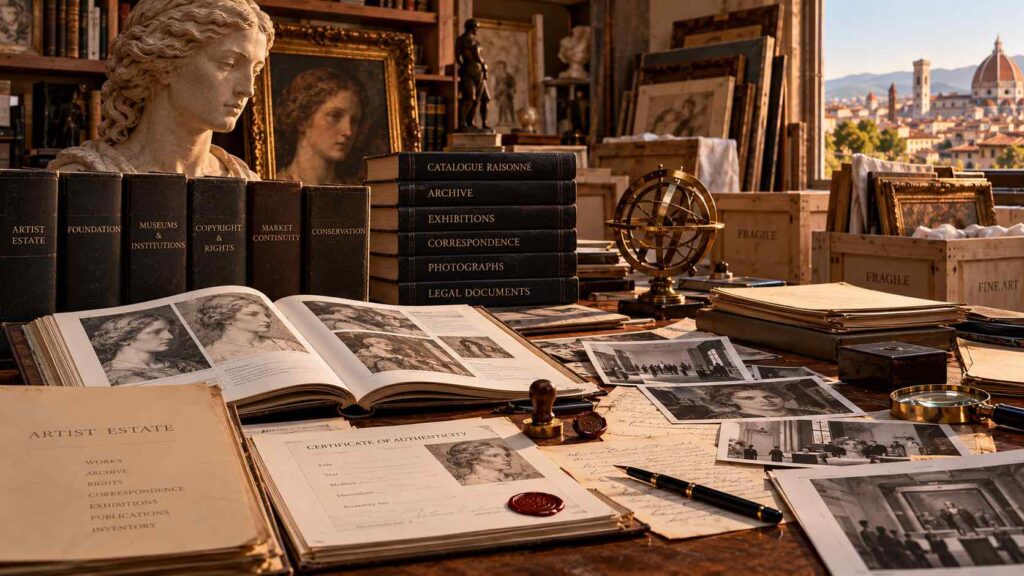
The catalogue raisonné
One of the most advanced expressions of archival work may eventually be the catalogue raisonné.
A catalogue raisonné is not simply an illustrated book about an artist.
It is a systematic scholarly attempt to identify, classify and document a defined body of work.
Such a project may require examination of:
photographs;
archive records;
provenance;
exhibition histories;
bibliography;
inscriptions;
technical information;
historical correspondence;
private and institutional collections.
Its purpose is not to make an artist appear important.
Its purpose is to make the artist’s production researchable.
That distinction is fundamental.
Conservation is part of the estate
An artistic patrimony can be perfectly catalogued and badly preserved.
Documentation alone is therefore insufficient.
Temperature.
Humidity.
Light.
Dust.
Handling.
Packing.
Storage.
Frames.
Restoration.
Insurance.
Transportation.
These practical questions belong to the same long-term responsibility.
Protecting the historical record while allowing the objects themselves to deteriorate would be a contradiction.
Photography becomes evidence
Every important artwork should ideally possess adequate photographic documentation.
Not merely a photograph made for social media.
Where possible:
high-resolution front image;
reverse;
signature;
labels;
inscriptions;
frame;
relevant details.
Museums use precisely these kinds of physical traces when investigating provenance. Getty provenance research includes labels, marks, inscriptions and stamps among the evidence used to reconstruct an artwork’s history. Getty
A photograph that seems secondary today may become essential evidence tomorrow.
Digital memory is fragile
Digital documentation has made archiving easier.
It has also introduced new vulnerabilities.
Hard drives fail.
Websites disappear.
Domains expire.
Passwords are forgotten.
Platforms close.
Accounts become inaccessible.
Formats become obsolete.
A serious artistic estate therefore needs a digital-preservation strategy.
Multiple backups.
Clearly organised folders.
Consistent filenames.
Controlled access.
Updated contact information.
Secure management of credentials.
A cloud account is useful.
It is not, by itself, an archive.
Museums and institutions
Whenever an artwork develops an institutional history, the corresponding evidence should be preserved carefully.
Museum correspondence.
Loan agreements.
Donation documents.
Accession records.
Inventory numbers.
Exhibition catalogues.
Installation photographs.
Official acknowledgements.
The language used must also remain precise.
An artwork may have been:
temporarily exhibited;
loaned;
deposited;
donated;
acquired;
entered into a permanent collection.
These situations are not equivalent.
Saying exactly what happened is stronger than using a larger but inaccurate definition.
Documentary precision protects both the artist and the institution.
Publications become part of memory
Articles, catalogues, monographs and scholarly texts do not replace artworks.
But they help artworks enter cultural memory.
A dated publication can demonstrate that a work, attribution, interpretation, exhibition or stage of an artist’s career was already documented at a specific moment.
This gives editorial activity an importance that extends beyond publicity.
A serious publication can become part of the historical infrastructure surrounding an artist.
Reputation is part of the legacy
An artistic legacy contains not only objects and rights.
It contains reputation.
And reputation can be damaged by poor documentation.
An incorrect attribution.
An exaggerated curriculum.
An institutional title used improperly.
An undocumented provenance.
A claim repeated online until nobody remembers where it originated.
These problems can survive longer than the original mistake.
For this reason, legacy management is also reputational protection.
Restricting public statements to what can actually be documented does not diminish an artist.
It strengthens the historical record.
The danger of fragmentation
One of the greatest threats to an artistic estate is dispersion.
The paintings are in one place.
Documents somewhere else.
Certificates with another person.
Photographs on an old computer.
Contracts inside boxes.
Emails inside a personal account.
Catalogues in storage.
Passwords known to nobody.
Every element may technically still exist while the patrimony itself becomes almost impossible to manage.
Organisation does not necessarily mean placing everything physically in one room.
It means establishing one coherent system of knowledge.
Preparing the future while the artist is still present
The artist is the primary witness to the artist’s own career.
The artist can identify works.
Correct titles.
Clarify dates.
Recognise models.
Explain symbols.
Reconstruct cycles.
Describe techniques.
Remember commissioners and collectors.
Explain why certain works were changed or abandoned.
Leaving all of this solely inside personal memory means accepting that part of it may eventually disappear.
Transforming memory into documentation creates continuity.
From collection to system
The decisive step occurs when individual elements begin to communicate with one another.
The artwork connects to its record.
The record to the photograph.
The photograph to the certificate.
The certificate to the archive.
The archive to the exhibition.
The exhibition to the publication.
The publication to the bibliography.
The provenance accompanies the artwork as ownership changes.
Professional valuations remain chronologically preserved.
Museum records document institutional history.
At that point, an artist no longer possesses merely a collection of materials.
A system begins to exist.
And it is the system, rather than any isolated document, that makes long-term continuity possible.
Conclusion
Protecting an artist’s legacy does not mean constructing a premature monument to that artist.
It means something much more concrete:
organising the documentary truth of the work.
Knowing what exists.
Knowing where it is.
Knowing how it is identified.
Knowing which documents accompany it.
Knowing which rights remain protected.
Knowing which works still belong to the patrimony.
Knowing which have entered other collections.
Knowing which exhibitions, museums and publications form part of their history.
An artistic legacy does not begin on the day a career ends.
It begins whenever an artwork is properly recorded.
Whenever a provenance is preserved.
Whenever an exhibition is documented.
Whenever a photograph is archived.
Whenever a document is protected from disappearance.
Whenever memory is transformed into evidence.
An artistic legacy does not begin when an artist disappears. It begins when the artist’s work, documents and history are organised so that they can survive beyond the present.
It is at that point that artistic production begins to move beyond individual experience and becomes organised cultural memory.
Editorial note: inheritance, taxation, foundations, estate structures and the transfer or administration of intellectual-property rights depend upon the applicable jurisdiction. This article is intended for cultural and informational purposes and does not constitute legal, tax or financial advice.

Other Articles