

From medieval altarpieces to museum walls, the frame has never been merely decorative. It has protected artworks, separated painted space from the real world and profoundly influenced the way we see art.
When we stand before a great painting, something curious happens.
We look at the face.
The light.
The colour.
The landscape.
The painted surface.
We rarely look at what surrounds it.
Yet between the painting and the world there is often a structure capable of profoundly affecting our perception of the image:
the frame.
For centuries, frames have been carved, gilded, painted, altered, replaced, destroyed and reconstructed.
They have functioned as architecture.
Protection.
Status.
Theatre.
Boundary.
Sometimes the frame was created together with the painting. In other cases, it arrived centuries later.
The history of the frame is therefore about far more than decoration.
It is the history of how we learned to separate the image from the world around it.
When painting and frame were one
Early European frames were not necessarily separate objects.
In medieval panel painting, borders could be carved directly from the same wooden support or attached before the painting surface was prepared.
The Getty traces important Italian examples of these engaged frames to the thirteenth century. Their purpose was partly practical: the raised border helped protect the painted surface.
The modern distinction between painting and frame was therefore not always so clear.
They could belong to the same physical structure.
Architecture in miniature
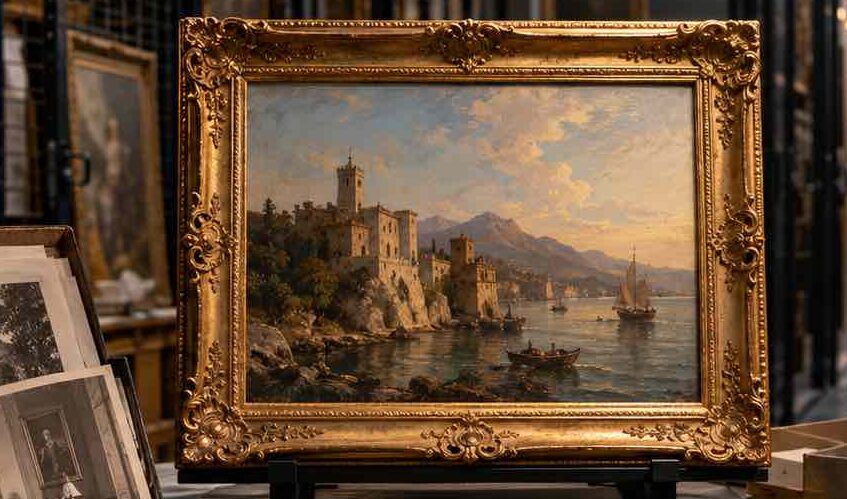
Medieval altarpieces make this relationship particularly visible.
Columns.
Arches.
Pinnacles.
Niches.
Gothic ornament.
Frames echoed the architecture of the churches for which the images were made.
They did not merely surround the painting.
They placed it within a symbolic architectural environment.
The Metropolitan Museum of Art notes that frame design developed in close relationship with architecture, borrowing forms from doors, windows, niches and interior decoration.
The frame became a kind of architecture in miniature.
A constructed threshold around an image.
From altarpiece to independent picture
During the Renaissance, something decisive began to happen.
Painting increasingly developed as a more independent object.
The Metropolitan identifies Gentile da Fabriano’s 1423 Adoration of the Magi as an important step toward the idea of an independent, self-supporting frame made to contain a painting rather than simply forming an indivisible part of its panel.
At first this may sound like a technical change.
It was also conceptual.
A painting could increasingly move.
Be owned.
Be sold.
Enter another interior.
The frame became the device that allowed the image to inhabit a new environment.
The frame as window
In his fifteenth-century treatise on painting, Leon Battista Alberti famously described the pictorial field through the metaphor of an open window.
The frame becomes particularly important within this idea.
It defines the window.
On one side stands the physical world of the viewer.
On the other begins the imagined world of the painting.
The Metropolitan has noted that Alberti’s conception of pictorial space presupposes an element capable of defining its edges and separating representation from surrounding reality.
The frame becomes a threshold.
It belongs neither entirely to the painting nor entirely to the wall.
It occupies the space between them.
The rise of the cassetta frame
As secular painting expanded during the Renaissance, frames gradually moved away from explicitly ecclesiastical forms.
Portraits.
Mythological scenes.
Allegories.
Paintings intended for domestic interiors.
For such works, Italy developed the cassetta frame, a more regular construction in which mouldings and decorative bands extend around all four sides of the image.
The Metropolitan describes the cassetta as deriving from a simplification of the architectural tabernacle frame and becoming widely influential across Italy.
Painting was entering the home.
Its architecture had to change with it.

Gold, wood and power
Gilding was not merely ornamental.
Gold captured light.
Separated the painting visually from the wall.
Made the object appear precious.
In Baroque and Rococo frames, these possibilities became spectacular.
Scrolls.
Leaves.
Shells.
Flowers.
Architectural ornament.
The frame could become almost sculptural.
Across Europe, regions developed distinctive frame traditions, while continuously influencing one another. Getty research documents an extraordinary range of materials, techniques and styles from the thirteenth through the nineteenth centuries.
Frames also represented their owners
The frame around an Old Master painting today is often not its original frame.
Far from it.
Paintings were frequently reframed when ownership changed.
A collector might wish the picture to harmonise with a palace.
Another might want an entire gallery framed consistently.
Another might simply prefer the fashion of a later period.
As a result, enormous numbers of original frames disappeared.
The Metropolitan notes that serious interest in historical frame authenticity among museums and collectors developed relatively late, especially toward the end of the nineteenth century, by which time many early examples had already been lost.
A frame may therefore tell us not only about the artist.
It may tell us about the later owners of the artwork.
A second biography
This creates a fascinating problem.
A sixteenth-century painting may today have an eighteenth-century frame.
It is not original.
Yet that later frame may itself have become historically significant.
The National Gallery in London aims, where possible, to present paintings in appropriate period frames. It also recognises cases in which an important later frame has become part of the painting’s own history and deserves to be retained.
The question is therefore no longer simply:
“Is this the original frame?”
We may also ask:
“What does this frame tell us about the later life of the painting?”
A frame changes what we see
This is not purely a historical problem.
Framing affects perception.
A frame can visually bring an image forward or hold it back.
It can strengthen certain colours.
Separate the painting from the wall.
Increase monumentality.
Change visual balance.
The National Gallery explicitly notes that the impact of a picture can be enormously affected by the way it is framed.
To change the frame is, within limits, to change the way the same painting is seen.
Poussin understood this
Artists themselves were aware of the problem.
In 1639 Nicolas Poussin wrote about the framing of one of his paintings, concerned that the frame should help focus the eye rather than allowing surrounding objects to interfere with the viewing experience.
The Metropolitan discusses this evidence as an example of the artist’s awareness that framing could affect the perception of the work.
A painting does not necessarily end with the artist’s final brushstroke.
What surrounds it can alter the experience.
Artists begin to rebel
By the nineteenth century, ornate gilded frames had become a dominant presence in major exhibitions and collections.
Some artists began to resist.
The Impressionists often explored simpler framing solutions that they considered more sympathetic to the light, colour and modernity of their paintings.
The Getty notes that simpler frames could also distinguish these works from the heavily ornamented presentation associated with academic establishment taste.
The frame itself had become an aesthetic statement.
To simplify it could be an act of independence.
Degas, Monet and artist-designed framing
Some artists went further.
Degas studied and designed frames.
Monet made deliberate framing choices for works including his Rouen Cathedral series.
Metropolitan and Getty sources document the increasing involvement of artists in framing their own work during the nineteenth and early twentieth centuries.
This has an important consequence for collectors today:
when a frame was selected or designed by the artist, replacing it may alter part of the original conception of the work.
The museum and the search for the right frame
Museums now face a difficult question.
How should a painting be framed when its original frame no longer survives?
One solution is to locate an antique frame compatible with the work’s period, region and style.
Another is to construct a carefully researched reproduction.
The Getty describes a process involving collaboration between curators, paintings conservators and frame conservators. Finding an appropriate historical frame may take years.
The frame is no longer treated merely as furniture.
It has become an object of research.
Conserving the frame itself
Historic frames have their own conservation problems.
Warped wood.
Lifting gilding.
Missing ornament.
Cracks.
Later paint.
Structural alterations.
Previous repairs.
Their conservation therefore requires specialist knowledge.
Major institutions increasingly recognise historical frames as significant objects in their own right — evidence of carving, gilding, craftsmanship, design and material culture.
For centuries we carefully preserved paintings while often sacrificing what surrounded them.
Today we understand that part of the history was there as well.
Can a frame be wrong?
Yes.
Not necessarily because it is unattractive.
It may simply be historically or visually inappropriate.
An excessively monumental frame can overwhelm a delicate painting.
A frame that is too slight may weaken an image conceived for architectural presence.
Its colour may interfere with the palette.
Its ornament may compete with the composition.
Framing is therefore a curatorial decision.
The space between painting and world
Perhaps the frame’s most fascinating function is the least obvious.
It creates distance.
A painting must not simply dissolve into the wall.
The frame announces:
another space begins here.
The space of representation.
A painted face belongs physically to the surface of the canvas, yet it may appear to exist beyond that surface.
The frame makes this ambiguity possible.
It establishes the boundary that allows the illusion to work.
The portrait and the frame
In portraiture, this function becomes especially powerful.
The face can appear contained yet present.
A dark portrait surrounded by an appropriate frame may acquire an almost apparitional quality.
The border strengthens the sensation that the figure exists within another space.
The frame becomes more than decoration.
It becomes a psychological device.
The frame and Neo-Stilnovism
This idea naturally enters into dialogue with Neo-Stilnovist Painting.
If an artwork is conceived as a presence, the frame can be understood as the threshold between two realities.
Outside:
the viewer’s world.
Inside:
the world of the image.
Between them:
the frame.
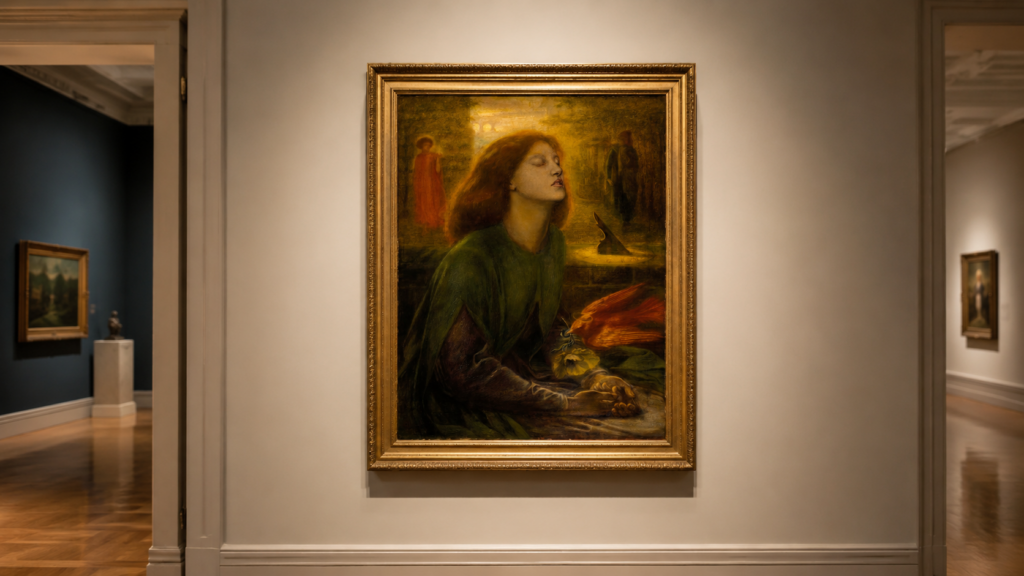
Within Neo-Stilnovist portraiture, where the face and gaze may operate as psychological thresholds, framing should not necessarily dominate the artwork.
It should accompany its presence.
Protect it.
Separate it from surrounding visual noise.
Allow the eye to enter.
When no frame is needed
Not every contemporary work requires a traditional frame.
Painted canvas edges.
Works conceived without decorative boundaries.
Three-dimensional supports.
Installations.
Paintings for which the absence of a frame forms part of the aesthetic decision.
That absence also carries meaning.
The point is not that every artwork requires a frame.
The point is that the presence or absence of a frame changes the relationship between artwork and surrounding space.
Collectors should look beyond the painting
When acquiring an old or modern painting, it is therefore worth examining its frame.
Is it original?
Is it contemporary with the painting?
Was it selected by the artist?
Was it added later?
Does it carry labels or inscriptions?
Is its history documented?
Is it historically significant?
Has it been properly conserved?
For some artworks, this information deserves to become part of the object’s broader documentation.
The frame should not automatically be separated from the history of what it contains.
The forgotten architecture
Perhaps we have learned not to notice frames precisely because the best ones perform their function so naturally.
They direct us toward the image.
They do not necessarily ask to become the subject themselves.
Yet ignoring them completely means losing part of art history.
Behind a frame may stand:
craftsmen;
woodcarvers;
gilders;
architects;
collectors;
dealers;
curators;
conservators;
and sometimes the artist.
Conclusion
A frame is not simply what surrounds a painting.
Historically, it has helped separate the image from the world.
It protected fragile surfaces.
Turned altarpieces into architecture.
Accompanied paintings into collectors’ homes.
Followed changing fashions.
Declared wealth.
Focused vision.
Was replaced.
Lost.
Reconstructed.
And eventually studied.
Today we understand that a frame can possess a biography of its own.
Perhaps we should learn to look a few centimetres beyond the painted surface.
Because precisely where painting ends and the physical world begins, a silent structure has performed an extraordinary function for centuries:
transforming an image into a presence.

Other Articles

The Secret Life of Pigments: How Colour Shaped the History of Art
The Artist’s Estate: How an Artistic Legacy Is Protected Over Time