
Stones from Afghanistan, metals, earth, plants and even insects: before becoming paint, colour was rare matter, valuable merchandise, chemical discovery and one of the instruments through which artists constructed their vision of the world.
Today, an artist opens a tube and blue is simply blue.
Red is ready.
White waits on the palette.
For centuries, painting was not so simple.
Before modern industry, colour had to be found in nature, extracted, ground, purified, transformed and mixed with a binder.
Some pigments came from nearby earth.
Others travelled across continents.
Some were inexpensive.
Others were precious enough to influence how a painting itself was conceived.
Art history can therefore be told through something that often remains invisible:
the history of the materials that create colour.
Before paint comes pigment
Pigment and paint are not exactly the same thing.
Pigment is the coloured material.
To become paint, it must be combined with an appropriate binding medium.
Egg in tempera.
Oil in oil painting.
Gums in certain water-based techniques.
Other binding substances in different traditions.
The same coloured substance may therefore behave differently according to how it is prepared and applied.
The historical painter did not simply choose a colour.
The painter chose a material.
The earliest palettes came from the earth
Red ochre.
Yellow ochre.
Carbon blacks.
Earth pigments.
These belong among humanity’s oldest image-making materials.
Their importance begins with availability.
Colour initially came directly from the landscape.
Earth itself became image.
That material origin can still be sensed in many natural pigments today. They possess weight, granularity, warmth and a physical character very different from the abstract idea of colour on a digital screen.
Blue was a problem
Perhaps no colour reveals the relationship between art, economics and technology more clearly than blue.
A beautiful, intense and stable blue was historically difficult to obtain.
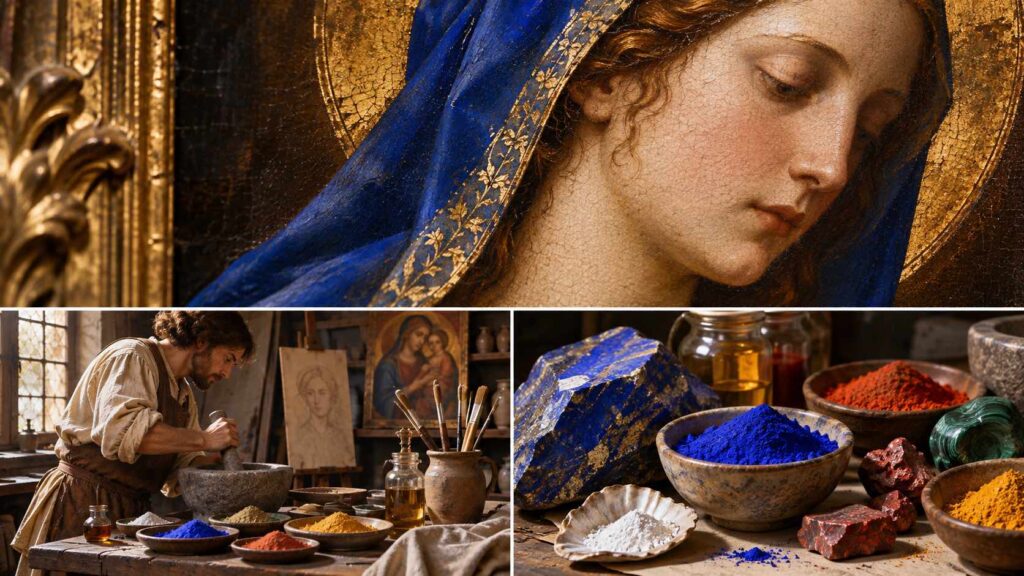
One of the most extraordinary solutions was natural ultramarine, produced through the laborious refinement of lapis lazuli.
The National Gallery notes that the finest lapis lazuli used to make ultramarine came from Badakhshan, in present-day Afghanistan, reaching Europe through long-distance trade networks.
Its name itself preserves the journey:
ultramarinus.
From beyond the sea.
Colour could communicate wealth
Consider a Renaissance sky.
Or the Virgin’s blue mantle.
Today we see a magnificent colour.
A contemporary viewer could also have understood something else:
the material value of that blue.
The National Gallery identifies expensive lapis-lazuli ultramarine, for example, in the sky of Domenico Ghirlandaio’s The Virgin and Child.
Colour could therefore carry economic and symbolic meaning simultaneously.
Not every painted passage cost the same to make.
Sacred blue
The high value of ultramarine contributed to its association with important figures and prestigious commissions in European painting.
Using it represented an investment.
In religious painting, precious material could reinforce the dignity of what was being represented.
Painting therefore contained a hierarchy not only of images, but of matter.
What mattered most could receive what cost most.
Another blue: azurite
Ultramarine was not the only possibility.
Azurite, a copper mineral, could be ground into a brilliant blue pigment.
The Metropolitan Museum notes its historical use as a pigment and its occurrence in copper deposits in regions including Egypt, Cyprus and Spain.
Yet different pigments did not simply produce interchangeable versions of “blue”.
They possessed different handling properties.
Textures.
Transparency.
Intensity.
Behaviour in different binders.
The painter worked with a geography of materials.
The red of earth and the red of mercury
Red also possessed many identities.
Earth pigments could provide stable and relatively accessible reds.
But much more brilliant materials existed.
Cinnabar is naturally occurring mercury sulfide; its manufactured form became known as vermilion.
It could create an extraordinarily intense orange-red.
The National Gallery of Art documents the use of cinnabar and vermilion since antiquity as well as their susceptibility to colour alteration under particular conditions.
Colour was never only beauty.
It was chemistry.
Colours no longer look exactly as they once did
This changes the way we should look at historical painting.
Not every pigment has remained unchanged.
Some fade.
Some darken.
Some react with substances in the environment.
Others interact with neighbouring materials.
Around 1400, Cennino Cennini was already warning artists about unstable materials and problematic combinations. Modern conservation science confirms how chemical alteration can transform the appearance of paintings over time.
When looking at a painting five centuries old, we should therefore remember:
we may not be seeing exactly the colours its painter saw.
The white that built centuries of painting
Among the most historically important pigments was lead white.
For centuries it was one of the principal whites available to European painters.
It offered opacity.
Handling qualities.
The ability to construct flesh, highlights and light.
Its manufacture, however, depended upon lead and chemical processes now recognised as hazardous.
The National Gallery of Art documents both the long history of lead-white production and the chemical transformations that can cause certain lead-based pigments to darken under specific conditions.
The beauty visible on a museum wall can therefore possess a far less innocent material history.
The difficult green
Stable and beautiful greens were another challenge.
Malachite.
Verdigris.
Copper compounds.
Mixtures of blue and yellow.
Painters had many solutions, but not all behaved equally well.
Scientific research into historical pigments continues to study materials such as malachite, verdigris and copper resinates precisely because their chemistry influences both their use and preservation.
The painter’s palette was also a small chemical laboratory.
Colour from insects
Not every pigment or colourant came from stone, earth or metal.
Important reds could also derive from organic materials.
The National Gallery records the use of red colourants extracted from dried insects in European painting.
It is a detail that can seem astonishing today.
Yet it demonstrates how deeply painting is connected to trade, agriculture, mineralogy, chemistry and even entomology.
An entire material world can exist inside a single image.
The workshop was also a laboratory
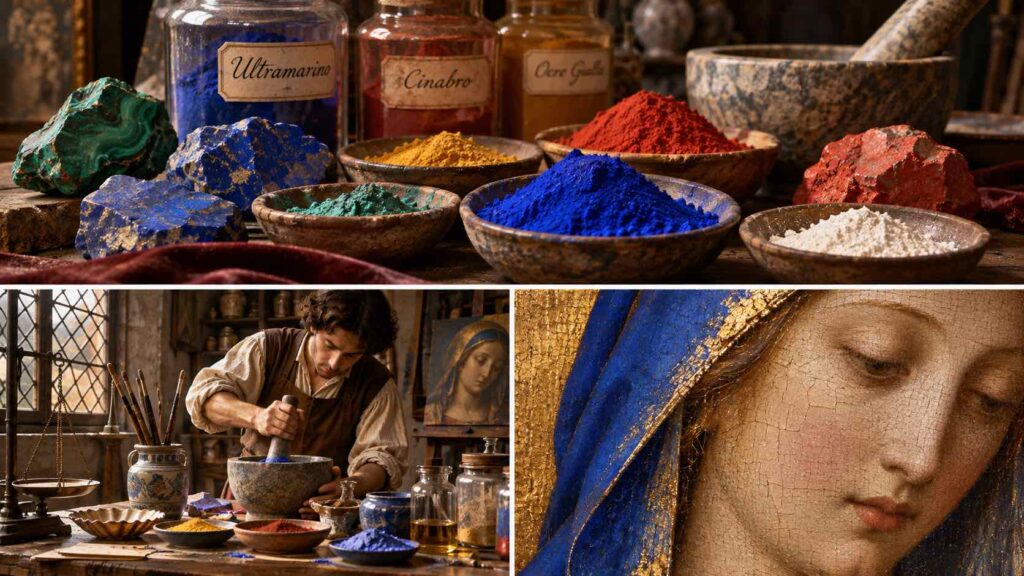
Before ready-made paint became normal, considerable preparation took place inside the workshop.
Pigments were ground.
Powders stored.
Binders prepared.
Surfaces treated.
Recipes remembered.
Incompatibilities avoided.
An apprentice therefore learned more than drawing.
The apprentice learned matter.
How fine a pigment should be ground.
How much binder it required.
How it dried.
Which materials could be layered together.
Which combinations caused problems.
Technique was inseparable from material knowledge.
When chemistry changed the palette
Then came a transformation that profoundly changed painting.
Modern chemistry began producing new pigments.
At the beginning of the eighteenth century, Prussian blue appeared, widely regarded as the first modern synthetic pigment.
Metropolitan research places its accidental discovery by Johann Jacob Diesbach in Berlin around 1706, with the new blue entering painting soon afterwards.
It was intense.
It had great tinting strength.
And it was less expensive than some traditional blues.
Colour had entered the chemical age.
A pigment can expose an alteration
Knowledge of pigments is now important not only for conservation.
It can assist in dating and understanding artworks.
The National Gallery’s Portrait of Alexander Mornauer provides a fascinating example.
A later blue overpaint was found to contain Prussian blue.
Because the pigment was unavailable when the fifteenth-century portrait was created, its presence proved that the blue layer was a later addition.
Matter had become evidence.
Sometimes a pigment can reveal that something in an artwork’s history does not belong.
The synthetic ultramarine revolution
The nineteenth century brought another major transformation.
Chemistry found a way to reproduce a pigment closely resembling natural ultramarine.
A manufacturing process for synthetic ultramarine was made public in 1828.
A colour that had ranked among the most expensive materials in European painting could now be produced at a fraction of its former cost.
The National Gallery describes this as a profound shift: ultramarine moved from luxury material toward an everyday component of the modern artist’s palette.
A chemical invention had changed the economics of colour.
Industry enters the studio
The nineteenth century changed painting materials in other ways as well.
New pigments.
Commercial manufacture.
Prepared colours.
And in 1841, the collapsible metal paint tube made colour considerably easier to preserve and transport.
The Metropolitan Museum notes the importance of industrially manufactured materials and portable paint tubes for nineteenth-century artistic practice, including painting outdoors.
Colour no longer had to be created entirely inside the workshop.
It could travel with the artist.
Impressionism could not have had the same palette before
Changes in materials inevitably influenced artistic possibilities.
Cobalt blue.
Synthetic ultramarine.
New yellows.
New greens.
More accessible manufactured colours.
The National Gallery documents the importance of cobalt blue and synthetic ultramarine for nineteenth-century painters and the Impressionists in particular.
The history of style therefore depends not only upon ideas.
It also depends upon what was physically possible to place on a palette.
Colour is never only colour
This may be the most important lesson contained within pigment history.
A blue may contain the history of trade between Central Asia and Europe.
A red may carry the history of a mineral or an insect.
A white may reveal manufacturing methods now recognised as toxic.
A synthetic pigment can tell the story of modern chemistry.
A faded colour can alter the way later generations interpret a painting.
Painting is not merely image.
It is matter transformed into vision.
Knowing pigments changes the way we look
Once we understand that a blue mantle may contain a material extracted from stone mined in Afghanistan, we no longer see only blue.
We see the mine.
The journey.
The merchant.
The apothecary.
The workshop.
The apprentice grinding pigment.
The painter deciding where to use the most valuable colour.
The patron paying for it.
Colour becomes history.
Pigment and Neo-Stilnovism
In contemporary painting and within Neo-Stilnovist research, knowledge of material can also deepen the relationship between technique and emotion.
Colour is not merely something used to fill a shape.
It constructs atmosphere.
Depth.
Temperature.
Presence.
A figure can change psychologically through an apparently minor variation in flesh tone, background or illumination.
Painting material therefore participates directly in the emotional construction of the image.
Technique and emotion do not inhabit separate worlds.
Technique gives emotion a visible body.
The palette as autobiography
An artist’s habitual palette can eventually become almost autobiographical.
Some painters seek contrast.
Others restricted harmonies.
Some build figures through earth colours and darkness.
Others embrace pure chromatic intensity.
Some pursue luminosity.
Others depth.
Over time, the use of colour can become as recognisable as drawing itself.
The palette becomes a silent form of identity.
Conclusion
Behind every colour lies a history.
Of earth.
Stone.
Trade.
Chemistry.
Danger.
Invention.
Workshop practice.
For centuries artists needed to understand not only what they wanted to represent, but which material could make that representation possible.
Science expanded the palette.
Industry made once-rare colours accessible.
Modern conservation has revealed that many of those materials continue to change.
A painting is therefore never simply an immobile image.
It is a physical, chemical and visual balance constructed through time.
Before colour becomes paint, it is matter.
Before it becomes painting matter, it may have been stone, earth, metal, plant or living organism.
And perhaps this is the most extraordinary part of pigment history:
beneath the silent surface of a painting survives the geography of the world from which its colours came.

Other Articles
The Frame: The Forgotten Architecture Around a Painting