
When Light Does More Than Illuminate the Figure — It Constructs Meaning
Throughout the history of Western painting, light has never been merely a technical problem.
It has been revelation.
Theatre.
Mystery.
Hierarchy.
Psychology.
Faith.
Fear.
Knowledge.
Chiaroscuro emerges from the relationship between light and shadow, yet its power goes far beyond modelling a three-dimensional figure. At the highest levels of painting, light becomes a genuine narrative instrument.
It can indicate what must emerge.
Conceal what should not yet be understood.
Transform a face into an apparition.
Turn an ordinary space into a psychological environment.
This understanding of light — far broader than simple realism — runs throughout the great figurative tradition and becomes central once again within Neo-Stilnovism.
Constructing Through Light
Every visible object exists in relation to light.
When illumination strikes a body, it generates highlights, halftones, core shadows and cast shadows.
Painters use these transitions to construct volume.
A cheek moves forward.
An eye socket recedes.
Fabric gains depth.
A hand emerges from the surface.
Yet artistic chiaroscuro truly begins when the painter stops merely recording natural illumination and starts organising it.
Light becomes choice.
Caravaggio and the Theatre of Revelation
With Caravaggio, this possibility reaches one of its most radical expressions.
Figures frequently emerge from dark backgrounds.
Light strikes faces, hands, fabrics and gestures.
The surrounding space may almost disappear.
The effect is not merely spectacular.
Light selects meaning.
It tells the viewer where to look.
A seemingly secondary gesture may become the dramatic centre of the scene.
An illuminated face may become the site of conversion, fear, pain or awareness.
Painting becomes theatre.
But theatre in which light is the director.
Shadow Is Not Absence
One of the most important lessons of the Caravaggesque tradition is that shadow is not simply the absence of light.
Shadow has a function.
It conceals.
Protects.
Amplifies.
Waits.
A face partially immersed in darkness may be considerably more powerful than one fully illuminated.
Because what cannot be seen becomes part of the viewer’s imagination.
Painting does not need to reveal everything.
Chiaroscuro and Psychology
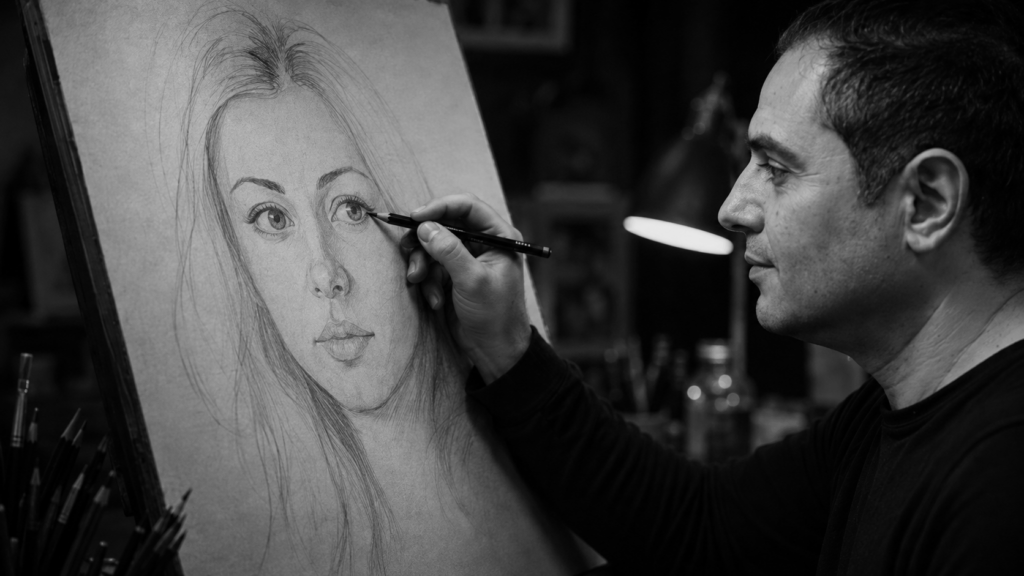
Applied to the human figure, chiaroscuro becomes a psychological instrument.
The same person can appear radically different depending solely on illumination.
Frontal light tends to flatten.
Side lighting creates tension.
Light from above may suggest transcendence or isolation.
Light from below can generate unease.
A portion of the face left in shadow creates ambiguity.
The painter does not merely illuminate a person.
The painter constructs an emotional condition.
From Volume to Presence
Within figurative painting, chiaroscuro allows the transition from silhouette to body.
The figure ceases to appear drawn onto a surface and begins to occupy space.
Forehead.
Cheekbones.
Nose.
Neck.
Shoulders.
Hands.
Fabric.
Each element is constructed through tonal transitions.
Volume is born from difference.
There can be no light without shadow.
And no shadow without light making it visible.
Light as Compositional Hierarchy
A strong composition possesses hierarchy.
Not everything should hold equal importance.
Painters may use light to establish an order.
First: what must immediately be seen.
Second: what is discovered afterwards.
Third: what remains almost hidden.
The eye is guided.
The artwork is read through time.
Painting acquires rhythm.
The Face as a Luminous Centre
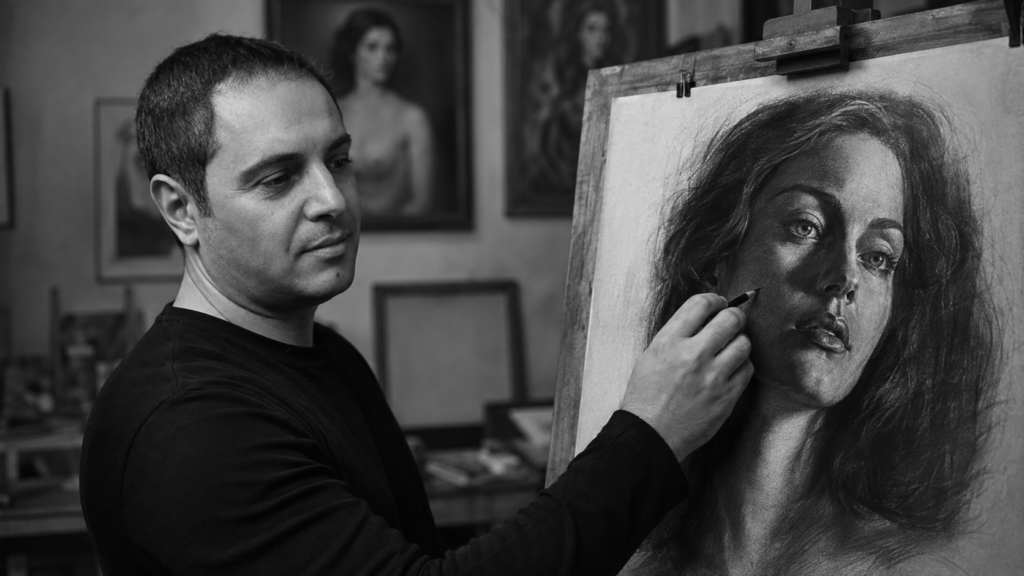
Within Neo-Stilnovism, the face frequently occupies a central position.
For this reason, its illumination requires particular care.
It is not enough simply to illuminate the face.
The painter must decide how.
Which element should emerge?
The eyes?
Forehead?
Mouth?
Cheekbone?
A figure may have a largely visible face while the eyes remain within shadow.
Or the opposite.
A tiny point of light within the gaze may become the most intense element of the entire painting.
The Eyes and Chiaroscuro
Eyes are especially sensitive to the relationship between light and shadow.
Too much illumination may make them descriptive.
Too much darkness may erase them.
The balance allows the gaze to retain mystery.
Within Neo-Stilnovist language, where the eyes may function as a psychological threshold, chiaroscuro becomes essential.
The viewer should perceive the presence of the gaze without fully understanding it.
The Donna Angelo Between Light and Shadow
The Donna Angelo is one of the places where this dialectic becomes especially powerful.
She cannot simply be luminous.
A Donna Angelo entirely without shadow would risk becoming an idealised and distant figure.
Neo-Stilnovism instead uses light to construct complexity.
One part may belong to luminosity.
Another to shadow.
Spirituality and body.
Purity and desire.
Strength and vulnerability.
Knowledge and mystery.
Light does not eliminate contradiction.
It makes contradiction visible.
Chiaroscuro as Symbol
When light acquires symbolic meaning, painting moves beyond realism.
A luminous area may represent:
revelation;
knowledge;
grace;
consciousness;
elevation;
life.
Shadow may suggest:
mystery;
death;
the unconscious;
pain;
fear;
memory;
descent.
This does not mean that every shadow represents evil or every light represents good.
The most interesting painting avoids such simplifications.
Light and darkness may exchange meanings.
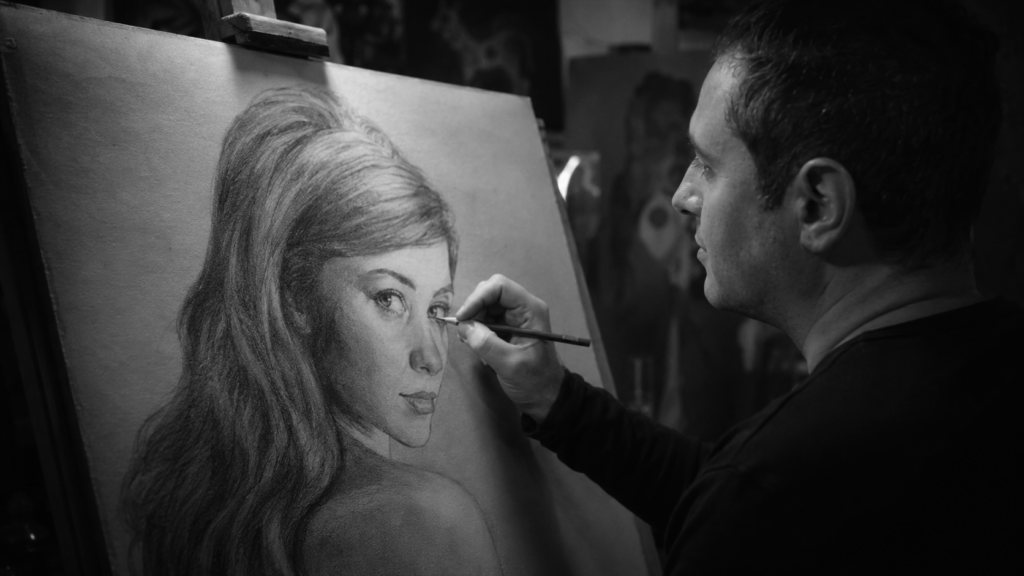
Protective Shadow
There is also a shadow that protects.
A partially hidden figure may appear more intimate.
More withdrawn.
More distant from the external world.
Darkness may become an interior space.
In some paintings, shadow does not threaten.
It guards.
Chiaroscuro and the Sacred
Religious tradition has frequently employed light to evoke the sacred.
Yet sacredness does not necessarily require a halo.
It may emerge from the way a face appears out of darkness.
From silence surrounding a figure.
From illumination whose source cannot be completely identified.
Within Neo-Stilnovism, sacredness may therefore be constructed through perception.
Not only through iconography.
Theatrical Light
The Baroque introduces another fundamental element: theatricality.
Light may operate as a spotlight.
A figure becomes isolated.
The surrounding space recedes.
The painting acquires scenic intensity.
Yet theatricality does not necessarily mean artificiality.
It may be a means of concentrating experience.
Chiaroscuro and Colour
Chiaroscuro is not simply black and white.
Every colour possesses tonal value.
Red may be luminous or deep.
Blue may almost disappear into darkness.
Gold can capture light.
Black may contain reflections.
Tonal construction must therefore dialogue with chromatic construction.
Black Is Not Emptiness
One common mistake in dark painting is to treat black as a uniform area.
In reality, darkness contains countless variations.
Browns.
Deep blues.
Violets.
Green-blacks.
Warm greys.
The richness of shadow allows the figure to breathe.
An apparently black background may contain enormous amounts of information.
Glazing and Depth
Glazing makes it possible to construct particularly profound shadows.
By superimposing transparent layers, painters can create darkness that retains luminosity.
The shadow does not simply appear covered.
It seems deep.
This is one reason oil painting remains especially effective for chiaroscuro.
Light Does Not Have to Be White
Light itself may possess colour.
Warm.
Cold.
Golden.
Reddish.
Blue.
Lunar.
Candlelit.
The temperature of the source radically transforms the scene.
Warm light may bring skin to life.
Cold light may create distance.
Sculptural Projection and Light
The Neo-Stilnovist concept of sculptural projection directly intersects with chiaroscuro.
If a figure is mentally conceived as volume, light must behave as though it were striking a genuinely three-dimensional form.
Where does the skull advance?
Where does the temple recede?
How does the neck turn?
What is the volume of the shoulder?
How does the hand occupy space?
Light becomes the means through which mental sculpture becomes painting.
Beyond Photographic Copying
Photography may be useful.
But mechanically copying photographic light and shadow can limit the painter.
Painting permits reality to be altered.
A highlight can be intensified.
A region suppressed.
A detail removed.
An eye redirected.
A shadow deepened.
Painterly chiaroscuro should not become a slave to photographic reference.
It should serve composition.
From Natural Light to Interior Light
The true transformation occurs when light stops describing only the body and begins describing inner condition.
A figure may be realistically illuminated.
But great painting seeks something more.
Light may become the visible manifestation of invisible tension.
This is precisely where technique and poetry meet.
Chiaroscuro in the Digital Age
Today almost any software can increase contrast, change brightness or create dramatic lighting effects.
This makes the distinction between effect and construction even more important.
Painterly chiaroscuro is not a filter.
It emerges while the figure itself is being constructed.
It interacts with material, glaze, pigment and surface.
It has a body.
The Caravaggesque Legacy
To speak of the Caravaggesque tradition does not necessarily mean imitating Caravaggio.
It means understanding a fundamental lesson:
light can narrate.
It can establish hierarchy.
Separate.
Unite.
Reveal.
Conceal.
Transform a scene into experience.
This lesson remains fertile even when visual language changes completely.
From Caravaggio to Neo-Stilnovism
Within Neo-Stilnovism, this legacy is reinterpreted within a different artistic research.
Theatrical illumination may intersect with:
the Donna Angelo;
symbolism;
spirituality;
psychology;
Pre-Raphaelite culture;
medieval memory;
the archetypal construction of the figure.
Chiaroscuro therefore does not exist merely to create an “old master” effect.
It exists to create presence.
Inner Light
One of the most important concepts becomes that of inner light.
Not necessarily supernatural illumination.
Rather, the sensation that the figure possesses its own luminosity.
The face appears to emerge.
The eyes seem to contain something.
Skin is not merely illuminated.
It appears revealed.
This is the moment when chiaroscuro ceases to be technique and becomes language.
Necessary Shadow
Light acquires power only when there is something against which it may contrast.
For this reason, shadow is necessary.
Symbolically as well.
There is no elevation without the possibility of descent.
No knowledge without mystery.
No revelation without something previously hidden.
Light and shadow are not enemies.
They are complementary.
Painting What Emerges
Chiaroscuro ultimately teaches a fundamental lesson:
not everything must be said.
Parts of an artwork may remain in darkness.
The viewer completes what is missing.
Painting becomes a collaboration between what the artist reveals and what the observer imagines.
And perhaps it is precisely this ability to leave something unresolved that makes chiaroscuro one of the most powerful instruments in figurative painting even today.

Other Articles