
From Medieval Poetry to Contemporary Painting
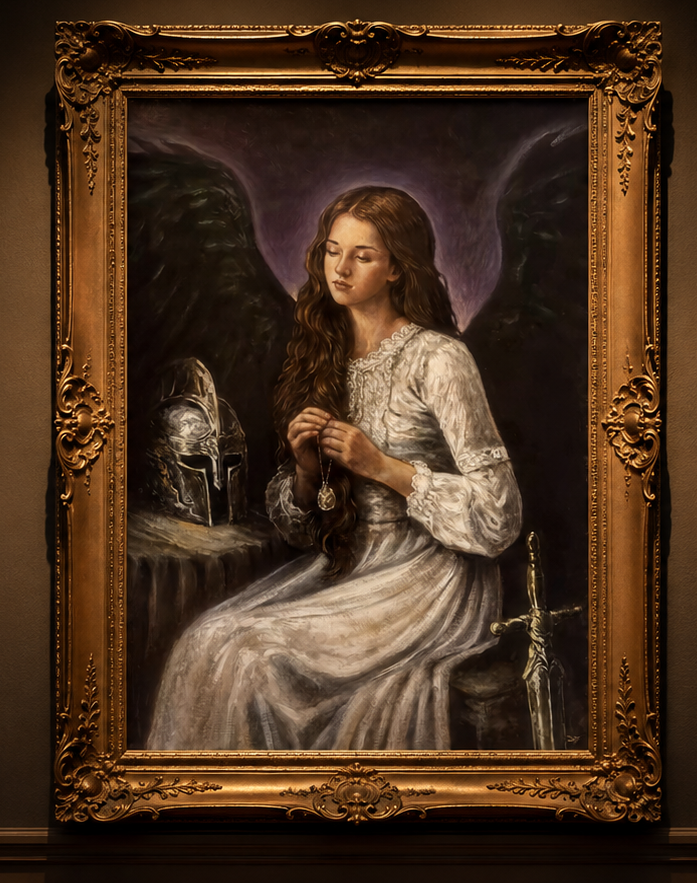
Within Neo-Stilnovism, one figure returns with particular intensity and perhaps more than any other summarises its symbolic structure: the Donna Angelo, or Angel Woman.
She is not simply a beautiful woman.
Not an idealised model.
Not a decorative character.
She is an archetype.
A figure capable of holding together apparently opposing dimensions: light and shadow, strength and vulnerability, eros and spirituality, motherhood and independence, royalty and sacrifice, knowledge and mystery.
Within Neo-Stilnovism, the Donna Angelo becomes one of the principal instruments through which painting investigates the human condition.
To understand her meaning, we must return to the origins of the idea.
From the Dolce Stil Novo
Within medieval Dolce Stil Novo poetry, the woman performs a function extending beyond romantic love.
She is not merely the object of desire.
She becomes a mediator.
A presence capable of guiding the individual towards a higher condition.
Beauty and spirituality become connected.
The feminine figure becomes a symbol of transformation.
Neo-Stilnovism does not simply reproduce this concept.
It transforms it.
The contemporary Donna Angelo no longer belongs exclusively to medieval poetry.
She enters painting.
Acquires body.
Face.
Weight.
Material.
Psychology.
And, above all, complexity.
Not a Perfect Woman, but a Total Woman
One possible danger in the concept of the Donna Angelo would be reducing her to a perfect, idealised figure without conflict.
Neo-Stilnovism takes the opposite direction.
The Donna Angelo may be:
mother;
queen;
warrior;
saint;
sibyl;
visionary;
lover;
wounded figure;
dark presence;
guardian;
priestess;
tragic woman.
These identities do not exclude one another.
They complete one another.
The feminine figure becomes a principle capable of containing multiple forms of human experience.
She represents not only elevation.
She may represent descent.
Not only purity.
She may represent desire.
Not only light.
She may contain shadow.
It is precisely this plurality that makes her contemporary.
The Archetype Beyond Portraiture
Within traditional portraiture, the face represents a person.
Within Neo-Stilnovism, the face may exceed individual identity.
The model is the point of departure.
Not the destination.
The face may become:
Morgana;
Persephone;
Mary;
Hypatia;
a sibyl;
a queen;
a martyr;
a mother;
an unnamed figure.
Individual identity is progressively transformed into symbol.
Portraiture becomes archetype.
The Face as a Place of Knowledge
The face occupies a central position within Neo-Stilnovist painting.
It is not simply a surface to render correctly.
It is a psychological space.
Forehead.
Eyes.
Mouth.
Eyebrows.
Tilt of the head.
Every element contributes to an internal condition.
The Donna Angelo does not need to smile.
Very often she does not.
She may appear distant.
Thoughtful.
Wounded.
Solemn.
Impenetrable.
Beauty therefore becomes a vehicle for complexity.
Eyes as a Portal
Within Neo-Stilnovism, the eyes perform a particular function.
They are among the principal points of access to the artwork.
A direct gaze may question the viewer.
A lowered gaze may suggest interiority.
A sideways glance may generate distance.
The eyes become a threshold.
Between visible and invisible.
Between painted surface and inner dimension.
For this reason, the face must never simply be “beautiful.”
It must possess presence.
Beauty as Force
Beauty within Neo-Stilnovism is not decoration.
Not ornament.
Not perfection for its own sake.
It is perceptual force.
Beauty holds the gaze.
Encourages it to remain.
But once attracted, the viewer encounters something more complex.
Pain.
Symbol.
Silence.
Mystery.
Sacredness.
Beauty becomes a doorway.
Not a conclusion.
Eros and Spirituality
One of the most delicate dimensions of the Donna Angelo is the relationship between eros and spirituality.
The woman is not desexualised.
Nor is she reduced to erotic object.
The body may be present.
Sensuality may exist.
But both are integrated within a broader symbolic structure.
Eros becomes energy.
Presence.
Desire.
Life.
Spirituality does not deny the body.
It transforms it.
The Mother
Among the deepest manifestations of the Donna Angelo is the maternal figure.
Motherhood is not interpreted solely as biology.
It may represent:
protection;
origin;
sacrifice;
memory;
continuity;
care;
pain.
The mother becomes universal.
Within Neo-Stilnovist language, she may approach the Madonna, but also the earthly mother, mythological mother or symbolic mother.
The Queen
The Donna Angelo may also assume a regal dimension.
Crowns.
Gold.
Thrones.
Precious fabrics.
Armour.
Yet royalty does not necessarily coincide with political power.
It may represent dignity.
Self-awareness.
Inner sovereignty.
A Neo-Stilnovist queen may be powerful and vulnerable at the same time.
She may dominate the space while appearing imprisoned by her own role.
The Warrior
The warrior introduces another dimension.
Strength.
Defence.
Resistance.
Armour becomes symbol.
Not merely physical protection.
It may represent the need to protect interior life.
The armed woman does not lose femininity.
She expands it.
The warrior Donna Angelo demonstrates that delicacy and strength can inhabit the same body.
The Saint
The sacred dimension represents another possible face of the archetype.
The saint does not need to be represented according to conventional religious formulas.
Sacredness may emerge through:
light;
silence;
gesture;
gaze;
symbol;
composition.
The sacred is produced through presence.
A face may become sacred when it seems to exceed individual identity.
The Sibyl
The sibyl represents knowledge.
Prediction.
Mystery.
Connection between visible and invisible.
She is especially close to Neo-Stilnovist structure because she combines femininity, knowledge and symbolic depth.
The sibyl does not provide simple answers.
She interprets.
Guards.
Suggests.
The Dark Woman
The Donna Angelo may also pass through shadow.
She may become:
Morgana;
Lilith;
Persephone;
witch;
queen of the night;
underworld figure.
This does not destroy the archetype.
It completes it.
Shadow is part of human existence.
To exclude it would produce an incomplete figure.
The dark woman makes the hidden dimension visible.
Desire.
Fear.
Death.
Rebellion.
Power.
Light and Shadow
Chiaroscuro therefore becomes essential.
The Donna Angelo rarely exists within flat light.
Light must construct.
Reveal.
Conceal.
It may illuminate the face while allowing the body to disappear.
Leave the eyes in shadow.
Transform fabric into luminous surface.
The relationship between light and shadow becomes a metaphor for psychological complexity.
Colour as Archetypal Language
Colour reinforces the identity of the figure.
Red.
Gold.
Black.
Blue.
White.
Purple.
Each colour produces a symbolic field.
Red may become blood, passion, power or sacrifice.
Gold may suggest sacredness, royalty or transcendence.
Black may become mystery, death, elegance or silence.
White may evoke purity, light or apparition.
Colour does not simply accompany the Donna Angelo.
It defines her.
Garments, Veils and Armour
Within Neo-Stilnovism, clothing is not merely costume.
It becomes part of the narrative.
A veil may conceal.
Protect.
Separate.
Armour may defend.
A crown may elevate or imprison.
A mantle may create distance.
Dress becomes an extension of psychology.
Symbol
The Donna Angelo often exists within a symbolic system.
Roses.
Moons.
Crowns.
Mirrors.
Water.
Fire.
Wings.
Weapons.
Books.
Animals.
Each may contribute to the construction of the archetype.
But symbolism works only when it does not become decoration.
It must have a reason.
The Donna Angelo and Contemporary Culture
Why should an archetype rooted in medieval culture remain meaningful today?
Because many of the questions it contains remain unresolved.
What does it mean to be a woman?
How much space exists between image and identity?
How do strength and vulnerability coexist?
What is the relationship between body and spirituality?
Between beauty and power?
Between desire and knowledge?
Between motherhood and autonomy?
The Donna Angelo allows these questions to be approached through symbolic language.
Against the Superficiality of Images
Contemporary culture produces an enormous number of images of women.
Advertising.
Fashion.
Social media.
Cinema.
Artificial intelligence.
Quantity is immense.
Depth is not guaranteed.
Neo-Stilnovism attempts to oppose this speed with a figure demanding time.
She does not wish merely to be consumed.
She asks to be interpreted.
The Risk of Idealisation
There is, naturally, a risk.
Over-idealising the Donna Angelo could transform her into an unrealistic model.
For this reason, complexity must remain essential.
The woman should not become an image of compulsory perfection.
The archetype works when it contains contradiction.
Wounds.
Errors.
Shadow.
Strength.
Desire.
Vulnerability.
Only then does it remain alive.
The Donna Angelo in the Work of Carmelo Fabio D’Antoni
Within Carmelo Fabio D’Antoni’s research, the Donna Angelo crosses different cycles, subjects and identities.
She does not always appear in the same way.
She may take sacred, mythological, historical, regal, dark or warrior forms.
What remains constant is the attempt to transform the feminine face into symbolic structure.
The woman becomes the centre of a painting seeking to unite:
beauty;
psychology;
symbol;
history;
spirituality;
technique;
memory.
An Open Archetype
The Donna Angelo should not be understood as a closed formula.
An archetype lives precisely because it can be reinterpreted.
Every period may ask it new questions.
Every artist may alter its meaning.
Every viewer may recognise something different within it.
This openness prevents it from becoming simple iconography.
From Woman to Memory
Ultimately, the Donna Angelo represents something extending beyond the individual image.
It is an attempt to return the feminine figure to a central function in the construction of meaning.
Not simply subject.
Not simply beauty.
But a presence capable of carrying memory, knowledge and transformation.
And this is why, within Neo-Stilnovism, the Donna Angelo occupies not only the centre of the canvas.
She occupies the centre of the vision.