

Neo-Stilnovist Artists — International Profiles
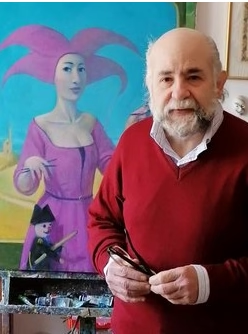
Claudio Giulianelli occupies a distinctive position within contemporary Italian figurative painting.
Born in Rome in 1956, he developed his artistic identity through an intense study of the Old Masters, particularly Caravaggio and the Flemish and Northern Renaissance traditions. His official biography recalls his fascination with ancient painting from childhood, his technical study of historical masterpieces, and his formative encounters with artists such as Delfo Previtali and Guido Razzi.
Yet Giulianelli’s work cannot be understood simply as a revival of the past.
His paintings construct an autonomous visual world in which medieval memory, symbolism, female figures, mystery, alchemical references and imaginary landscapes coexist.
It is precisely this capacity to transform historical memory into a personal symbolic universe that makes his research particularly compatible with the Neo-Stilnovist vision.
An artist formed through the Old Masters
Giulianelli’s relationship with tradition is direct and physical.
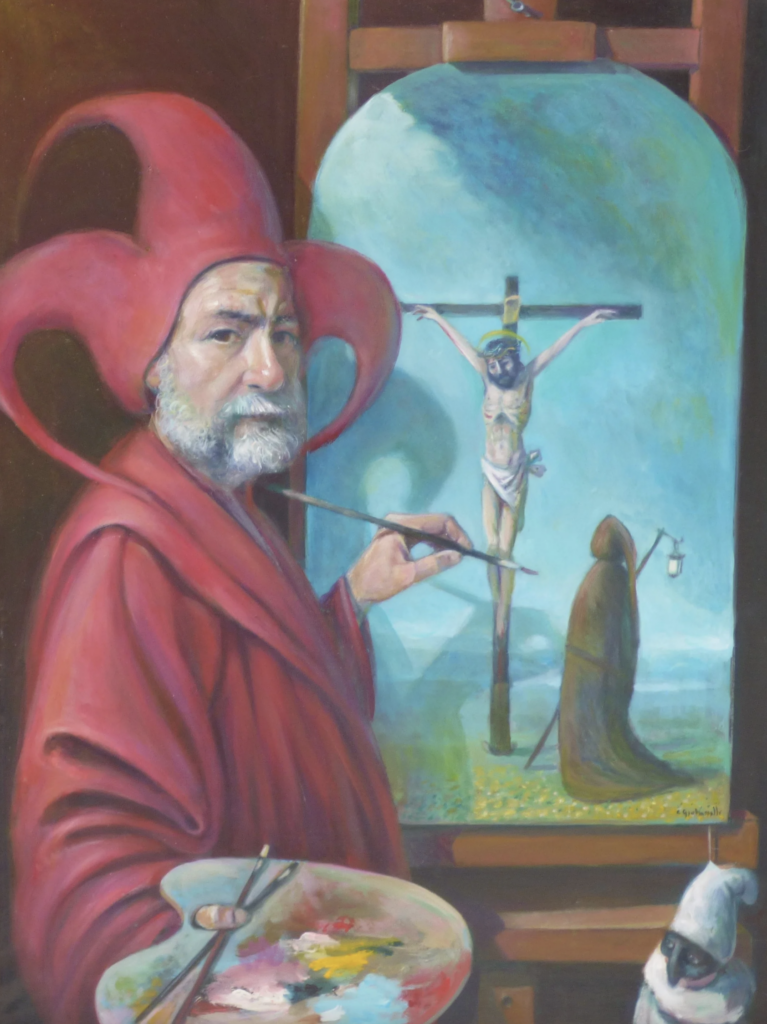
He has described his fascination with Caravaggio as something that entered his artistic DNA, leading him to study the painter’s works both compositionally and technically. Another decisive encounter came through Hieronymus Bosch, whose visionary and enigmatic imagery opened for him a world of mystery, symbolism and hidden knowledge.
This dual inheritance is fundamental.
From Caravaggio comes attention to pictorial construction, light, density and dramatic presence.
From Bosch comes the possibility that painting may contain another level of meaning: one that is not immediately explained but must instead be interpreted.
Between these two poles, Giulianelli develops his own language.
A Middle Ages that never existed
One of the strongest characteristics of Giulianelli’s painting is his relationship with the Middle Ages.
But this is not an archaeological Middle Ages.
It is not historical reconstruction.
It is an imagined Middle Ages.
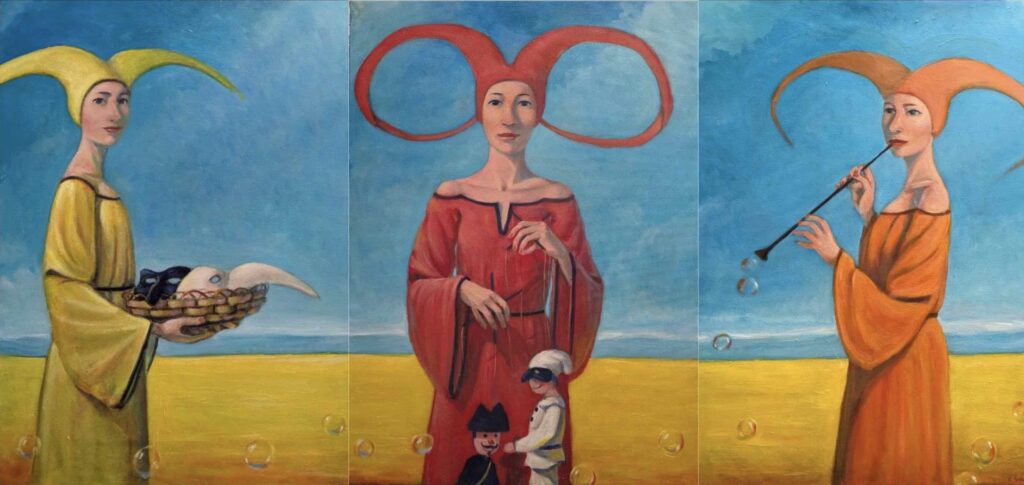
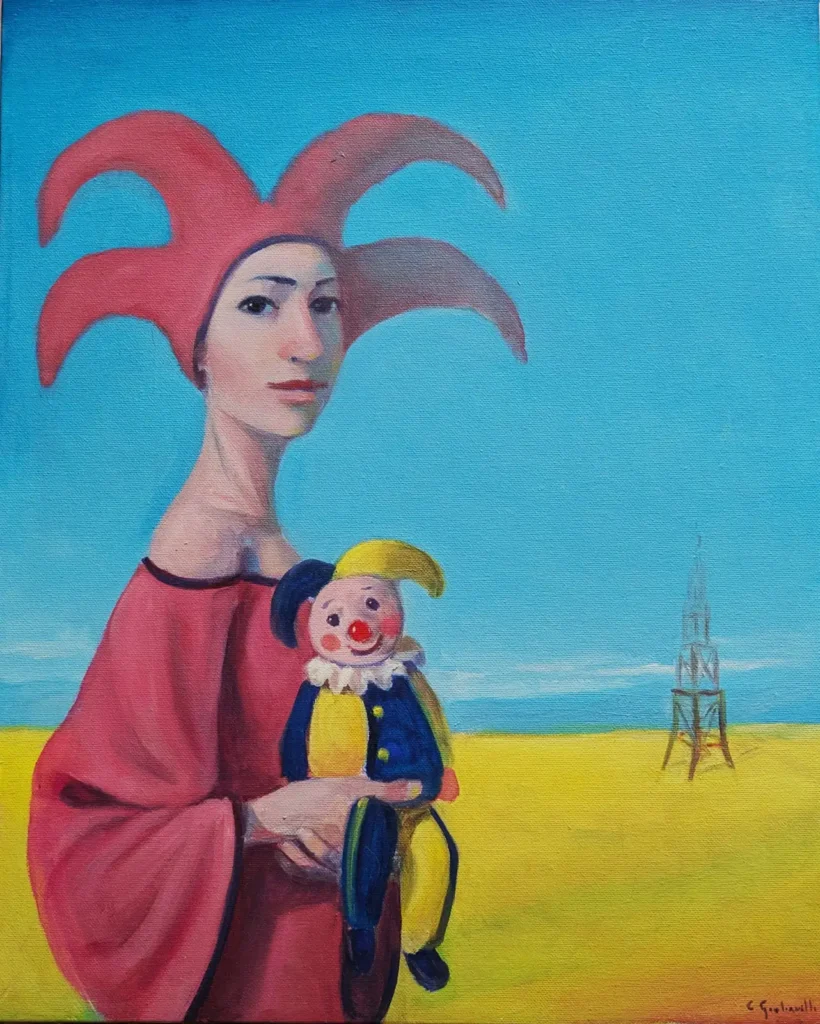
His paintings often present noble women, mysterious figures, puppets, symbolic objects, invented landscapes and theatrical spaces that seem to belong simultaneously to memory and dream.
This quality has already been recognised in critical writing on his work, where his universe has been described through recurring elements such as women, jesters, puppets, turbans, flutes and symbolic narratives that create a personal medieval alphabet.
The important point is not historical accuracy.
It is transformation.
The past becomes material for the imagination.
Hermeticism as a method of seeing
The term hermetic is particularly appropriate in relation to Giulianelli.
His paintings rarely reveal everything immediately.
They suggest.
Hide.
Repeat symbols.
Create relationships between figures and objects.
The viewer is invited to decode.
This distinguishes his work from straightforward narrative painting.
A scene may appear understandable at first sight, yet retain something unresolved.
Why is that figure there?
What does the puppet mean?
Why does the woman look away?
What relationship exists between the landscape and the symbolic object?
The painting becomes a field of interpretation.
The woman as central presence
The female figure plays a fundamental role in Giulianelli’s imagery.
His women are often dignified, enigmatic and almost regal.
They do not behave like decorative figures.
They appear to possess an inner authority.
This is one of the most significant points of contact with Neo-Stilnovism.
Within the Neo-Stilnovist vision, woman is not reduced to physical beauty.
She may become archetype.
Guide.
Queen.
Sibyl.
Mother.
Visionary.
Presence.
Giulianelli’s women frequently inhabit precisely this territory.
They seem to belong both to the visible world and to another symbolic dimension.
The gaze and the withheld meaning
Many of Giulianelli’s women do not confront the viewer directly.
Their gaze may be distant.
Lowered.
Lateral.
Contained.
This creates a psychological distance.
The viewer can see the figure but cannot completely enter her.
That distance produces mystery.
And mystery is essential to Giulianelli’s work.
The woman is not entirely available to interpretation.
She retains something.
A secret.
A memory.
A thought.
A symbolic function that remains partly inaccessible.
Beauty and mystery
Beauty in Giulianelli’s work is never merely decorative.
It is often connected with stillness, distance and suspension.
His female figures may be visually harmonious, but they are rarely simple.
Their beauty draws the eye.
Their mystery prevents immediate consumption.
This balance between attraction and opacity is one of the reasons his work can be read within a Neo-Stilnovist framework.
Beauty is not the destination.
It is the threshold.
The puppet as symbol
One of Giulianelli’s most recognisable recurring elements is the puppet.
This is particularly important.
The puppet introduces a different layer into the painting.
It may suggest fragility.
Dependence.
Manipulation.
Childhood.
Innocence.
Humanity itself.
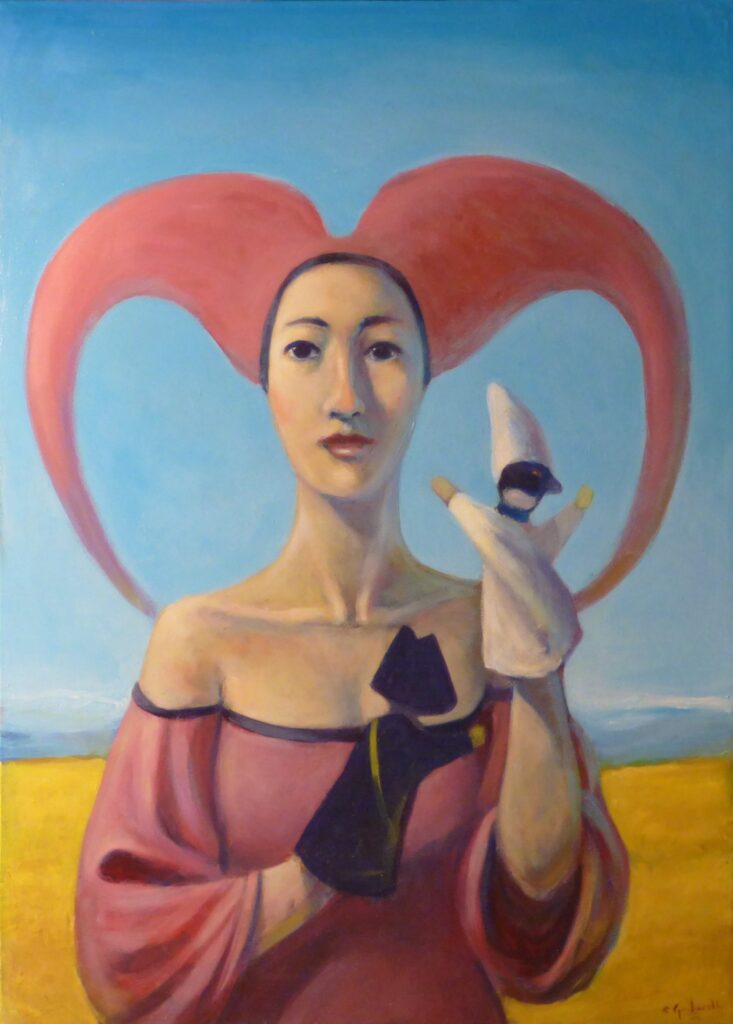
In Giulianelli’s own reflections, female figures sometimes hold puppets or marionettes almost as if these objects possessed an autonomous life, transforming them into more than theatrical accessories.
The puppet therefore becomes symbolic presence.
A small figure through which the painting asks larger questions.
Who controls whom?
What is freedom?
What is fragility?
What is illusion?
Painting as coded narrative
Giulianelli’s paintings often function like stories written without words.
They do not tell everything directly.
They combine signs.
Figures.
Objects.
Landscapes.
Gestures.
The result resembles a visual code.
This is precisely where the adjective hermetic becomes useful.
The painting is not closed.
But neither is it transparent.
It asks for interpretation.
The viewer must participate.
Technique as memory
Giulianelli’s relationship with historical technique is another important point.
His long study of Baroque and Flemish painting is not merely academic curiosity.
It becomes a technical memory.
The past survives through the way the image is constructed.
Through layering.
Through colour.
Through light.
Through the treatment of the figure.
Contemporary criticism has also underlined his dedication to artisanal painting, technical rigor and traditional oil practice, describing his work as a synthesis of classical mastery and symbolic invention.
Beyond quotation
The danger for an artist deeply connected to historical painting is imitation.
Giulianelli avoids this when historical references cease to be quotations and become part of a personal mythology.
Bosch may remain present.
Caravaggio may remain present.
The Renaissance may remain present.
But they no longer appear as models to be copied.
They become memory.
The artist uses tradition to construct another world.
This is an essential distinction.
Tradition is not reproduction.
It is transformation.
Why “Neo-Stilnovist Hermetic”
The definition Neo-Stilnovist Hermetic Artist should therefore not be understood as a decorative label.
It identifies a specific position.
Neo-Stilnovist, because Giulianelli’s work shares a commitment to figurative painting, symbolic beauty, the dignity of the human figure, archetypal femininity and continuity with historical artistic memory.
Hermetic, because his imagery works through concealment, symbols, layered meanings, dream-like narratives and a visual language that requires interpretation.
The two dimensions reinforce each other.
Neo-Stilnovism provides the field of beauty, figure, memory and symbolic presence.
Hermeticism defines the way Giulianelli constructs mystery within that field.
A language close to the Neo-Stilnovist world
Neo-Stilnovism does not require artists to paint in the same way.
This is crucial.
A movement becomes culturally interesting precisely when different artists can share principles without losing individual language.
Giulianelli does not paint like Carmelo Fabio D’Antoni.
Nor should he.
His world is more overtly hermetic, medieval, narrative and symbolic.
Yet there are important points of convergence:
the centrality of the figure;
the importance of beauty;
the symbolic woman;
the relationship with historical painting;
the resistance to purely decorative contemporaneity;
the idea that art should contain meaning;
the belief that technique must serve vision.
These affinities allow individuality to remain intact.
Art must make us think
Perhaps the most revealing sentence in Giulianelli’s own reflections is his conviction that art should make people think.
This principle is central.
Painting should not end at the surface.
A beautiful image is not enough.
A technically refined painting is not enough.
The work must activate something.
A question.
A memory.
A doubt.
A symbolic association.
This intellectual and emotional activation is precisely what gives hermetic figurative painting its relevance.
An international trajectory
Giulianelli’s career has also developed through numerous exhibitions and international contexts. His published curriculum records exhibitions and professional relationships extending across Italy and abroad, while sources connected to his activity mention exhibitions in countries including China, England, Sweden, Belgium and the United Arab Emirates, together with galleries and contacts in Europe, China and the United States.
This international dimension is important for The Stilnovist.
Neo-Stilnovism cannot remain a closed local language.
It must operate through dialogue.
Different countries.
Different artists.
Different symbolic vocabularies.
Individuality inside a movement
The inclusion of an artist such as Giulianelli demonstrates something important about Neo-Stilnovism.
Belonging does not mean standardisation.
It does not mean repeating the founder’s imagery.
It means sharing a field of values while preserving an individual voice.
Giulianelli brings into that field his own elements:
Bosch.
Alchemy.
The imagined Middle Ages.
The puppet.
The enigmatic woman.
The coded landscape.
The silent narrative.
This is precisely what makes his presence valuable.
The persistence of mystery
Contemporary culture tends to explain everything quickly.
Images are consumed rapidly.
Meanings are simplified.
Giulianelli’s painting moves in the opposite direction.
It asks the viewer to slow down.
To look again.
To search for relationships.
To accept that not everything will be immediately resolved.
This persistence of mystery is not nostalgia.
It is resistance.
A resistance to the idea that every image must be immediately understandable.
Painting as a world
Giulianelli’s strongest works do not simply represent scenes.
They construct worlds.
Those worlds appear familiar because they contain fragments of European artistic memory.
And yet they remain impossible to locate historically.
This is their strength.
They seem remembered even though they never existed.
The medieval past becomes dream.
The dream becomes symbol.
The symbol becomes painting.
Claudio Giulianelli and the Hermetic Neo-Stilnovist identity
Within the expanding language of Neo-Stilnovism, Claudio Giulianelli introduces a particularly distinctive dimension.
His painting reminds us that beauty may conceal.
That the past may be reinvented.
That a woman may become an archetype without losing mystery.
That a puppet may contain an entire philosophical question.
And that figurative painting can still require interpretation.
For this reason, the definition Hermetic Neo-Stilnovist identifies not merely a stylistic proximity, but a specific way of inhabiting the movement.
A way in which historical memory, technical discipline, symbolic invention and mystery converge.
Giulianelli does not paint the Middle Ages as they were. He paints the Middle Ages as memory, dream and symbol might recreate them.
And perhaps this is precisely where his work meets the deepest Neo-Stilnovist principle:
tradition becomes alive only when the artist transforms it into a world that did not exist before.

Other Articles

The Atelier as a Place of Transmission: Where Technique Becomes Memory
The Face as a Threshold: Building a Gaze That Has Presence