

When Portraiture Becomes More Than Resemblance
The face is one of the most difficult territories in figurative painting.
It takes very little to make it believable.
And even less to make it empty.
Correct proportions, convincing anatomy, coherent light and recognisable resemblance may create a technically accomplished portrait. Within Neo-Stilnovism, however, this is still not enough.
The face must acquire presence.
It must stop being merely an image.
It must become a threshold.
A point of passage between the painted surface and the inner life the viewer senses beyond it.
Resemblance Is Only the Beginning
Recognising a person within a painting matters.
But resemblance belongs mainly to the descriptive level.
It tells us who the subject is.
It does not necessarily tell us what that face has become within the artwork.
Neo-Stilnovism seeks a further passage.
The real face may be the starting point.
Painting must then transform it.
Make it denser.
More silent.
More ambiguous.
More memorable.
A face may be perfectly recognisable and still fail to hold the viewer.
Another may move slightly away from photographic precision and possess far greater force.
The difference lies in presence.
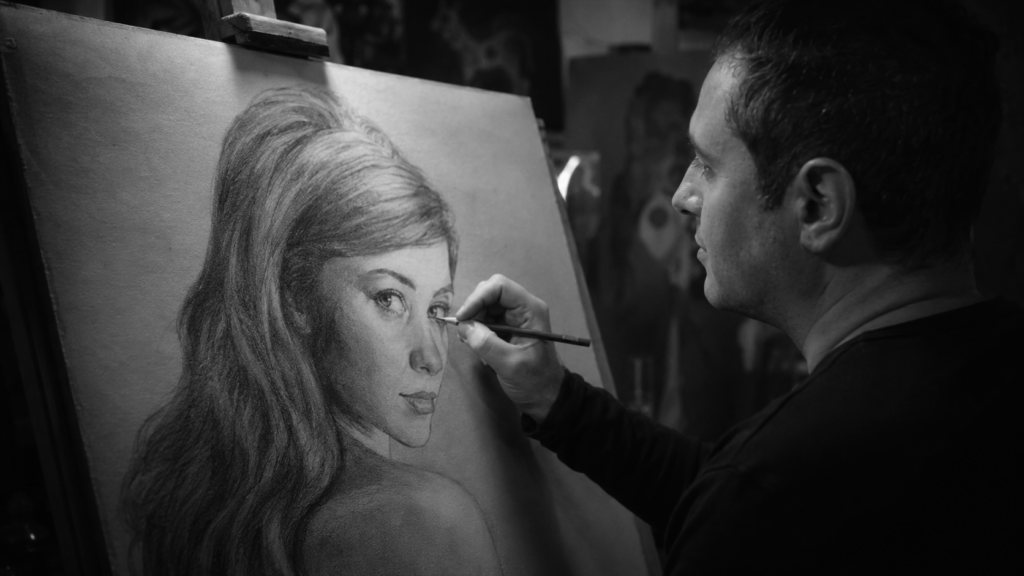
The Eyes Are Not Two Details
The eyes are often regarded as the expressive centre of the face.
Yet in painting they never function alone.
Painting two beautiful eyes is not enough.
Everything surrounding them must be constructed.
Eyelids.
Eyebrows.
Shadow.
Distance.
Asymmetry.
Direction.
Tension.
The gaze emerges from the whole.
An eye that is too perfect can become artificial.
Two eyes that are too symmetrical may lose vitality.
Human faces are built from minute differences.
Expression often begins precisely there.
The Direction of the Gaze
Where does the figure look?
At the viewer?
Beyond the frame?
Downward?
Upward?
Inward?
Every choice changes meaning.
A direct gaze creates relationship.
A lateral gaze suggests waiting or distance.
A lowered gaze may generate introspection.
Closed eyes can transform a face into a meditative presence.
The direction of the gaze is therefore not merely narrative detail.
It is psychological structure.
When the Painting Looks Back
There are paintings before which the viewer experiences a particular sensation.
One is not simply looking.
One almost feels observed.
This sensation does not arise from a simple trick.
It results from a delicate construction.
Eye direction.
Frontality.
Light.
Silence.
The position of the head.
When these elements work together, the face acquires autonomy.
It ceases to appear as object.
It becomes subject.
This is where portraiture begins to return the gaze.
Eyelids
Eyelids profoundly alter perception.
A fully open eye may appear alert.
A slightly lowered lid may create distance.
A heavier eyelid may suggest fatigue, sensuality or memory.
Tiny differences create major effects.
For this reason the face should not be constructed from formulas.
Every character requires a different tension.
Presence comes from the precision of character, not from the standardisation of beauty.
Eyebrows
Eyebrows are equally fundamental.
They define energy.
Severity.
Fragility.
Suspicion.
Gentleness.
A minimal change in their curve may radically transform the face.
Within Neo-Stilnovist portraiture, their function is not decorative.
They participate in the construction of archetype.
A warrior will not necessarily possess the same relationship between eyes and eyebrows as a sibyl.
A queen will not carry the same tension as a maternal figure.
The Mouth
The mouth is often the second great centre of the face.
A completely relaxed mouth may communicate absence.
Minimal tension at the corners may suggest restraint.
Pressed lips may become resistance.
The mouth does not need to “express” in an obvious way.
It may retain.
And retention is often more powerful than display.
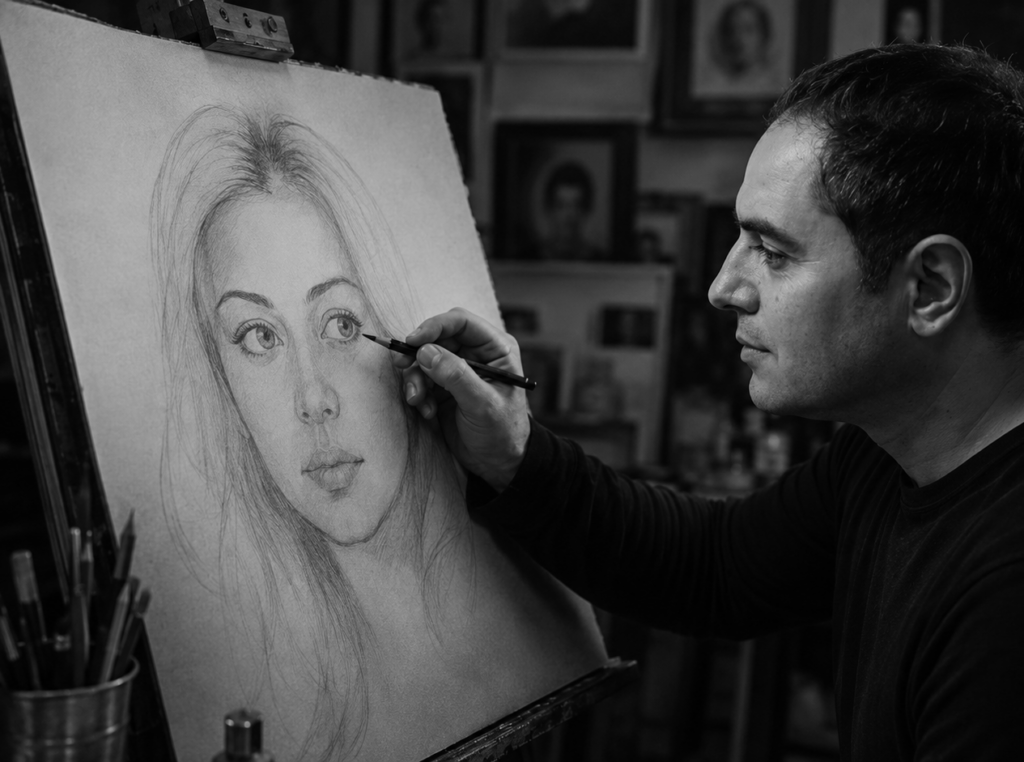
The Silence of the Face
A powerful face does not need theatricality.
It can remain almost motionless.
Silence is an important quality in Neo-Stilnovist painting.
A figure that does not explain everything forces the viewer to remain longer.
To search.
Interpret.
Imagine.
The face becomes an apparently still surface within which something continues to move.
Light Models Psychology
Light does more than construct volume.
It constructs character.
Frontal light may make the face appear more open.
Side lighting may create mystery.
Light from above may suggest severity or sacredness.
Chiaroscuro is not only a tool for three-dimensionality.
It can become a form of psychology.
What is illuminated is declared.
What remains in shadow is retained.
Chiaroscuro as Threshold
Within Neo-Stilnovism, chiaroscuro assumes a particularly important function.
The figure emerges from darkness.
Never completely.
Something remains concealed.
This balance prevents the face from being fully possessed by the viewer’s gaze.
Light offers.
Shadow withdraws.
Presence emerges from this tension.
Sculptural Projection Applied to the Face
The face should not be conceived as flat surface.
It must be built as volume.
The forehead advances.
Cheekbones emerge.
Eye sockets recede.
The nose projects.
The jaw creates weight.
This is the principle of Sculptural Projection applied to the head.
Before painting, the artist must feel the face in space.
As though it could be mentally rotated.
As though it were sculpture.
Light can work convincingly only when it encounters believable volume.
The Face Before the Canvas
Within the Neo-Stilnovist process, the face may begin long before the painting.
It may emerge from memory.
A model.
A dream.
A person encountered.
An imagined character.
The inner image begins to form.
Before the brush reaches the surface.
When the face already exists within the mind, technique can begin to materialise it.

The Model as Portal
Here the concept of the Model as Portal returns.
The model should not simply be copied.
Her presence may activate a character.
A real face may contain a possibility.
Queen.
Sibyl.
Warrior.
Donna Angelo.
The artist observes the face, but what is painted does not necessarily coincide with the person standing there.
The person opens the door.
The archetype emerges beyond it.
Extracting Rather Than Reproducing
The task therefore becomes one of extraction.
Not mechanical reproduction.
Extracting a gaze.
A tension.
A vulnerability.
A strength.
Painting selects.
Amplifies.
Transforms.
This allows the face to move from biography into archetypal form.
The person remains.
But the artwork exceeds her.
Asymmetry
The human face is not perfectly symmetrical.
This imperfection is part of what makes it alive.
One eye may sit slightly higher.
One side of the mouth may carry more tension.
One cheek may be fuller.
One eyebrow stronger.
Over-polished painting risks erasing all of this.
And with it, part of the presence.
Asymmetry is not a defect.
It is identity.
Controlled Error
Even a small error may become meaningful.
An unexpected line.
A variation in brushwork.
A slightly deeper shadow.
Within the Velatio Method, this becomes even more important.
Control is partially suspended.
The hand may create something unforeseen.
If that mark brings vitality, it should not automatically be erased.
It must be observed.
Judged.
Perhaps integrated.
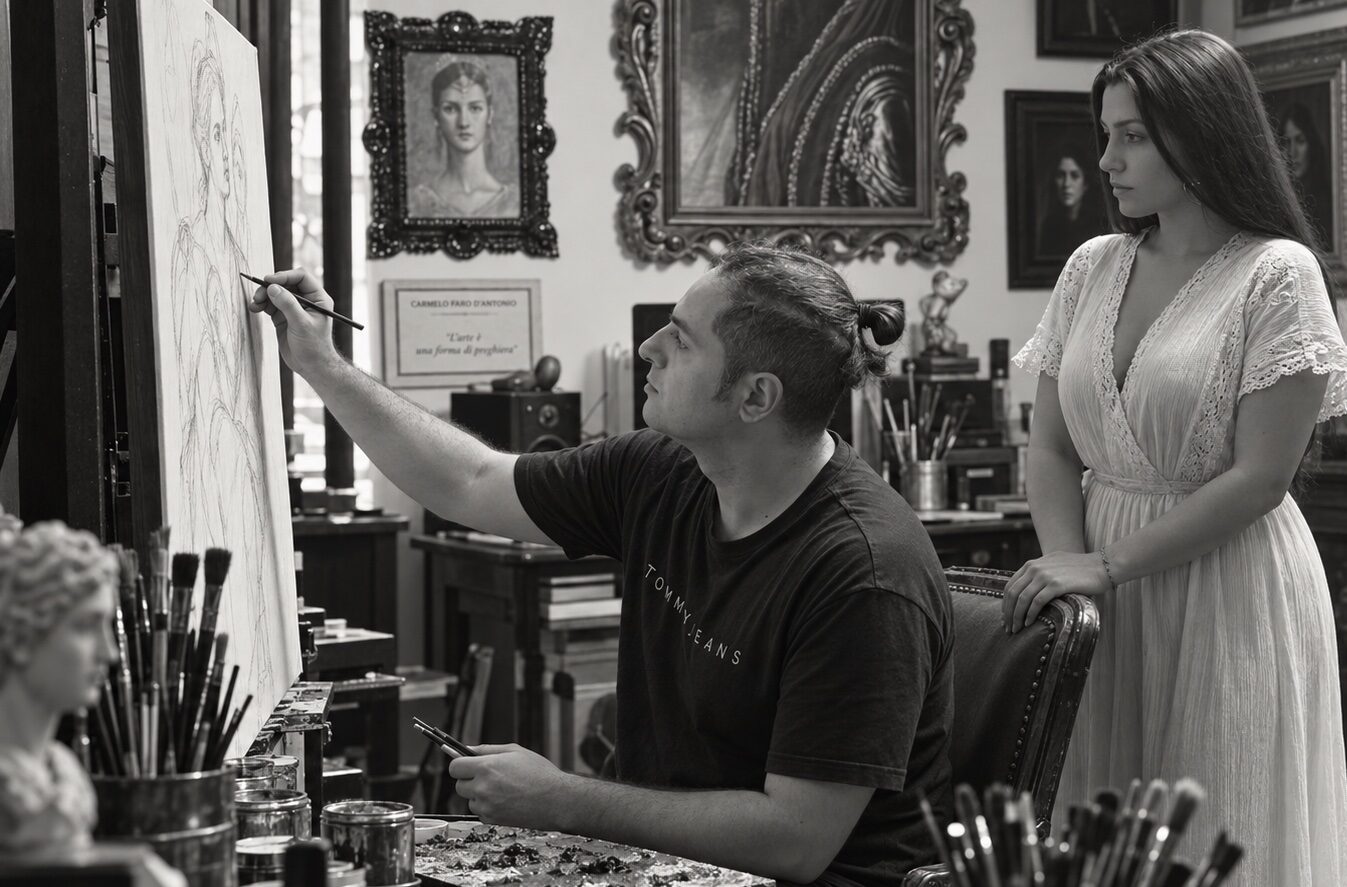
Technique and Emotion
The face does not live through technique alone.
It may be perfectly constructed and remain cold.
Real emotion is needed.
Not necessarily dramatic emotion.
It may be minimal.
A memory.
Desire.
Fear.
Respect.
Distance.
Technique makes that emotion visible.
Emotion prevents technique from becoming mere exercise.
The Face as Archetype
When the process succeeds, the face ceases to belong only to one individual.
It may become mother.
Queen.
Warrior.
Sibyl.
Donna Angelo.
The archetype does not erase the person.
It expands her.
It allows the face to speak to viewers who do not know the model.
Who do not know the story.
Who do not know the artist.
The face acquires autonomy.
The Donna Angelo
Within Neo-Stilnovism, the Donna Angelo represents one of the most important territories of this transformation.
She is not simply a beautiful woman.
She is a presence.
She may be luminous or dark.
Severe or maternal.
Regal or wounded.
What matters is that the face suggests another dimension.
It should not merely be seen.
It should be perceived.
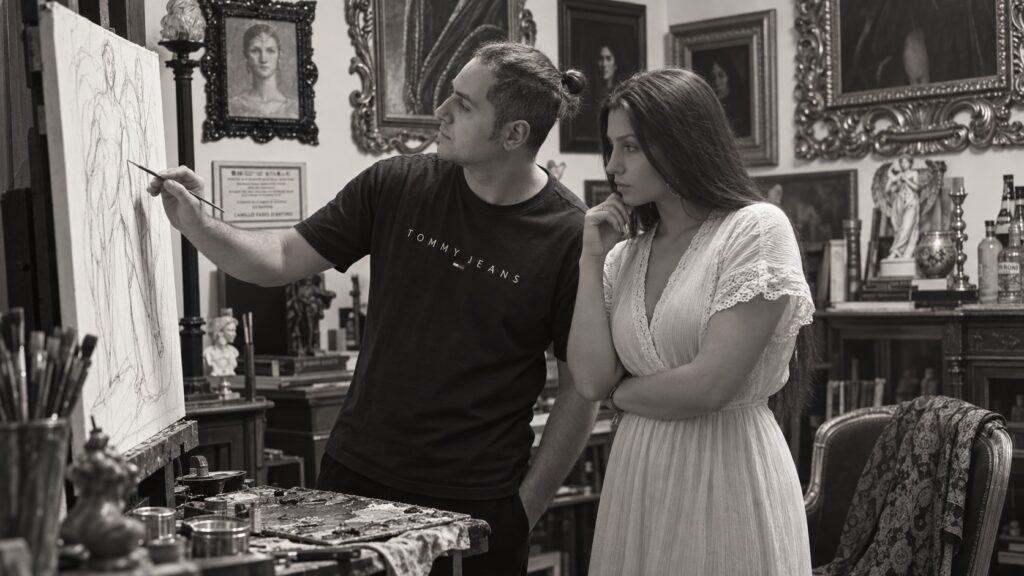
Beauty and Presence Are Not the Same
This point is essential.
A beautiful face is not automatically a powerful face.
Beauty may attract.
Presence holds.
Beauty may be immediate.
Presence requires time.
For this reason, the Neo-Stilnovist face should not seek harmony alone.
It should seek density.
The Viewer’s Memory
A truly successful face continues to exist after the viewer has moved away.
Perhaps many details will be forgotten.
But the eyes remain.
A tension.
A sensation.
This is one sign of presence.
The image has left the canvas and entered memory.

Portrait and Presence
Portrait says:
“This person exists.”
Presence adds:
“This figure has something to say to you.”
The distinction is profound.
The first belongs to representation.
The second to relationship.
Within Neo-Stilnovism, the face attempts to reach this second level.
The Threshold
This is why the face may be described as a threshold.
On one side lies painting.
Pigment.
Canvas.
Matter.
Technique.
On the other lies everything that is not materially present.
Memory.
Emotion.
Archetype.
History.
Silence.
The viewer encounters both at the same moment.
It is this encounter that transforms the face into presence.
A face truly becomes painting when it stops being merely recognisable and begins to be present.
Within Neo-Stilnovism, the face is not the conclusion of the figure. It is the threshold through which the artwork enters into relationship with the person who looks at it.

Other Articles

The Sibyl in Art: Prophecy, Knowledge and the Mystery of the Feminine