
The Atelier Is More Than a Space
An artist’s atelier is not simply a room in which paintings are made.
It is a place where knowledge takes form through gesture.
Where tools acquire memory.
Where time accumulates.
Where every prepared surface, worn brush and colour-stained table contains traces of a method.
Within Neo-Stilnovism, the atelier therefore acquires a precise meaning.
It is not only a place of production.
It is a place of transmission.
The atelier preserves the way an artist works, but above all the way an artist sees.
Learning by Watching
For centuries, a fundamental part of artistic education took place through direct observation.
Not only through books or treatises.
Artists learned by watching.
How a canvas is stretched.
How a ground is prepared.
How a medium is handled.
How pigment is mixed.
How flesh is constructed.
How proportion is corrected.
How one waits.
How one recognises that a passage needs more time.
Many of these things can be explained.
But seeing them happen changes understanding completely.
Gesture
Gesture is one of the most difficult forms of knowledge to transmit.
One may explain how to hold a brush.
But that is not enough.
Pressure changes.
Speed changes.
Angle changes.
Distance from the surface changes.
Gesture contains experience.
An experienced artist performs movements that may no longer require conscious thought.
They have become part of the body.
This is where the atelier acquires fundamental value.
Technique can be explained. Gesture must be seen.
Master and Student
The relationship between master and student should not be understood only in an ancient or hierarchical sense.
It may be much simpler.
A presence observing.
A question.
A correction.
A demonstrated gesture.
A repeated attempt.
The student does not learn only technique.
The student learns rhythm.
Discipline.
A way of confronting error.
A way of looking at a figure.
A way of waiting.
Daily Discipline
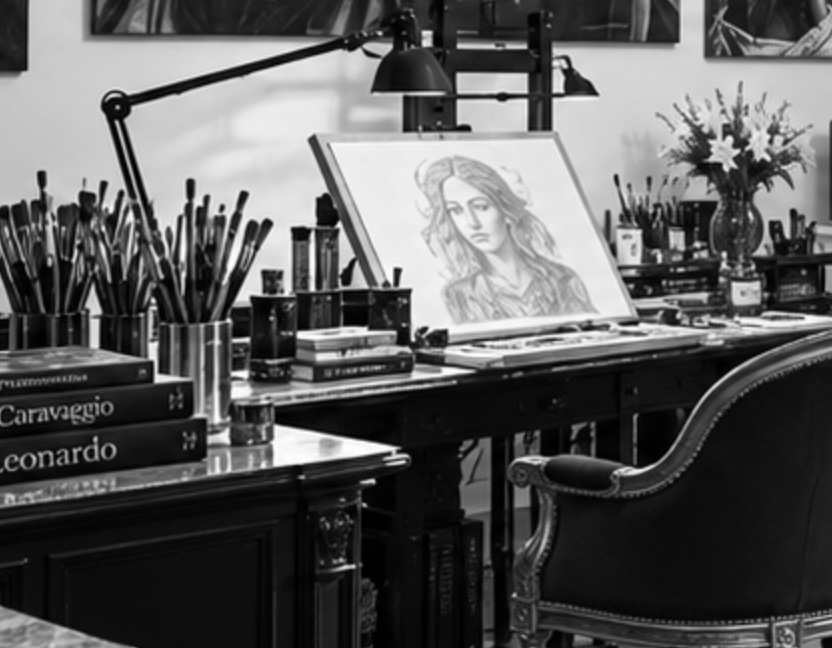
The atelier is also a place of repetition.
Drawing.
Preparing.
Correcting.
Reconstructing.
Trying.
Artistic growth rarely occurs through a single extraordinary gesture.
It develops through continuity.
Daily work trains the eye.
The hand.
Memory.
Slowly, what once required conscious attention becomes natural.
The Memory of Matter
Every material teaches something.
Linen behaves one way.
Jute another.
Wood another.
An absorbent ground changes colour.
A smoother surface changes gesture.
An opaque pigment behaves differently from a transparent one.
The atelier allows these differences to be learned through experience.
Not merely through theory.
Matter becomes knowledge.
Preparing the Support
Surface preparation is one of the most underestimated stages of painting.
Yet it determines much of the final result.
The support is not neutral.
It affects brushwork.
Colour.
Luminosity.
Durability.
Within atelier practice, learning to prepare a canvas means understanding that the painting begins long before the image.
Before the face.
Before drawing.
Before colour.
The artwork begins with the ground that must sustain it.
Drawing as Foundation
Drawing remains one of the most important instruments.
Not merely as preparation.
As an exercise in seeing.
Drawing means understanding.
Weight.
Proportion.
Volume.
Direction.
Tension.
Within Neo-Stilnovism, drawing participates directly in constructing presence.
It is not merely contour.
It is structure.
From Line to Volume
When drawing becomes truly useful to painting, line ceases to be merely an edge.
It begins to suggest volume.
The face must be conceived three-dimensionally.
The body must be perceived in space.
Here drawing enters into direct dialogue with Sculptural Projection.
The atelier is the place where this principle can be transmitted not as definition, but as practice.
By showing.
Correcting.
Demonstrating how a flat sign becomes believable form.
Sculptural Projection as Transmissible Knowledge
Sculptural Projection is not merely a concept to be read.
It must be practised.
The artist must learn to see the figure mentally.
To rotate it.
To perceive its weight.
To imagine how light will meet its volumes.
This process can be explained.
But it becomes truly comprehensible when observed in practice.
When one sees a flat mark transformed into form.
Chiaroscuro
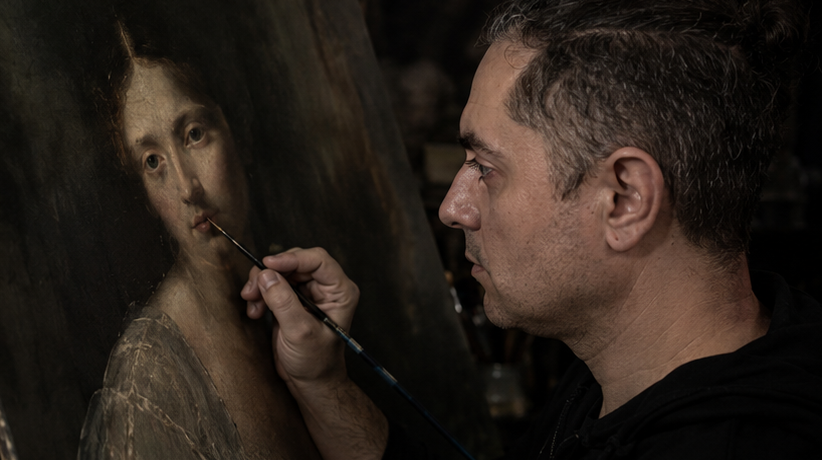
Chiaroscuro is also learned through observation.
It is not enough to know that light and shadow exist.
One must understand where to stop the light.
How dark to make the shadow.
When to leave an area unresolved.
How to avoid explaining everything.
The atelier teaches that shadow does more than construct volume.
It constructs mystery.
Colour
Colour may be one of the hardest elements to transmit verbally.
One may speak of temperature.
Contrast.
Saturation.
Complementaries.
But colour must be watched as it comes into being.
A mixture that is too cold.
A tone losing vitality.
A flesh passage requiring the smallest adjustment.
These are things a master can show in seconds.
A text may struggle to communicate them with equal precision.
The Time of Colour
Painting also teaches time.
Not everything should happen immediately.
A glaze may need to dry.
A passage may require rest.
A colour may seem wrong when first applied and become balanced the next day.
The atelier therefore teaches something increasingly rare:
waiting.
Error
Error is fundamental to learning.
A figure too rigid.
A face losing presence.
A colour too strong.
A proportion that fails.
Error should not be hidden.
It should be understood.
The atelier allows the student to see how an experienced artist reacts.
Not only how error is avoided.
But how it is transformed.
Correcting Without Destroying
Correction is a form of knowledge.
Understanding what to keep.
What to remove.
What to redraw.
What to leave.
Many young artists erase too much.
Others correct too little.
Knowledge lies in recognising the right moment.
This type of decision grows from experience.
And experience is precisely what the atelier can transmit.
The Velatio Method
The Velatio Method also finds its natural place within atelier transmission.
Control is not eliminated.
It is temporarily suspended.
The artist relies on memory, gesture and inner perception.
Such a method cannot be reduced to formula.
It must be experienced.
Seen.
Tried.
Corrected.
The master can demonstrate the boundary between freedom and randomness.
Between intuition and loss of structure.
The Model as Portal
The presence of a model in the atelier introduces another level.
The model is not merely anatomical reference.
She may become Model as Portal.
A presence capable of activating within the artist a character.
An archetype.
A memory.
A figure that does not yet exist.
This process can only be fully understood by experiencing the relationship between observation and transformation.
Seeing a person.
And then seeing something beyond that person.
When the Character Is Born
This moment is almost impossible to describe completely.
It may arrive through a gaze.
A posture.
A light.
A pause.
The artist suddenly recognises a figure that was not there before.
The model remains the same.
But something else is born within the artist.
Queen.
Sibyl.
Warrior.
Donna Angelo.
The atelier becomes the place where archetype appears.
Technique Is Not Enough
One of the atelier’s most important lessons is precisely this.
Technique is essential.
But it is not enough.
An artist may learn every rule.
Every process.
Every material.
And still fail to create presence.
Because the artwork needs emotion.
Vision.
Necessity.
Technique must serve something deeper.
Sensitivity Cannot Be Taught, but It Can Be Cultivated
Not everything can be taught directly.
Sensitivity cannot be transferred like a formula.
But it can be cultivated.
Through observation.
Discipline.
Reading.
Listening.
Dialogue.
The atelier creates conditions.
It does not guarantee results.
The Value of Silence
Silence also forms part of learning.
Not everything must be explained.
Sometimes the student must observe.
Understand.
Try.
Fail.
The atelier is not a continuous lesson.
It is also shared time.
Knowledge often passes precisely in moments when nobody is speaking.
The Atelier in the Digital Age
Today access to information is enormous.
Videos.
Tutorials.
Online courses.
Digital archives.
High-resolution images.
One can learn a great deal.
But this does not make the atelier obsolete.
On the contrary.
It makes more visible what digital learning cannot completely replace.
Presence.
Matter.
Gesture.
Live correction.
The smell of materials.
The real time of painting.
Watching an Artist Work
Watching an artist at work reveals things that are rarely discussed.
How long they remain still.
How much they observe.
When they change brush.
When they step back.
When they decide not to intervene.
When they destroy a successful passage because it does not serve the whole.
Painting is not only gesture.
It is decision.
Learning When to Stop
Perhaps one of the most difficult forms of knowledge is understanding when a work is finished.
Continuing may improve.
But it may also destroy.
The atelier slowly teaches how to recognise that boundary.
Not through a rule.
Through experience.
An artwork is finished when every additional intervention risks removing more than it adds.
The Atelier as a Living Archive
A true atelier preserves more than paintings.
It preserves studies.
Drawings.
Pigments.
Supports.
Errors.
Tools.
Methods.
Habits.
It is a living archive.
Many of these things may possess little museum value.
But enormous educational value.
They tell us how the artwork was born.
Transmitting a Method
For Neo-Stilnovism, this becomes particularly important.
If a movement is to endure, it cannot transmit images alone.
It must transmit methods.
Sculptural Projection.
Velatio.
Model as Portal.
Construction of the face.
Use of chiaroscuro.
The relationship between technique and emotion.
The atelier becomes the natural place where these principles move from theory into practice.
Not Creating Copies of the Master
But transmission does not mean producing imitators.
An authentic atelier should not manufacture stylistic copies of the master.
It should produce autonomy.
The student must learn principles.
Tools.
Rigour.
Then develop an individual language.
Otherwise tradition becomes repetition.
And repetition does not generate a future.
Tradition as Movement
Tradition survives only when it changes.
Each generation receives something.
Understands it.
Transforms it.
Returns it.
In this sense, the atelier does not preserve the past by freezing it.
It preserves it by allowing it to continue.
The Hand as Memory
Eventually, many techniques become part of the body.
The hand remembers.
Brush distance.
Pressure.
Amount of colour.
Speed.
This is a different form of memory from intellectual knowledge.
A physical memory.
And this is one of the most valuable things an atelier can create.
From the Master to Future Artworks
When a student truly absorbs a method, that knowledge continues within works the master could never have imagined.
This is the true success of transmission.
Not producing the same painting.
Producing new possibilities.
Received knowledge becomes starting point.
Not destination.
The Atelier as Future
For this reason, the atelier does not belong only to the past.
It may be one of the most contemporary spaces in art.
Precisely because it protects what speed tends to erase.
Time.
Matter.
Presence.
Discipline.
Dialogue.
Memory.
Transmission.
Within Neo-Stilnovism, the atelier can become the place where an individual artistic research begins to transform into cultural heritage.
The atelier does not preserve only the artist’s tools. It preserves the way the artist learned to see.
When a technique is transmitted, it is not only a way of painting that survives. A way of looking at the world survives with it.