
Vision Comes Before Technique
Every authentic artwork is born twice.
First within the artist.
Then in matter.
Before canvas, colour, brush or drawing, there is an invisible moment in which something begins to take shape internally.
A face.
A body.
A presence.
A light.
A figure that does not yet exist, but that the artist already feels.
Within Neo-Stilnovism, this moment is fundamental.
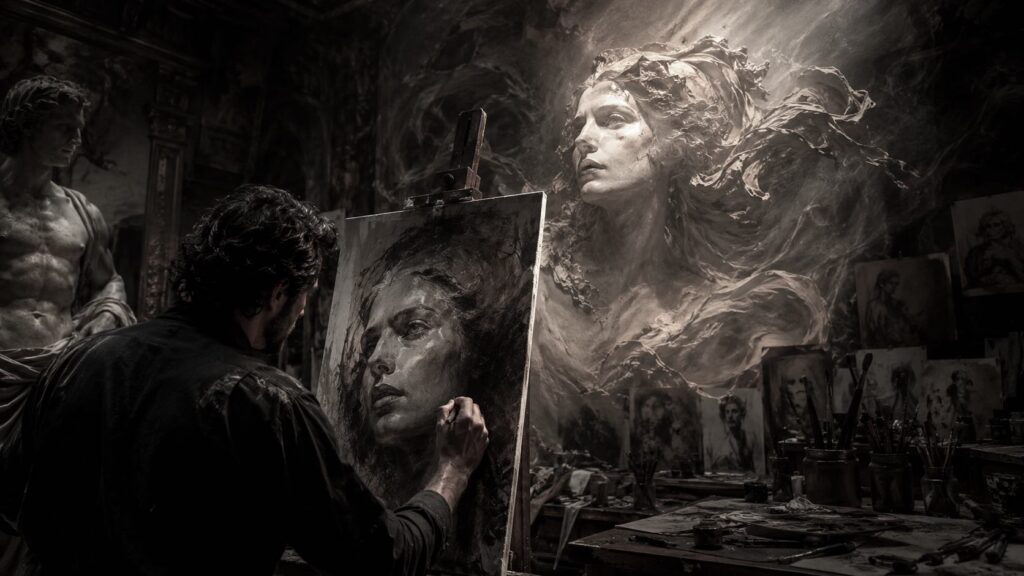
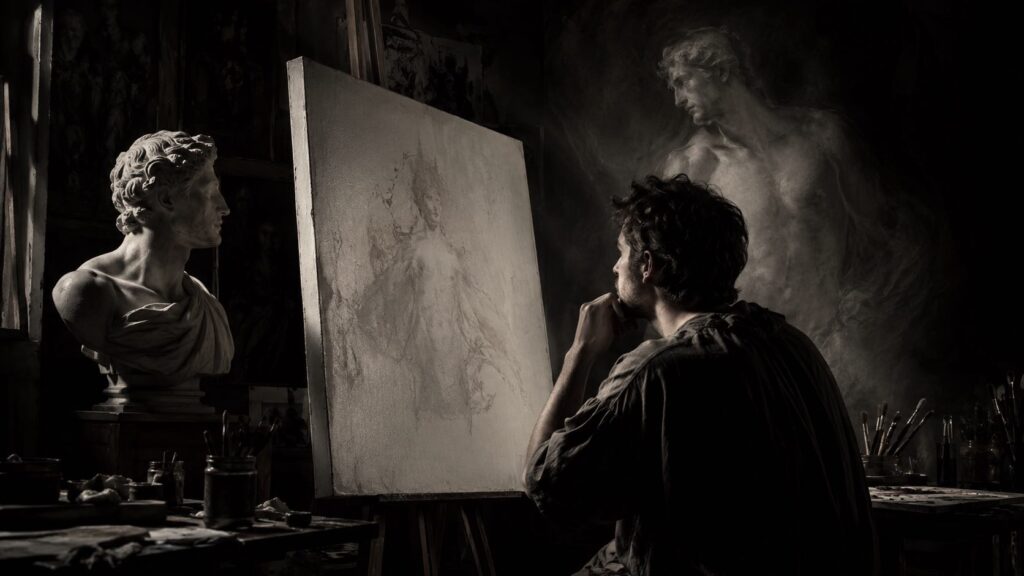
It is here that the principle of sculptural projection takes form: the ability to imagine the artwork before it is physically constructed, as though the figure already existed within an inner space and were simply waiting to be released.
The process recalls sculpture.
Standing before a block of stone, the sculptor does not see material alone.
He may already perceive a figure.
A head.
A body.
A tension.
A hidden form.
Creation begins at the moment in which that form is inwardly perceived.
The hand comes later.
Seeing Before the Artwork Exists
Sculptural projection does not simply mean understanding volume.
It goes further.
It means mentally seeing what does not yet exist.
The artist imagines the figure in space.
Observes it inwardly.
Perceives its weight.
The rotation of the head.
The distance between face and shoulders.
The depth of the eyes.
The tension of the hands.
The light that will move across the body.
It is almost an invisible sculpture.
Before drawing begins, the artist must first sense its presence.
This changes the entire relationship with painting.
The artwork is not constructed exclusively from the outside.
It is brought outward from within.
Imagination Is the Key
Within Neo-Stilnovism, imagination is not secondary.
It is one of the central keys of creation.
To imagine means to create a reality before that reality exists.
It does not mean uncontrolled fantasy.
It means inward construction.
Seeing.
Feeling.
Anticipating.
For this reason, painting need not depend entirely upon an already existing image.
A photograph may help.
A model may help.
A drawing may help.
But none of these should replace the artist’s ability to create mentally.
If an artist simply copies what stands before him, he translates an existing reality.
When he begins instead from an inner vision, he attempts to create something that did not previously exist.
Painting then returns to being genuine creation.
The Emotion of Birth
There is a particular moment in the artistic process.
It is the moment when an imagined form finally begins to appear.
A line replaces a thought.
A shadow creates a face.
A mass of colour becomes a body.
A mark suddenly becomes a gaze.
It is one of the deepest emotions of creation.
The artist recognises something that previously existed only within.
That instant is not purely technical.
It is emotional.
Almost a confirmation.
The inner form is becoming real.
This emotional dimension separates mechanical construction from authentic creation.
Technique Is the Instrument
Drawing.
Anatomy.
Perspective.
Composition.
Chiaroscuro.
Colour.
Glazing.
Pigments.
Knowledge of materials.
All are essential.
But they are not the final purpose.
They are instruments.
Technique exists to give form to what the artist possesses within.
The more an artist understands technique, the greater the possibility of making an inner vision visible.
Yet technique alone does not necessarily create a living artwork.
It may create a perfect painting.
Correct.
Virtuosic.
And completely empty.
Technical knowledge constructs structure.
It does not automatically construct soul.
The Soul of the Artwork
Soul comes from emotion.
Not from formula.
It may emerge from memory.
Loss.
Love.
Fear.
Desire.
A wound.
Hope.
Vision.
Something the artist feels before being able to define it precisely.
When that emotion truly enters the creative process, the artwork stops being merely a surface.
It begins to possess presence.
This leads to one of the central ideas of Neo-Stilnovism:
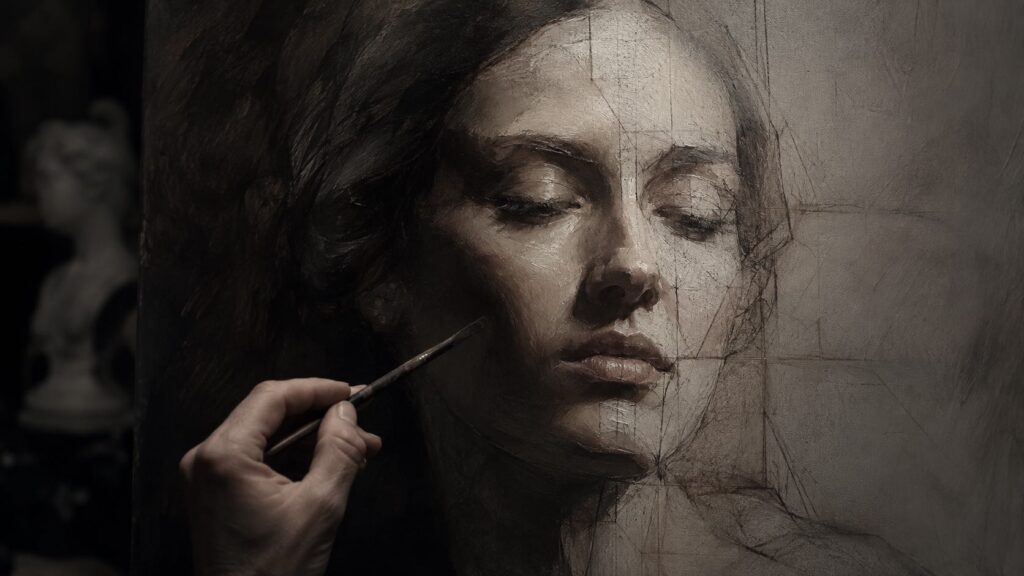
Technique constructs the artwork, but emotion gives it soul.
Creating From Nothing
To create from nothing does not mean ignoring everything that exists.
Every artist carries images, memories, experiences, observed bodies, studied artworks, landscapes, faces, pain and desire.
Nothing emerges from a complete void.
Creation means transforming all of this into something that did not previously exist in that form.
The mind gathers.
Combines.
Transforms.
Synthesises.
Then returns something new.
Sculptural projection emerges from this process.
A face may belong to no real person.
A queen may never have existed.
A Donna Angelo may emerge from the union of memory, symbol, emotion and imagination.
Painting becomes an act of generation.
From Body to Presence
Thinking sculpturally also means giving weight to the figure.
A body is not a collection of lines.
It is mass.
Balance.
Tension.
Volume.
The neck supports.
The shoulders possess weight.
The face occupies space.
The hands advance or recede.
The torso rotates.
Light must encounter real surfaces, even when those surfaces exist only within the artist’s imagination.
This matters because the figure must escape flatness.
Presence also comes from the credibility of the body.
But credibility is not only anatomical.
It is emotional.
A body may be perfectly constructed and communicate nothing.
Structure exists to serve presence.
Like a Sculptor Before Stone
The comparison with sculpture therefore becomes essential.
The sculptor sees mass.
But must imagine what that mass can become.
He removes material.
Releases the figure.
The painter performs a different process, yet conceptually a related one.
He begins with an empty surface.
He does not remove.
He adds.
And yet he too must see first.
As though something already existed within that surface.
The blank canvas becomes similar to a block of stone.
It is not empty.
It is full of possibilities.
The artist must discover the one that belongs to his vision.
Painting and Memory
Imagination is also nourished by memory.
An artist who has observed hundreds of faces carries an inner archive.
He knows how an eyelid folds.
How a mouth changes.
How a hand rests.
How a head tilts.
These things need not always be consciously recalled.
Over time they become part of the artist.
When sculptural projection begins, this memory emerges.
Not as copying.
But as transformed knowledge.
Emotion and Form
Emotion, however, cannot remain undefined.
It must find form.
This is the role of technique.
If the artist feels pain, he must decide how to make it visible.
Through the gaze?
Light?
Posture?
Colour?
Empty space?
Shadow?
If he feels strength, he must translate it.
If he feels motherhood, distance, fear, sacredness or desire, he must construct a language capable of transforming emotion into image.
Art is born within this translation.
Its Relationship With Velatio
Sculptural projection enters naturally into dialogue with the Velatio Method.
Within Velatio, the painter temporarily suspends part of visual control.
But this becomes possible only when an inner form is already sufficiently strong.
The hand can trust memory precisely because the figure has already been mentally constructed.
Sculptural projection prepares.
Velatio releases.
They are different but complementary moments.
One constructs presence before gesture.
The other allows gesture not to be completely imprisoned by control.
Light as a Sculptural Tool
Chiaroscuro also participates in sculptural projection.
Light does not simply illuminate.
It models.
A forehead emerges.
A cheekbone recedes.
A neck separates from the background.
A hand becomes volume.
Painting uses light almost as a chisel.
It removes no matter, yet constructs depth.
In this sense, chiaroscuro becomes one of the principal tools through which mental sculpture becomes painting.
Do Not Merely Copy What Exists
Photography can be useful.
But if it completely dominates the process, it may reduce imagination.
The problem is not using photography.
The problem is depending on it.
Sculptural projection asks the artist to understand what is seen and then move beyond it.
Change a pose.
Alter the light.
Invent a textile.
Transform a face.
Create a body that does not exist within the reference.
Reference becomes material.
Not command.
The Artwork Must Enter Into Dialogue
When the artwork is completed, the artist steps away.
Another life begins.
The painting will encounter other eyes.
Other histories.
Other sensibilities.
The viewer does not necessarily know what the artist felt.
Nor should they have to.
But if the artwork truly possesses soul, something passes between them.
Unease.
Tenderness.
Strength.
Sadness.
Mystery.
Protection.
Desire.
The viewer enters into relation with a presence.
This is where the painting begins to speak.
Giving Soul in Order to Create Memory
A technically perfect artwork may impress.
A living artwork may be remembered.
The distinction is fundamental.
Memory does not necessarily arise from technical complexity.
It arises from experience.
From what the artwork leaves within the person who encounters it.
If an artwork possesses soul, it continues to exist beyond the atelier.
It may meet people whom the artist will never know.
And each of them may discover something different within it.
Perhaps this is one of the deepest forms of continuity in art.
The Philosophy of Sculptural Projection
Sculptural projection is therefore not merely a technique.
It is a philosophy of creation.
It begins from the belief that the artist should not be limited to reproducing the world.
The artist should generate it.
First inwardly.
Then materially.
Imagination creates the vision.
Emotion gives it soul.
Technique allows it to become visible.
These three elements must remain united.
Without imagination, the artwork risks becoming copy.
Without emotion, it risks becoming exercise.
Without technique, the vision may fail to take form.
Their balance creates the work.
First, It Exists Within
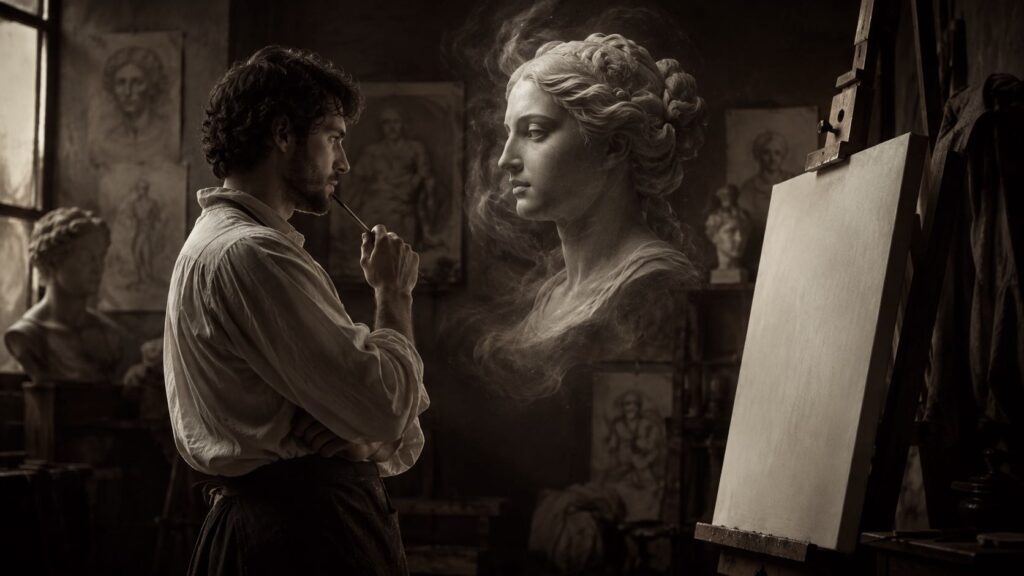
Perhaps the entire principle can be summarised through a single image.
A sculptor before a block of stone.
Everyone else sees stone.
The sculptor already sees a figure.
Not because the figure literally exists inside the block.
But because it exists inside him.
From that moment, the work consists in releasing it.
Neo-Stilnovist painting begins from the same principle.
The canvas is empty only to those who have not yet seen what it may become.
For the artist, the artwork must already have begun to exist.
First in the mind.
Then in emotion.
Finally in matter.
Technique constructs the artwork. Emotion gives it soul. Imagination allows that soul to take form.

Other Articles
The Model as Portal: When a Real Face Awakens the Archetype
Beatrice: When a Woman Becomes a Symbol of Elevation