

From a Historical Person to a Poetic Figure
Few female figures have crossed Western culture with the enduring force of Beatrice.
Her name belongs partly to Dante’s biography, but above all to his poetry. It is within that poetry that the decisive transformation occurs: the real woman gradually becomes a literary presence capable of carrying moral, spiritual and intellectual meaning.
Beatrice is not merely loved.
She is contemplated.
Remembered.
Lost.
Transfigured.
Eventually, she becomes a guide.
This transformation makes her essential to understanding a conception of the feminine that moves beyond individual portraiture.
With Dante, the female figure becomes capable of representing elevation.
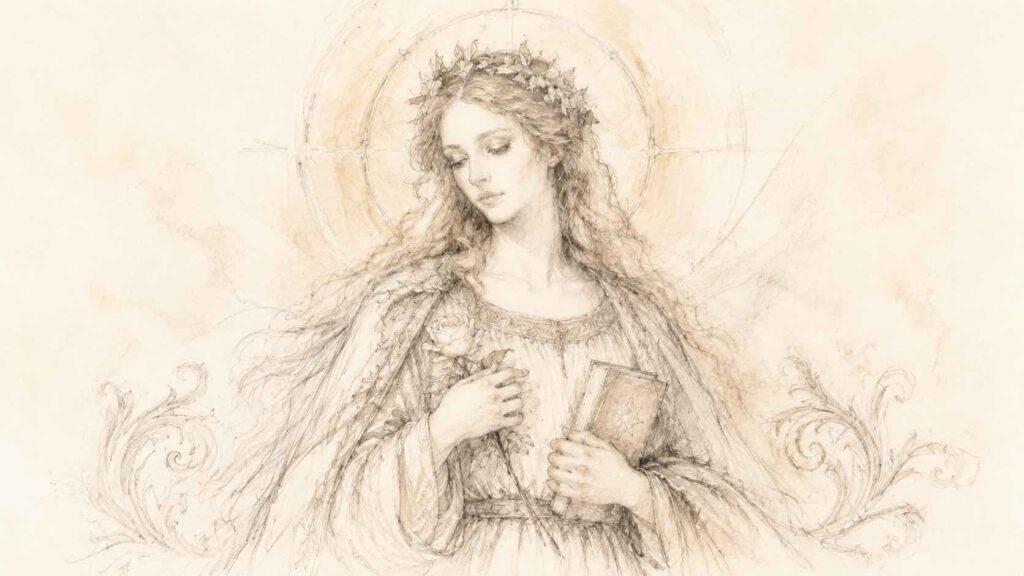
Historical Beatrice and Poetic Beatrice
Tradition generally identifies Dante’s Beatrice with Beatrice Portinari, a Florentine woman of the thirteenth century.
From a literary perspective, however, another question matters more.
The Beatrice known to us is not simply the woman reconstructed through historical evidence.
She is primarily the Beatrice created by Dante’s poetry.
A distance therefore exists between the real woman and the poetic figure.
And it is precisely within that distance that the symbol emerges.
Dante does not merely preserve the memory of a beloved woman.
He transforms personal experience into a system of meaning.
The face becomes presence.
The greeting becomes event.
Loss becomes knowledge.
Love becomes a path.
The Vita Nova: The Beginning of Transformation
In the Vita Nova, Dante narrates his experience of love through an innovative combination of prose and poetry.
From the beginning, Beatrice appears as an exceptional presence.
Her encounter with Dante is not presented as an ordinary episode.
It acquires an almost ritual dimension.
The sight of the woman alters the poet’s inner world.
This is one of the central principles of the Stilnovist tradition: authentic love does not concern only the desire to possess the beloved.
It transforms the person who loves.
Woman therefore becomes the cause of inward movement.
Not simply the object of the gaze.
The Meaning of the Greeting
One of the most powerful elements in the Stilnovist image of woman is the greeting.
To a modern reader, it may appear insignificant.
Within Dante’s poetic universe, however, it possesses extraordinary force.
To receive Beatrice’s greeting is to receive a form of recognition capable of transforming the poet’s inner condition.
The greeting becomes almost an apparition.
The woman’s presence moves beyond the social dimension of a simple gesture and acquires spiritual meaning.
This reveals one of the great powers of Stilnovist poetry: even an ordinary human action may become symbolic.
Grandeur does not require spectacle.
It may reside in a gaze.
An encounter.
A word.
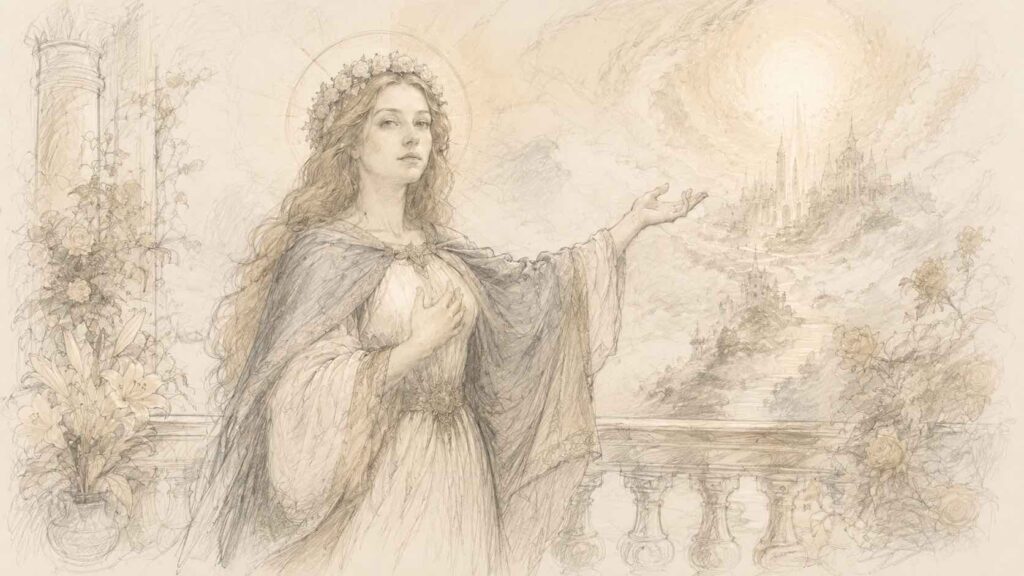
Beauty Is Not Enough
Beatrice is beautiful.
Yet to reduce her role to physical beauty would mean missing the centre of Dante’s poetic construction.
Her beauty matters because it is associated with virtue.
Gentleness.
Inner nobility.
The power to elevate.
This relationship between external form and interior quality distinguishes the Stilnovist woman from a merely decorative figure.
Beauty becomes the visible manifestation of something beyond itself.
The body is not erased.
But neither is it the final destination.
It becomes a threshold.
The Woman Who Transforms the Viewer
This may be one of the most profound innovations.
We usually imagine that the person looking possesses the power of the gaze.
The observer sees.
Judges.
Desires.
Within Stilnovist poetry something different happens.
The woman changes the one who looks at her.
Her presence has consequences.
The poet does not remain the same after the encounter.
Love becomes an experience of transformation rather than simple attraction.
Beatrice therefore acquires an active function: she is not merely contemplated, but exercises force upon Dante’s inner life.
Death and Transfiguration
The death of Beatrice marks a decisive moment.
Loss could have brought the love story to an end.
Within Dante’s poetic construction, however, the opposite occurs.
Death further transforms the figure.
Beatrice no longer belongs solely to earthly memory.
Her absence allows poetry to move her toward another level.
Individual grief opens into a spiritual dimension.
The beloved woman gradually becomes a figure capable of connecting earthly experience with transcendence.
The transformation is crucial.
It is precisely when physical presence disappears that symbolic presence reaches its greatest power.
From Memory to Vision
Poetry possesses a unique ability.
It can preserve what reality loses.
Dante transforms Beatrice into memory, but memory does not remain static.
It becomes vision.
She is no longer merely what has been.
She becomes something capable of pointing beyond itself.
This distinction is essential.
Memory preserves.
Vision directs.
Beatrice therefore moves from biography toward symbolic function.
This transformation prepares her later role in the Divine Comedy.
Beatrice in the Divine Comedy
When Beatrice returns in the Divine Comedy, her function has changed profoundly.
She is no longer simply the beloved woman of Dante’s youth.
She is a guide.
Virgil has accompanied Dante through Hell and Purgatory, embodying, among other things, the greatness of human reason.
But there comes a point when Virgil cannot continue.
The next stage requires another form of knowledge.
It is here that Beatrice appears.
The woman who once initiated an experience of love now becomes the guide toward a higher understanding.
It is one of the most extraordinary transformations in Dante’s work.
Personal love becomes a principle of knowledge.
A Guide, Not a Passive Presence
Beatrice in the Comedy is not fragile celestial decoration.
She speaks.
Explains.
Corrects.
Judges.
Questions.
Guides.
She possesses authority.
This aspect is fundamental.
The angelic woman should not be understood merely as passive idealisation.
Within Dante’s poem, Beatrice exercises decisive intellectual and spiritual agency.
Through her, Dante comes to understand elements of the moral and metaphysical structure of Paradise.
Woman therefore becomes a figure of knowledge.
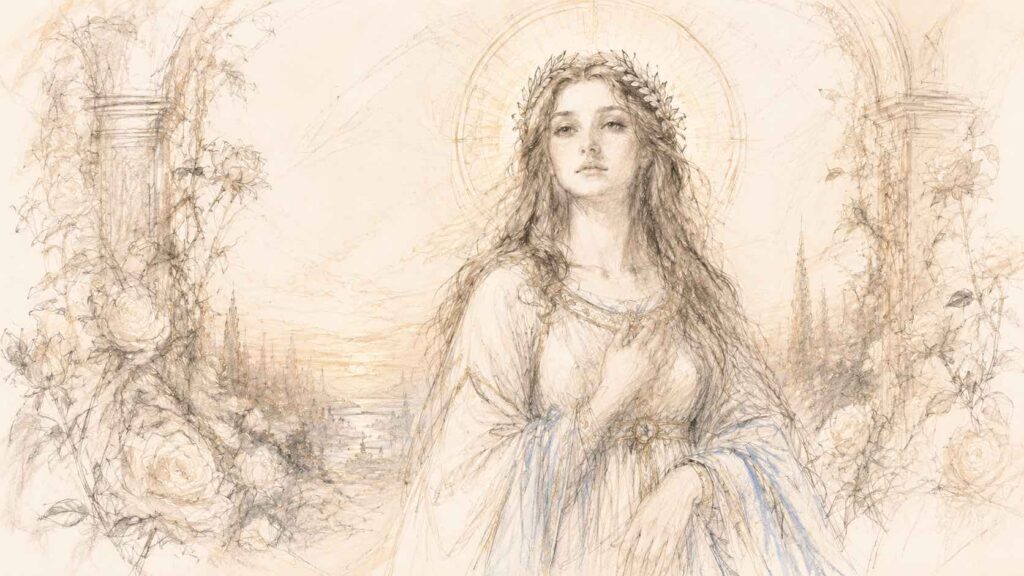
Earthly Love and Spiritual Knowledge
It would be too simple, however, to oppose earthly and spiritual love completely.
Dante’s journey is more complex.
The original experience of love is not erased.
It is transformed.
Personal history remains the root.
But something broader grows from that root.
Feeling becomes an opportunity for knowledge.
The real woman becomes symbolic figure.
Love becomes path.
It is precisely this ability to transform individual experience into universal meaning that allows Beatrice to transcend Dante’s biography.
Beatrice Is More Than the “Perfect Woman”
Across the centuries, Beatrice has often been reduced to an ideal image of female perfection.
Such a reading risks diminishing her.
Her importance does not lie primarily in perfection.
It lies in function.
Beatrice changes the meaning of female presence within Dante’s poetic journey.
From object of love she becomes sign.
From memory, guide.
From individual figure, principle.
It is this movement that makes her culturally extraordinary.
When a Face Becomes a Symbol
Painting understands this process particularly well.
An artist may begin with a real face.
A model.
A specific person.
Yet once that face enters the artwork, it may change.
Portrait may become queen.
Saint.
Sibyl.
Muse.
Mother.
Visionary.
The face retains individual characteristics while acquiring broader meaning.
This passage from individual to archetype makes the relationship between Beatrice and figurative art especially fertile even today.
Beatrice in Visual Culture
Across the centuries, Dante and Beatrice have generated a vast visual imagination.
The nineteenth-century rediscovery of Dante was particularly significant.
Artists associated with the Pre-Raphaelite environment found in medieval Italian culture, poetry and Dante a world remarkably close to their own concerns.
It is easy to understand why.
Poetry and painting.
Love and death.
Woman and symbol.
Beauty and spirituality.
Memory and vision.
These elements allowed artists to construct female figures that could be simultaneously human beings and apparitions.
Dante Gabriel Rossetti and Beatrice
The case of Dante Gabriel Rossetti is especially important.
His profound relationship with Dante and medieval Italian culture contributed to an artistic universe in which the female figure could acquire powerful symbolic meaning.
In works associated with Beatrice, the woman is not treated merely as literary illustration.
She becomes suspended presence.
Memory.
Love.
Death.
Transfiguration.
The encounter between medieval poetry and nineteenth-century sensibility demonstrates how Dante’s model could continue generating new visual languages centuries later.
From Dante’s Beatrice to the Donna Angelo
This opens an important connection with Neo-Stilnovism.
The Neo-Stilnovist Donna Angelo is not Beatrice.
Nor should she be understood as a contemporary reproduction of Dante’s figure.
Yet she inherits a fundamental question from the Stilnovist tradition:
Can the female figure become the vehicle of something that exceeds her individual identity?
Neo-Stilnovism expands the archetype.
Woman may become guide, but also mother.
Queen.
Warrior.
Sibyl.
Visionary.
Dark figure.
The possibility of elevation remains, but it enters a more complex contemporary understanding of femininity.
From Idealisation to Complexity
This transformation is necessary.
A twenty-first-century woman cannot simply be reduced to a medieval model.
Contemporary experience brings other dimensions.
Autonomy.
Conflict.
Body.
Identity.
Fragility.
Power.
Trauma.
Desire.
Contradiction.
The contemporary Donna Angelo may therefore contain both light and shadow.
She does not lose the possibility of elevation.
But elevation no longer requires the elimination of contradiction.
It may arise from passing through it.
Woman as a Possibility of Knowledge
Perhaps this is the most important part of Beatrice’s legacy.
Woman is no longer confined to the role of beloved object.
She becomes a possibility of knowledge.
Through her, the poet understands something about himself.
Love.
Limits.
Loss.
Transcendence.
The world.
This principle remains extraordinarily powerful.
Within contemporary figurative art, representing a woman may mean far more than producing an aesthetically beautiful image.
It may become an investigation into identity, memory, spirituality, desire and consciousness.
Why Beatrice Still Speaks to the Present
We live in an age in which the human face is reproduced continuously.
Photography.
Social media.
Advertising.
Video.
Artificial intelligence.
Millions of faces cross screens every day.
For this very reason, the question implicitly raised by Beatrice becomes surprisingly contemporary:
When does a face stop being merely an image and become meaning?
Quantity does not guarantee depth.
Beauty does not guarantee memory.
Visibility does not guarantee presence.
Transformation is required.
The same transformation that allowed a woman associated with medieval Florence to cross more than seven centuries of culture.
From Person to Memory, From Memory to Symbol
Beatrice’s journey may be understood through three stages.
Person.
Memory.
Symbol.
First comes the encounter.
Then absence.
Finally poetic transfiguration.
Yet the symbol never completely erases the person.
It is precisely because a human experience exists at the origin that the figure retains its force.
Great art often works in the same way.
It begins with something concrete.
A body.
A face.
Pain.
An encounter.
Then it transforms it.
Elevation
In contemporary language, the word “elevation” may sound distant.
Yet the concept remains deeply relevant.
To elevate does not necessarily mean abandoning reality.
It may mean looking at reality from a wider perspective.
Transforming desire into awareness.
Loss into memory.
Beauty into knowledge.
The face into symbol.
This is precisely what makes Beatrice one of the decisive figures of Dante’s culture.
Not because she represents an impossibly perfect woman.
But because through her Dante shows that a human presence can become a path toward something greater.
Beatrice remains in history not because Dante describes a perfect woman, but because through her the female figure becomes a possibility of knowledge.

Other Articles

Sculptural Projection: Creating What Already Exists Within
The Sacred in Neo-Stilnovism: Beyond Religion, Toward Presence