

Not a Muse, but a Threshold
Throughout artistic tradition, the model has often been described as a muse.
The one who inspires.
The one who poses.
The one who offers a face, a body or a posture to be transformed into an image.
Within Neo-Stilnovism, this relationship may become deeper.
The model is not necessarily the character.
Nor is she merely a visual reference from which proportions and forms are taken.
She may become a portal of creation.
A real presence capable of activating within the artist something that seems already to exist, yet has not previously found a face.
A queen.
A sibyl.
A warrior.
A Donna Angelo.
A dark figure.
A mother.
A being belonging to a story never told.
The person appears.
The artist looks.
And suddenly something happens.
The desire is not to copy her.
It is to recognise her in another form.
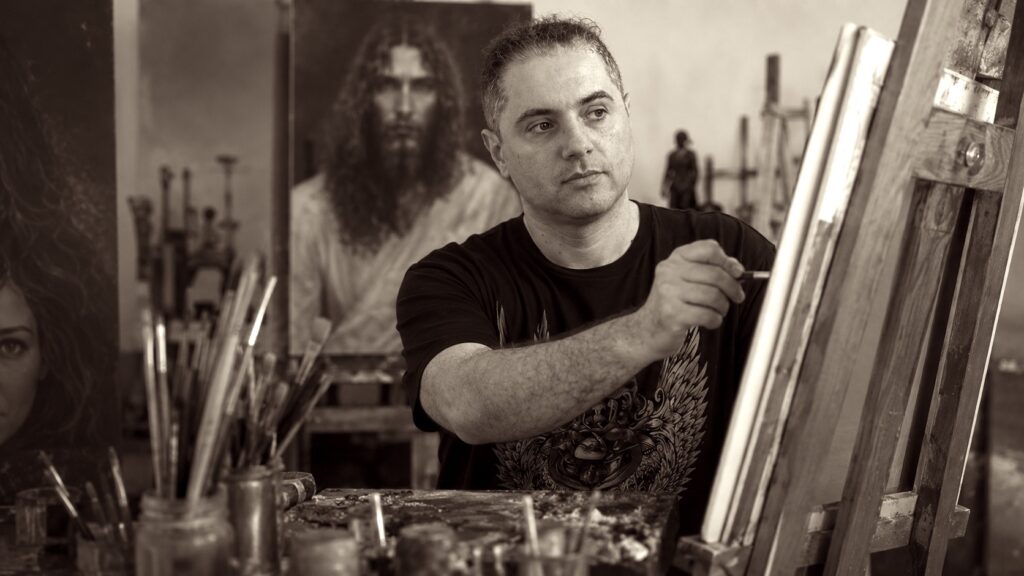
The Moment of Recognition
Some faces provoke nothing.
Others seem to open a door.
It may be a gaze.
The line of a nose.
A posture.
The way the head is held.
An almost imperceptible melancholy.
A strength visible only for a few seconds.
The artist perceives something that does not seem to belong solely to the person standing before him.
It is as though that face contains the possibility of another being.
The creative process may begin precisely at that moment.
The model does not say:
“Paint me.”
Her presence seems instead to suggest:
“Through me, you may see someone else.”
Like Remembering Something Never Lived
At times this sensation acquires a quality difficult to explain rationally.
It resembles déjà vu.
Recognising someone never previously encountered.
Remembering a character who never existed.
As though the real face had reactivated an impossible memory.
Within the poetic language of creation, it may almost resemble the memory of another life, as though the person before the artist temporarily carries the features of a figure already known in a place beyond ordinary memory.
This experience need not be interpreted literally.
Artistically, what matters is its intensity.
The artist experiences recognition before explanation.
And from that recognition the character may emerge.
The Model Is Not Copied
This principle radically distinguishes the Model-as-Portal from ordinary work from life.
The academic model provides information.
Anatomy.
Proportion.
Light.
Skin.
Structure.
The Model-as-Portal may provide these things as well, but the process does not end there.
The artist takes what is visible and passes through it.
A contemporary face may become the face of a queen belonging to no historical period.
An ordinarily dressed woman may become a priestess.
A severe gaze may generate a warrior.
A fragile expression may give birth to a maternal figure.
When the work is complete, the model may simultaneously recognise and fail to recognise herself.
That is precisely the point.
Portrait preserves the individual. Archetype exceeds her.
Emotion as Detonator
The true passage occurs through emotion.
A beautiful face is not enough.
Interesting proportions are not enough.
Something must happen.
The artist may perceive sadness.
Authority.
Tenderness.
Mystery.
Danger.
Sacredness.
Solitude.
Strength.
That sensation becomes the first material of the artwork.
Before colour.
Before drawing.
Before canvas.
The model therefore assumes a particular function: she activates the emotion through which the character begins to exist.
For this reason, reducing her role to mere “inspiration” is insufficient.
Inspiration may suggest an idea.
The Model-as-Portal may trigger an inner birth.
Inspiration Comes From Within
Here an apparent paradox emerges.
The model inspires the artwork.
Yet inspiration does not truly originate within her.
It comes from the artist.
The external presence activates something that was already inwardly possible.
She is like a key.
The key does not contain the room.
It opens it.
The model does not necessarily contain the character that will emerge.
She may instead open the mental space in which that character becomes visible.
Two artists before the same person could therefore create entirely different archetypes.
Because what is awakened depends upon the inner world of the person looking.

From Face to Story
Once the character has been activated, the process continues.
The artist begins to construct a story.
Not necessarily a written narrative.
It may simply be sensed.
Has this woman suffered a loss?
Is she a queen?
Does she protect someone?
Has she fought?
Is she waiting?
Has she undergone transformation?
Does she belong to light or shadow?
These questions gradually alter the image.
The pose changes.
The light changes.
A garment appears.
A crown.
Armour.
A veil.
A symbol.
The background begins to suggest a place.
At this stage, the painting is no longer primarily about the model.
It concerns the being born through her.
From Individual to Archetype
An archetype is not merely a generic character.
It is a figure capable of containing something broader than the individual.
Mother.
Warrior.
Queen.
Sibyl.
Donna Angelo.
Dark figure.
These structures can speak to very different human experiences.
The individual possesses a name.
A biography.
A specific life.
The archetype may belong to many.
This passage is fundamental within Neo-Stilnovist painting.
The artwork begins with the particular.
But attempts to reach the universal.
The Donna Angelo
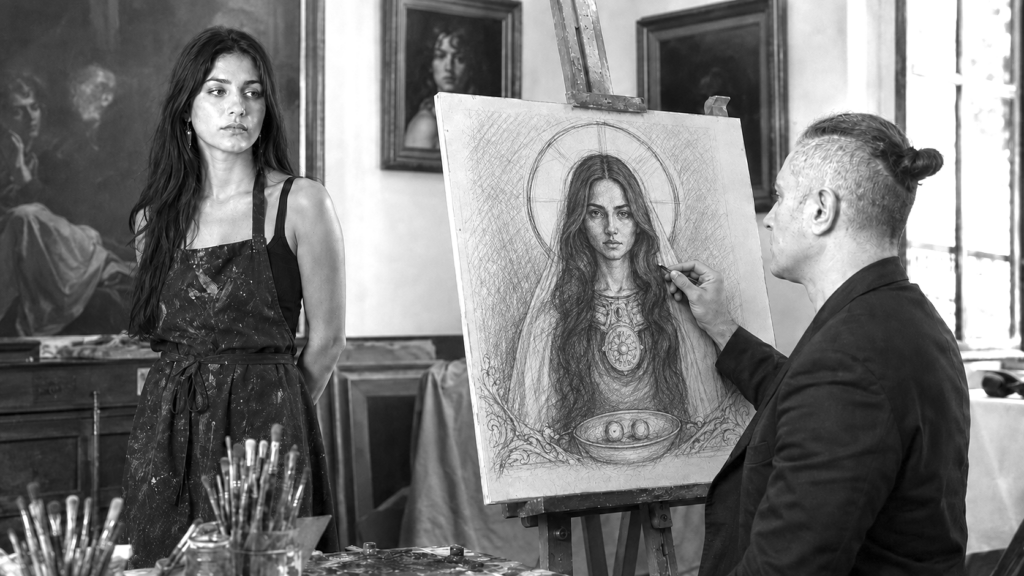
The Donna Angelo provides one of the clearest examples of this process.
The model may possess a real face.
But the Donna Angelo does not coincide with that person.
The artist may perceive within her a particular combination of strength, vulnerability, distance, sensuality, spirituality or pain.
From this perception a new figure emerges.
The model provides the initial presence.
The artist constructs the archetype.
Emotion generates its soul.
Technique allows it to become visible.
From this perspective, the Donna Angelo is not simply “found” ready-made within reality.
She is recognised as a possibility and then created.
The Relationship With Sculptural Projection
The Model-as-Portal connects directly with Sculptural Projection.
Once the character is recognised, the artist must begin to see it inwardly.
Not merely the face.
The entire presence.
How does she move?
How does she hold her body?
What is the weight of her clothing?
How does light fall upon her?
What kind of space does she occupy?
The model opens the portal.
Sculptural projection constructs what exists beyond the threshold.
The figure begins to inhabit mental space before appearing on the canvas.
Transformation, Not Costume
There is an important distinction between transformation and costume.
Simply placing a crown on a model does not create a queen.
Adding armour does not create a warrior.
Adding a halo does not create a sacred figure.
The archetype must exist before the accessory.
Symbol works only when it completes something the artist has already perceived inwardly.
Authentic transformation therefore occurs first through emotion and only afterwards through form.
Clothing is consequence.
Presence comes first.
Technique Comes Afterwards
Technique remains essential, but subordinate.
Anatomy.
Drawing.
Colour.
Chiaroscuro.
Perspective.
Materials.
All serve to make the character believable.
But none can invent its soul.
The artist must first understand what is being born.
Technique then arrives as an instrument of incarnation.
The same principle applies to Sculptural Projection:
imagination generates, emotion animates, technique materialises.
The Model May Surprise the Artist
The process cannot always be planned.
A model may be chosen for one character and generate another entirely.
The artist may imagine a luminous figure and suddenly perceive darkness.
He may prepare for a warrior and discover a vulnerability that leads instead towards motherhood.
This unpredictability is important because it prevents the method from becoming formula.
The relationship between artist and model must preserve possibility.
Listening.
Accident.
Discovery.
Authentic creation does not always confirm the original idea.
Sometimes it betrays it in order to lead elsewhere.

When the Character Surpasses the Model
Eventually the character must become autonomous.
The artist no longer needs to ask:
“Does this resemble the model?”
The question changes.
“Is it alive?”
Does it possess presence?
Can it enter into dialogue?
Does it communicate the emotion from which it was born?
When this happens, transformation is complete.
The real person was the point of entry.
The artwork now belongs to another territory.
Giving the Artwork a Soul
Here the fundamental idea of the artwork’s soul returns.
The model may unknowingly provide the initial emotion.
The artist receives it.
Transforms it through his own inner world.
Then returns it to the canvas.
It is almost an exchange.
The person appears before the artist.
Her presence produces an emotional vibration.
That vibration becomes character.
The character becomes painting.
And the painting is eventually given to the viewer.
The artwork becomes the final point in a chain of presences.
From Dialogue With the Model to Dialogue With the Viewer
At the beginning there is the silent dialogue between artist and model.
At the end another dialogue begins.
Between artwork and viewer.
The viewer does not know the model.
May not know the history of the creative process.
May not even know the original emotion behind the work.
Yet something may still be perceived.
This is the moment in which the soul of the artwork demonstrates its autonomy.
The original emotion is not simply transferred.
It is transformed once again by the viewer.
A face born from one person may therefore pass through many others.
This is where the archetype fulfils its function.
The Model as Portal
The model, then, is not merely a body to observe.
She may become encounter.
Threshold.
Revelation.
Possibility.
Her presence allows the artist to recognise something belonging to his own imagination.
She is not necessarily the queen, sibyl, warrior or Donna Angelo.
But for an instant, she may appear to be.
Long enough for the artist to see her.
And from that moment, the character may begin to live independently.
The model lends the face. The artist recognises the character. Emotion gives it a soul.


Other Articles
Sculptural Projection: Creating What Already Exists Within