
When Painting Stops Relying Exclusively on the Eyes
Every painter develops a relationship with the image through a balance between control and intuition.
Drawing, proportion, anatomy, light, composition and colour require discipline. Yet there comes a point in the creative process when absolute control may become a limitation.
It is from this tension that the Velatio Method emerges within the research of Carmelo Fabio D’Antoni and the technical grammar of Neo-Stilnovism.
Its principle is radical in its simplicity: temporarily reducing the dominance of sight in order to allow the hand, memory and inner perception to participate more directly in the act of painting.
It does not mean painting randomly.
It does not mean abandoning technique.
It means testing technique.
Seeing Is Not Only Looking
Western painting developed for centuries through the discipline of observation.
The painter looks.
Measures.
Compares.
Corrects.
But the eye is not the only instrument through which an artist understands form.
There is also memory.
The memory of a face observed hundreds of times.
The curve of a shoulder.
The distance between two eyes.
The weight of a head.
The movement of the hand.
An artist working over many years accumulates an enormous amount of visual and motor information within the body.
The Velatio Method attempts to access precisely this memory.
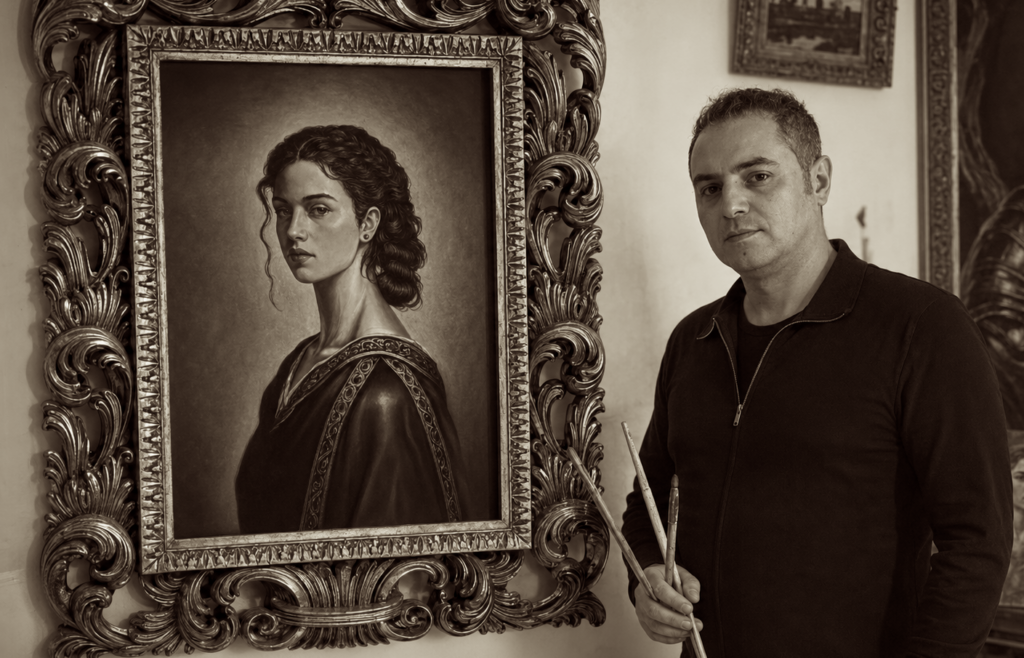
The Suspension of Control
The central principle of Velatio is controlled suspension.
The artist temporarily limits constant visual verification of the image.
At certain moments, direct vision may be reduced, the eyes partially closed, or brief phases of the work may depend more heavily on an inward perception of gesture.
The objective is not to produce error.
It is to interrupt the mechanism through which the eye continuously corrects the hand.
For a few moments, gesture is allowed to exist before judgement.
The hand acts.
The mind anticipates.
The eye arrives afterwards.
The Body as Archive
Every painterly gesture contains memory.
The distance travelled by the brush.
Pressure against the surface.
The angle of the wrist.
Speed.
Quantity of pigment.
Movement of the fingers.
Over time, these elements become embodied knowledge.
The painter no longer needs to calculate every action consciously.
Many gestures are recognised by the body before they are analysed by reason.
Within the Velatio Method, this bodily memory becomes central.
The hand temporarily becomes an archive.
The Risk of Excessive Control
Control is essential.
But excessive control may create rigidity.
A face may be technically correct yet lifeless.
A figure may be perfectly constructed and still lack presence.
The artist may become so focused on precision that the image loses emotional necessity.
The Velatio Method introduces a small fracture into the process.
A space in which perfection is not immediately demanded.
And it is often there that something unexpected may emerge.
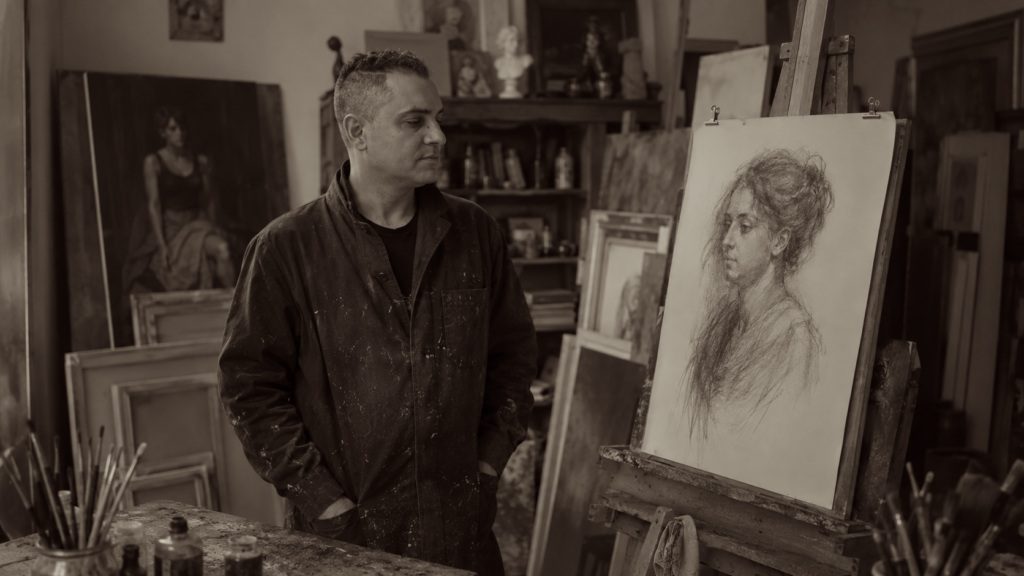
Chance and Awareness
Velatio should not be confused with pure automatism.
The artist does not abandon the process to chance.
The hand carries years of experience.
Drawing.
Anatomy.
Composition.
Volume.
Material.
Visual suspension works precisely because a technical structure already exists.
Without discipline, gesture may become random.
With discipline, it may become intuitive.
That distinction is fundamental.
Mental Drawing
Before a figure is painted, it may first be constructed in the mind.
This principle is central to Neo-Stilnovist research.
The artist imagines the form.
Rotates it mentally.
Observes it from different viewpoints.
Perceives its volume.
The painting therefore begins before the canvas.
It begins within a mental space.
The Velatio Method intensifies this process.
When visual control is temporarily reduced, the inner image must become stronger.
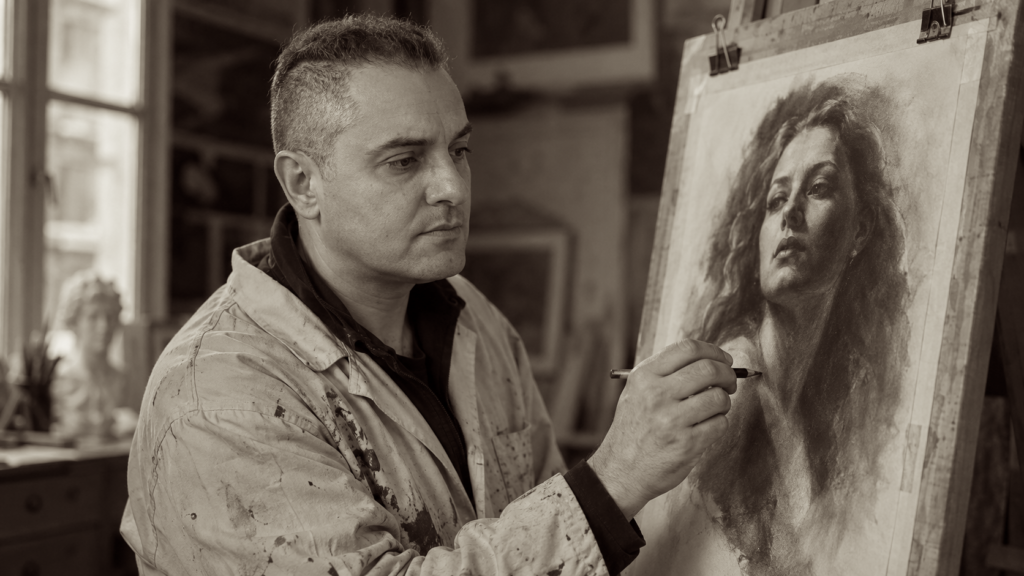
Sculptural Projection
The concept of sculptural projection is closely connected to Velatio.
The figure is not conceived merely as outline.
It is understood as mass.
Volume.
A body existing in space.
The face must possess depth.
The head must possess weight.
The neck must support.
The hands must occupy a believable imaginary space.
When visual verification is suspended, this three-dimensional mental construction becomes even more important.
The hand follows what the mind has already modelled.
The Face
The face represents one of the most complex territories for Velatio.
Small variations can completely alter expression.
An eyebrow.
The curve of an eyelid.
The angle of the mouth.
The shadow beneath a cheekbone.
For this reason, the method does not necessarily govern the entire construction.
It may intervene at specific moments.
A line.
A glaze.
A passage of shadow.
A seemingly minor gesture.
The result may introduce tension into a face that total control would not have produced.
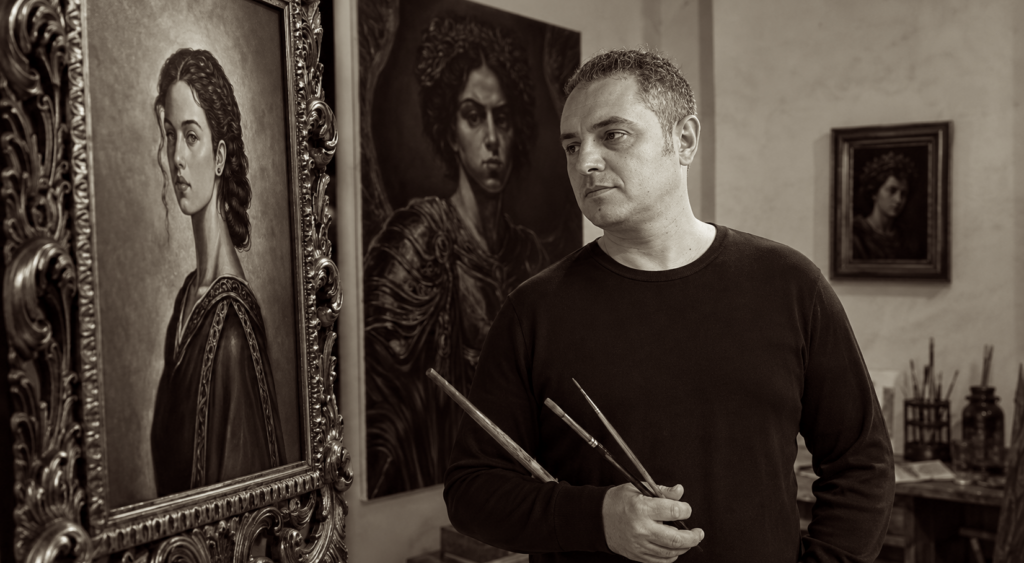
The Eyes
Within Neo-Stilnovism, the gaze occupies a central position.
The eyes are often conceived as a threshold.
Between viewer and figure.
Between surface and interiority.
For this reason they become one of the most delicate places in the relationship between control and intuition.
A painted eye must not merely be anatomically convincing.
It must contain presence.
Velatio may help interrupt the rigidity that sometimes emerges when a painter attempts to construct the gaze with excessive precision.
Error as Possibility
Within academic painting, error is normally corrected.
Within Velatio, error is first observed.
An unexpected line may suggest form.
A tonal transition may create an unforeseen depth.
An imprecision may generate tension.
This does not mean accepting every result.
It means not immediately erasing what was not planned.
The painter evaluates.
Decides.
Integrates.
Or removes.
Error therefore becomes a possibility rather than an obligation.
Between Consciousness and Instinct
The Velatio Method operates at a threshold.
On one side stands technical consciousness.
On the other, instinct.
Painting lives precisely within the tension between these two poles.
Too much rationality may suffocate gesture.
Too much instinct may destroy structure.
The method seeks equilibrium.
A moment in which the artist knows enough to allow himself not to control everything.
Not Painting the Photograph
Photography may be a useful tool.
But it can also become a cage.
When the artist depends completely on photographic reference, painting risks becoming a manual translation of something that already exists.
Velatio breaks this dependence.
The figure must continue to exist even when the reference is no longer being observed.
This forces the artist to understand what is being painted.
Not merely copy it.
The Memory of the Model
When a face is studied for a long time, its presence remains within memory.
Not as an exact photograph.
As structure.
Length of the nose.
Width of the forehead.
Relationship between eyes and mouth.
Inclination of the chin.
Energy of the gaze.
It is this synthetic memory that may emerge through Velatio.
Paradoxically, by temporarily moving away from the visible model, the painter may come closer to the perception he has formed of the subject.
Material and Gesture
The method does not concern drawing alone.
It may enter into the material construction of painting.
Glazes.
Passages of light.
Shadows.
Brushstrokes.
Overlapping layers.
Material possesses its own unpredictability.
Not everything can be controlled.
A glaze may react differently to the ground.
A pigment may produce unexpected depth.
Velatio accepts this dimension.
The artist guides the process without demanding complete domination.
An Inner Discipline
The most interesting aspect of the Velatio Method is not spectacular.
It is psychological.
The artist must learn to tolerate a temporary loss of control.
Trust accumulated experience.
Accept that the result may not be immediately perfect.
This requires a different form of discipline from academic discipline.
Not the discipline of control.
The discipline of trust.
Technique and Identity
A technique becomes truly important when it stops being a simple exercise.
It must contribute to the identity of the work.
Within Neo-Stilnovism, Velatio is not conceived as a public demonstration of skill.
It is an internal process.
One of the tools through which painting attempts to avoid the coldness of excessively calculated execution.
The finished work does not necessarily need to reveal where the method was used.
It needs to reveal its effects.
Vitality.
Tension.
Presence.
Velatio in the Age of Artificial Intelligence
The spread of artificial intelligence makes reflection on painterly gesture even more relevant.
A digital system can generate images within seconds.
It may simulate light.
Composition.
Style.
Material.
Physical painting, however, preserves something different.
It is the trace of a body.
Every brushstroke contains time.
Movement.
Uncertainty.
Decision.
Velatio intensifies precisely this dimension.
The possibility that part of an artwork may emerge through an immediate dialogue between body, memory and matter.
The Difference Between Image and Presence
Artificial intelligence can produce images.
Photography can record images.
Graphic design can construct images.
Painting may do all of these things, but it possesses another possibility.
To construct physical presence.
Pigment.
Layering.
Thickness.
Transparency.
Error.
Correction.
Time.
A painting preserves the history of its own making.
Velatio enters that history as a moment of controlled risk.
The Artist After Velatio
When the suspended phase ends, the painter looks again.
And here a second fundamental stage begins.
Evaluation.
Correction.
Integration.
Preservation.
The method does not end when the intuitive gesture is made.
It ends when the artist decides what to do with that gesture.
Control returns.
But it returns after something has happened.
An Open Method
The Velatio Method should not become a rigid formula.
If it became automatic procedure, it would lose its purpose.
Every artwork requires a different balance.
Some may demand greater control.
Others greater freedom.
The method must remain a tool.
Not a compulsory ritual.
Its strength lies precisely in its ability to intervene when painting risks becoming too predictable.
Beyond the Gaze
The final paradox of Velatio is simple.
In order to see more clearly, the painter may sometimes need to stop looking for a moment.
Not because the eye is unimportant.
But because an image is not born from the eye alone.
It emerges from memory.
The body.
Experience.
Imagination.
Material.
Error.
Control.
And the ability, at certain moments, to suspend it.
In Velatio, the artist does not stop seeing. He attempts to see before the eye decides what should appear.