

When the Female Face Becomes More Than a Portrait
Throughout Western art history, the female figure has been represented endlessly.
Mother.
Saint.
Queen.
Lover.
Muse.
Heroine.
Sinner.
Visionary.
Yet within the Pre-Raphaelite experience that emerged in Victorian Britain during the nineteenth century, woman acquired a particularly powerful role: she became not merely a subject to be represented, but an image of the mind, a symbol, an apparition and a vehicle of meaning.
This is one of the reasons why the Pre-Raphaelite world continues to exercise such fascination today.
Behind the beauty of its faces, elaborate fabrics, flowers, jewels and almost obsessive attention to detail lies a far deeper cultural proposition.
Woman becomes a place where poetry, desire, spirituality, death, nature and memory meet.
A Rebellion Against Academic Convention
The Pre-Raphaelite Brotherhood was founded in London in 1848.
Its very name contained a programme.
Its young artists sought an alternative to the academic painting of their age and looked with particular interest towards artistic cultures preceding the full establishment of Raphael and the conventions they believed had followed him.
Their attention turned towards medieval and Early Renaissance art.
Clear colour.
Detail.
Direct observation of nature.
Symbolism.
Literature.
Religion.
Most importantly, they developed a conception of painting in which virtually every element could carry meaning.
The picture was not merely a scene.
It was a system.
Painting and Poetry
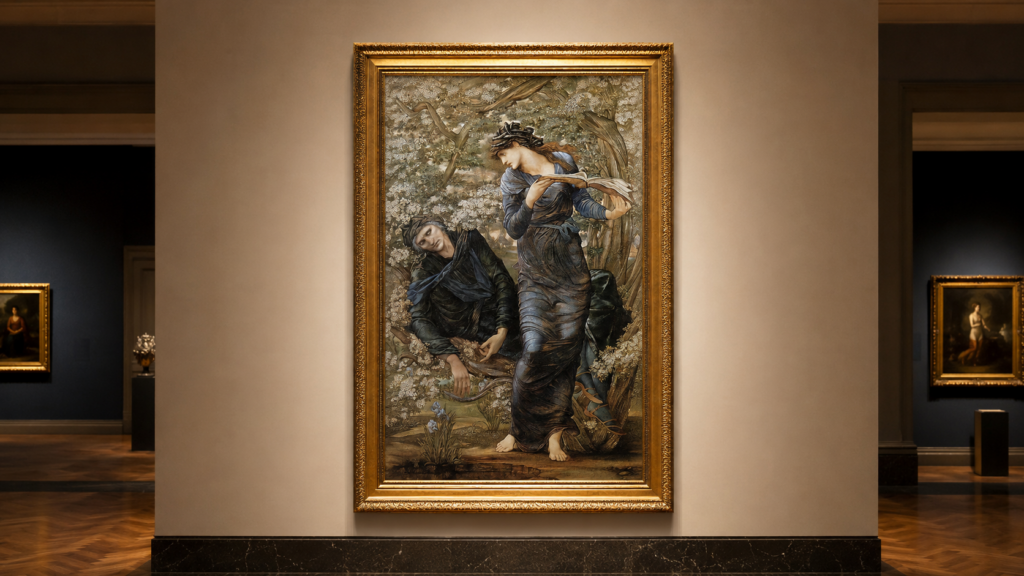
One of the fundamental characteristics of the Pre-Raphaelite universe is the relationship between visual art and literature.
Dante.
Shakespeare.
Tennyson.
Medieval legends.
Arthurian cycles.
Religious poetry.
Tragedy.
Love.
Death.
Painting repeatedly becomes the visual translation of the written word.
It is therefore unsurprising that so many female figures possess an almost literary character.
They are not simply painted women.
They are narrative figures.
They carry a story that begins before the image and seems capable of continuing beyond its surface.
Dante Gabriel Rossetti and the Female Image
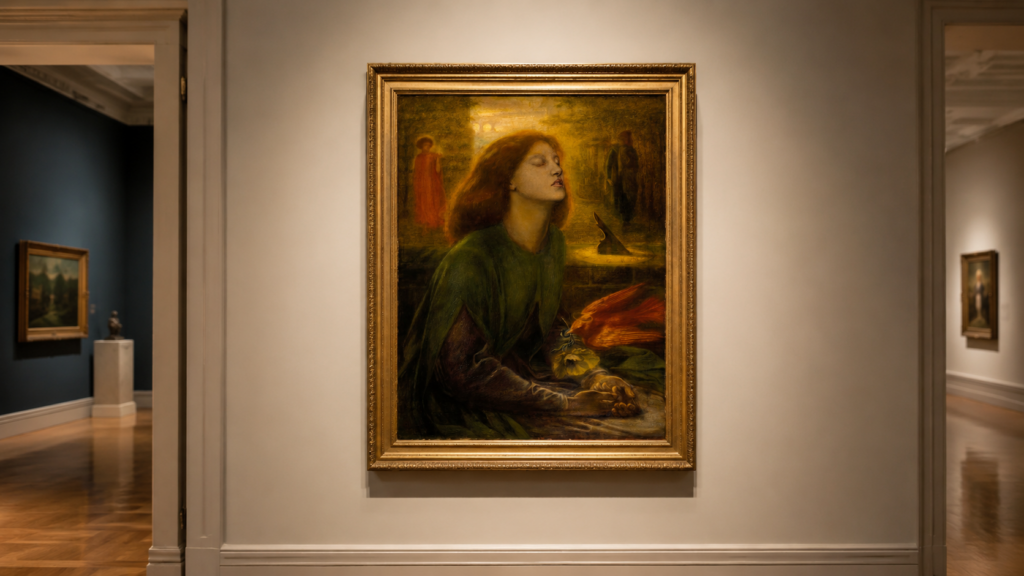
Among the movement’s central figures, Dante Gabriel Rossetti developed perhaps the most recognisable mythology of the female face.
His women are immediately distinctive.
Intense faces.
Abundant hair.
Pronounced lips.
Elongated necks.
Distant gazes.
A presence at once sensual and unreachable.
Rossetti does not merely paint the model.
He transforms her.
The real face becomes a poetic image.
The individual becomes an archetype.
This transformation lies at the heart of the Pre-Raphaelite imagination.
Elizabeth Siddal: Muse and Symbol
One of the best-known figures associated with the Pre-Raphaelites was Elizabeth Siddal.
Model, artist and poet, she became one of the emblematic faces of the movement.
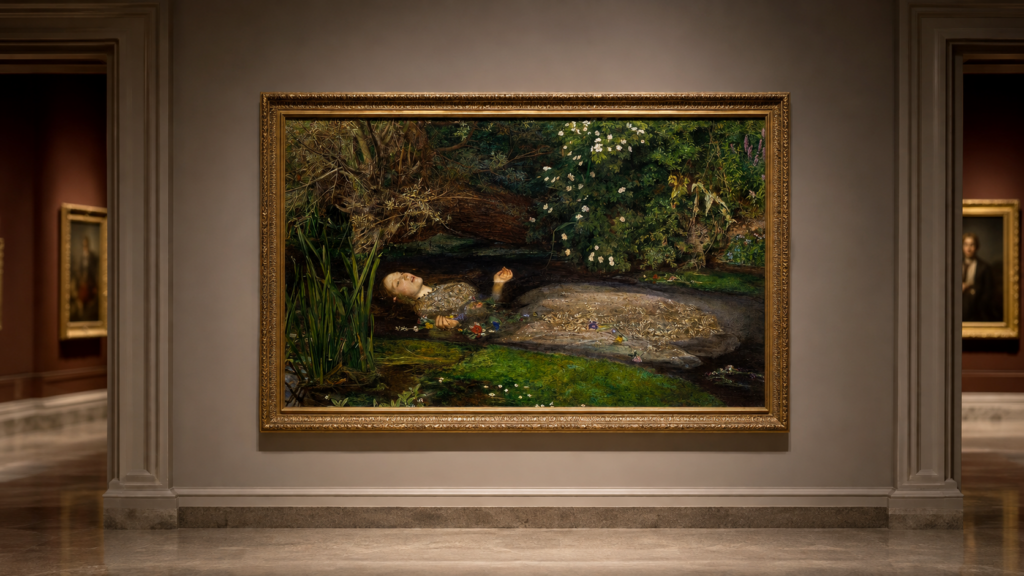
Her image remains inseparable from John Everett Millais’s Ophelia.
The figure floats upon the water.
Nature surrounds her.
Flowers acquire symbolic meaning.
Beauty and tragedy coexist.
It is precisely this relationship between beauty and death that gives the image its extraordinary force.
The woman is not simply represented at the threshold of death.
She becomes part of nature itself.
Almost a transformation.
Ophelia: Beauty and Dissolution
Ophelia provides one of the clearest examples of the Pre-Raphaelite ability to transform literature into symbolic image.
The body is immersed in water.
The hands remain open.
The gaze appears suspended.
Around her, vegetation is rendered with extraordinary precision.
Yet nothing is merely decorative.
Water becomes passage.
Flowers become language.
Nature participates in the fate of the figure.
Beauty does not eliminate tragedy.
It intensifies it.
This principle would later become central to Symbolist culture.
Between Sacredness and Eros
The Pre-Raphaelite world is crossed by a constant tension between sensuality and spirituality.
Woman may appear as an object of desire.
But also as an almost sacred presence.
Eros is not necessarily separated from the spiritual.
The two territories often overlap.
The female face may possess powerful sensuality while retaining an almost hieratic distance.
The body is present.
Yet something seems to extend beyond it.
This is one of the points at which the Pre-Raphaelite experience becomes strikingly modern.
The Medieval Woman
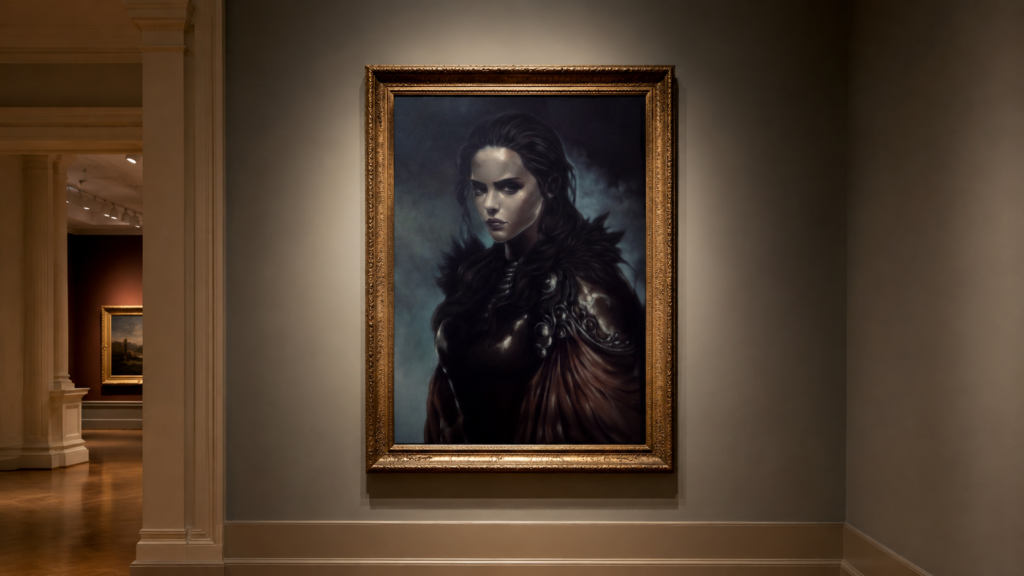
The Middle Ages offered the Pre-Raphaelites an immense symbolic vocabulary.
Queens.
Saints.
Ladies.
Princesses.
Arthurian figures.
Women drawn from legends and poetry.
This was not always rigorous historical reconstruction.
Their Middle Ages were above all a mental territory.
An imagined past in which beauty, myth and spirituality could still remain closely connected.
The medieval woman therefore becomes a figure outside ordinary time.
Woman as Threshold
Many Pre-Raphaelite women seem to exist between two worlds.
Between life and death.
Desire and renunciation.
Matter and spirit.
Nature and culture.
Past and present.
This liminal position is essential.
Woman does not merely represent something.
She allows passage towards something else.
She becomes a symbolic threshold.
The Face as Inner Landscape
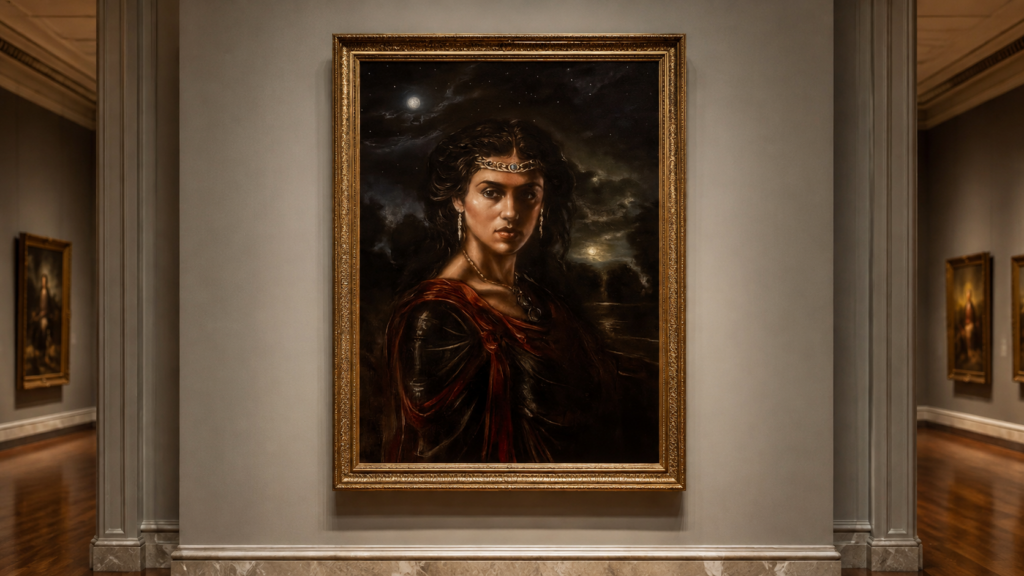
In Pre-Raphaelite portraiture and figure painting, the face frequently develops an extraordinary autonomy.
No spectacular action is required.
Sometimes a gaze is enough.
A mouth.
The inclination of a head.
The character appears to possess an inner world that is never entirely explained.
The viewer is required to imagine it.
This refusal to reveal everything gives the face its magnetic power.
Hair as Symbol
One recurring characteristic is the extraordinary attention paid to hair.
Long.
Wavy.
Loose.
Red.
Dark.
Golden.
Hair is not simply part of a hairstyle.
It becomes movement.
Material.
Sensuality.
Sometimes almost an aura.
In Rossetti’s paintings especially, it can occupy a significant part of the composition and contribute directly to the identity of the figure.
Flowers, Jewellery and Objects
Within the Pre-Raphaelite world, objects often possess a narrative role.
A flower.
A mirror.
A book.
A textile.
A jewel.
A fruit.
A window.
A lamp.
Each element may contribute to the symbolic interpretation of the work.
This principle is important because it demonstrates how figurative art can remain visually beautiful while carrying complex meaning.
The image seduces.
But beneath that seduction it constructs thought.
The Mirror
The mirror is one of the oldest symbols in Western culture.
It may suggest vanity.
Knowledge.
Identity.
Doubling.
Memory.
Illusion.
Within nineteenth-century and Symbolist culture it became particularly powerful because it allowed the figure to be multiplied and created distance between being and appearance.
Associated with the feminine figure, the mirror inevitably opens questions about identity.
Who is truly being represented?
The person?
Her image?
Or the desire of the observer?
Nature
Pre-Raphaelite nature is remarkably concrete.
Leaves.
Flowers.
Water.
Branches.
Grass.
Stone.
Each element is closely observed.
Yet this precision does not weaken symbolism.
It strengthens it.
The more real nature appears, the more powerful its symbolic function can become.
The principle is important:
realism and symbolism are not necessarily opposites.
Something may be represented with extraordinary truth while simultaneously pointing beyond itself.
Burne-Jones and the Dream
With Edward Burne-Jones, associated with the later development of the Pre-Raphaelite aesthetic, the image becomes even more suspended.
Figures appear to inhabit frozen time.
Elongated bodies.
Melancholic faces.
Unreal spaces.
Mythology.
Legend.
Dream.
Woman frequently appears as a distant presence.
She does not fully belong to our world.
This represents one of the most important developments of the idea of woman as apparition.
The Femme Fatale
During the later nineteenth century another female archetype gradually emerged.
Dangerous woman.
Seductress.
Magical figure.
Unreachable presence.
Fatally attractive.
European Symbolism would develop this archetype enormously.
Yet some of its foundations can already be identified within the Pre-Raphaelite imagination.
Woman therefore ceases to correspond to a single model.
She may be saint and temptress.
Muse and threat.
Mother and sorceress.
Light and darkness.
A Complex Femininity
It is precisely this plurality that makes the theme relevant today.
The symbolic woman should not be reduced to an idealised feminine image.
Her strength comes from complexity.
She can contain contradiction.
Fragile and powerful.
Sensual and spiritual.
Maternal and warrior-like.
Luminous and dark.
In this respect, the Pre-Raphaelite inheritance extends far beyond style.
It becomes a way of conceiving the figure itself.
From the Pre-Raphaelites to Symbolism
The Pre-Raphaelite legacy deeply influenced European visual culture.
The symbolic figure.
The mysterious woman.
Meaningful nature.
The relationship between painting and poetry.
Dreamlike atmosphere.
The return to myth.
All of these elements would find new developments within Symbolism.
The female figure gradually became one of the principal territories through which European art explored desire, fear, spirituality and the unconscious.
The Relationship With the Dolce Stil Novo
A particularly interesting affinity exists between certain Pre-Raphaelite sensibilities and medieval Italian poetic culture.
Dante Gabriel Rossetti possessed a profound knowledge of Dante and Italian poetry.
The idea of woman as a figure capable of exceeding her individual identity therefore found fertile ground in the relationship between medieval Italian culture and Victorian imagination.
The Stilnovist Donna Angelo and the Pre-Raphaelite symbolic woman are not identical.
Yet they share one essential possibility:
woman may become more than her physical presence.
She may become a sign.
From the Donna Angelo to the Symbolic Woman
Within the Dolce Stil Novo, woman may become a mediator of elevation.
Within the Pre-Raphaelite world she frequently becomes a mediator of vision.
The shift is significant.
The image may lead not only towards morality or spirituality.
It may also introduce mystery, memory, death, desire and dream.
The symbolic woman thus becomes more ambiguous.
And precisely because of this, profoundly modern.
The Contemporary Relevance of the Pre-Raphaelites
Why does this experience continue to matter?
Because it demonstrates that figurative painting can simultaneously be:
beautiful;
technically complex;
narrative;
symbolic;
literary;
psychological;
spiritual.
There is no necessity to choose between beauty and concept.
Technique and idea.
Figure and complexity.
The Pre-Raphaelites demonstrated that these elements may coexist.
From Tradition to Neo-Stilnovism
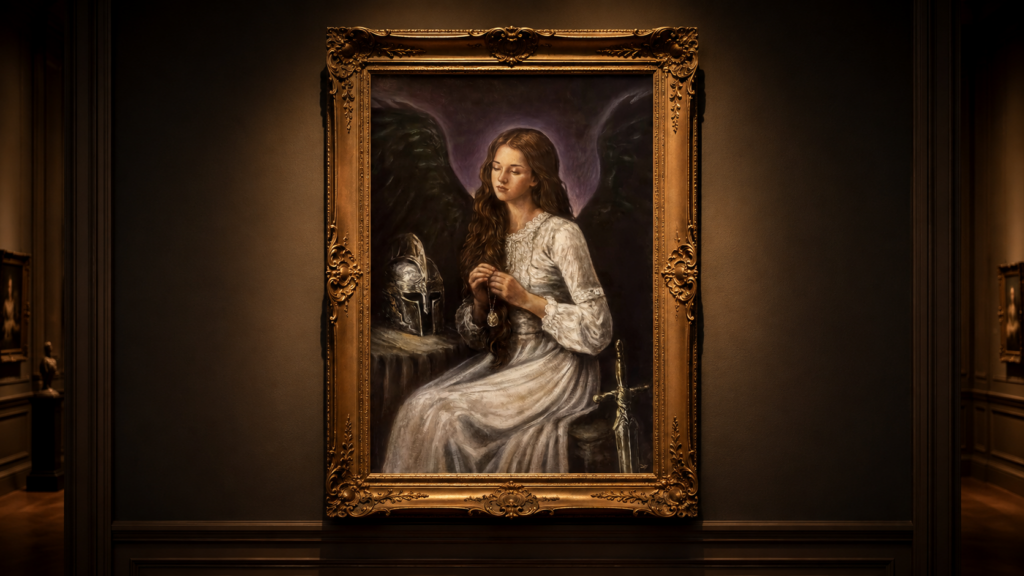
Within Neo-Stilnovism, the relationship with the Pre-Raphaelite inheritance should not be understood as stylistic imitation.
What matters is the principle.
The human figure as a bearer of meaning.
Woman as archetype.
The face as psychological space.
Light as language.
Nature and objects as symbols.
Beauty as a means of holding the viewer before a deeper content.
It is here that a nineteenth-century experience can enter into dialogue with contemporary research.
The Neo-Stilnovist Donna Angelo
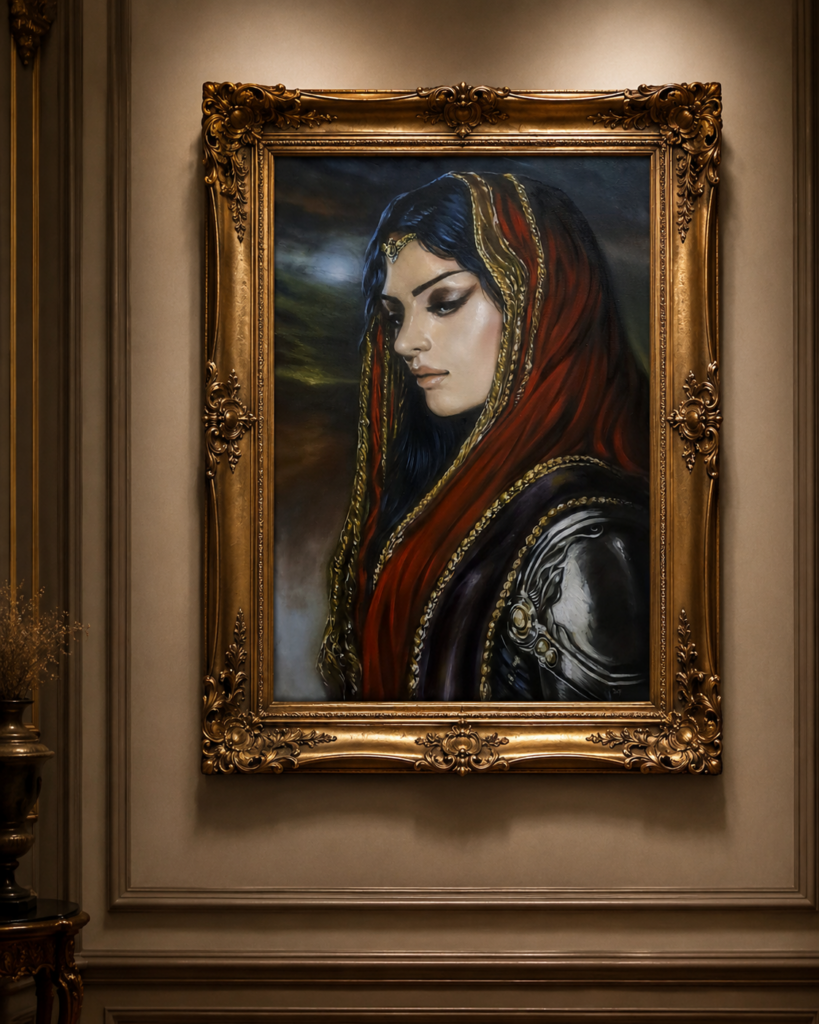
Within Neo-Stilnovism, the Donna Angelo may absorb many possibilities developed throughout history.
The spiritual woman of the Stilnovist poets.
The symbolic woman of the Pre-Raphaelites.
The mysterious woman of Symbolism.
The sacred figure.
The mother.
The warrior.
The queen.
The sibyl.
The visionary.
The dark figure.
These components need not remain separate.
They may become different faces of the same archetype.
Not Copying the Past
The relationship with the Pre-Raphaelites becomes meaningful only when the temptation to copy them is overcome.
Reproducing nineteenth-century painting today would not necessarily continue their intellectual project.
Their true legacy lies in understanding what they actually did.
They took culture, poetry, history and symbols from the past and transformed them into a language capable of speaking to their own age.
That is the genuinely contemporary principle.
Tradition must not be preserved immobile.
It must be transformed.
Beauty as Knowledge
Perhaps one of the most important lessons of the Pre-Raphaelites concerns beauty itself.
Beauty is not necessarily superficial.
It may become a means of leading the viewer into the image.
First it attracts.
Then it holds.
Finally it questions.
The female face can therefore become an entrance into much deeper concerns.
Love.
Death.
Time.
Memory.
Identity.
Spirituality.
Desire.
From Beauty to Vision
The Pre-Raphaelite symbolic woman continues to live because she never entirely coincides with the person we see.
Behind the face there is always something else.
A story.
A poem.
A myth.
A loss.
A desire.
A prophecy.
A memory.
It is precisely this “beyond” that transforms portraiture into vision.
And perhaps here lies one of the most fertile bridges between the Pre-Raphaelite world and contemporary figurative research:
Beauty becomes truly powerful when it does not merely represent what we can see, but suggests what we have not yet understood.

Other Articles
The Sacred in Neo-Stilnovism: Beyond Religion, Toward Presence
The Velatio Method: Painting Beyond Visual Control