
When an Image Becomes More Than What It Represents
The sacred is one of the most difficult concepts to use in contemporary art.
For many, it immediately coincides with religion.
Worship.
Christian iconography.
Liturgy.
Yet throughout art history, the sacred has often extended beyond specifically religious subjects.
A face.
A mother.
A figure immersed in silence.
Light.
Death.
Gesture.
Presence.
All may generate an experience of the sacred without belonging to a single confession.
Within Neo-Stilnovism, this distinction becomes essential.
The sacred is not understood merely as subject matter.
It is understood as a quality of the image.
It does not depend exclusively on what the painting represents.
It depends on what the image is capable of producing within the viewer.
Silence.
Suspension.
Tension.
Contemplation.
Presence.
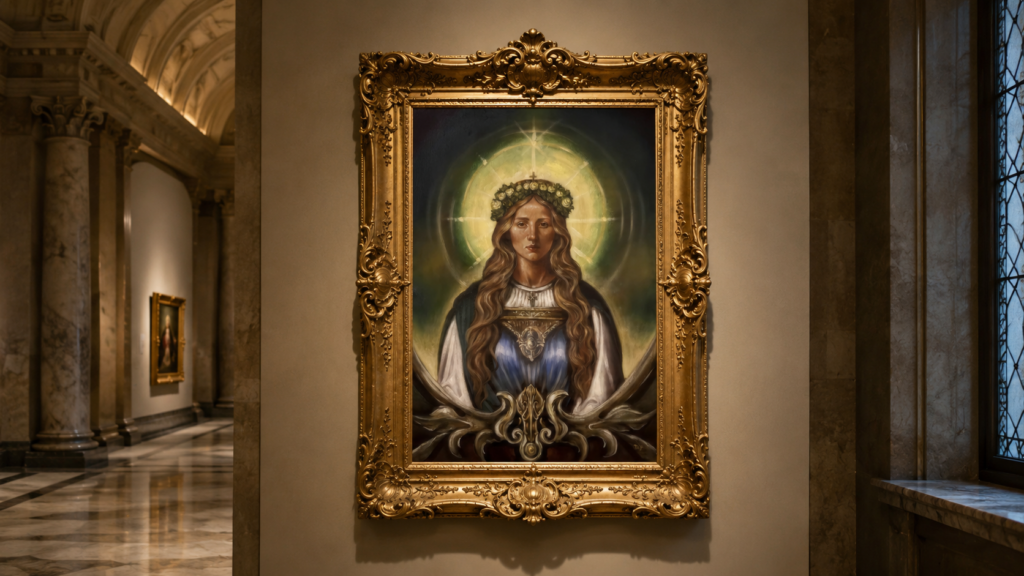
Religious and Sacred Are Not the Same
An artwork may be religious without necessarily being experienced as sacred.
And the reverse is also possible.
A painting of the Madonna clearly belongs to religious iconography.
Yet a sense of sacredness emerges only when the image moves beyond the description of its subject.
The figure must acquire weight.
Silence.
Authority.
Mystery.
Likewise, a woman representing no saint at all may assume a sacred force.
A mother.
A queen.
A sibyl.
A warrior.
A wounded figure.
A woman emerging from darkness.
The sacred appears when the image asks something of the viewer beyond simple recognition.
Presence
The central concept is presence.
An artwork possesses presence when it seems to occupy a space extending beyond its physical surface.
The figure does not merely appear painted.
It seems to be there.
To exist.
To breathe within the painting.
This effect may arise from many elements.
Scale.
Light.
Composition.
Gaze.
Silence.
Material.
Frontality.
Gesture.
Above all, it emerges from the artist’s capacity to construct a relationship between figure and viewer.
When this relationship becomes intense, the image may acquire a sacred dimension.
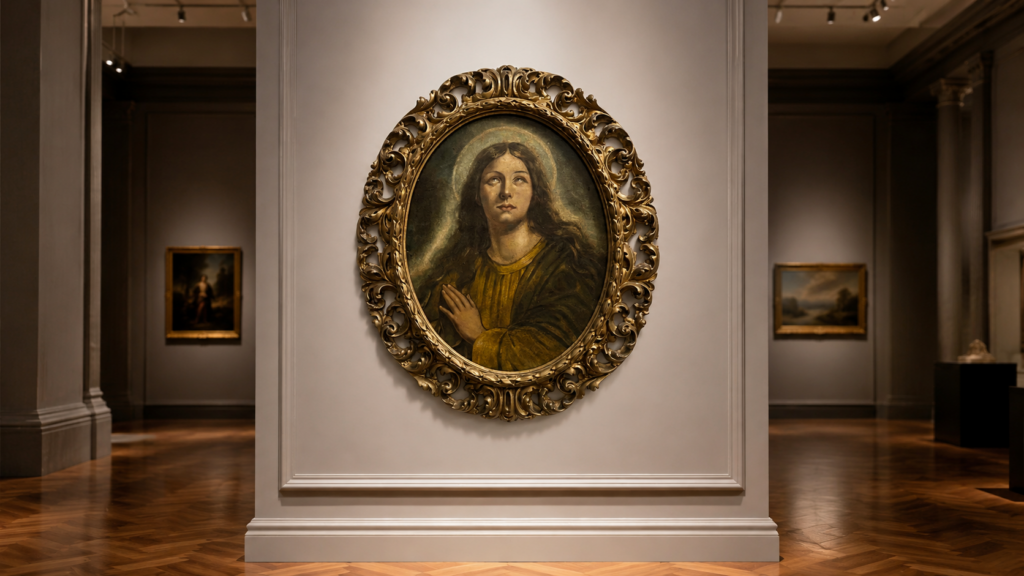
Silence
Within contemporary culture, silence has become increasingly rare.
Images speak constantly.
They explain.
Seduce.
Sell.
Inform.
Provoke.
Neo-Stilnovism seeks instead to recover an image that does not always need to shout.
Silence becomes part of the composition.
A fixed gaze.
A closed mouth.
An isolated figure.
A dark space.
Controlled light.
These elements slow the experience.
The viewer does not receive everything immediately.
They must remain.
And it is precisely this suspension that may create a contemplative dimension.
Light as Revelation
Light does not merely make the body visible.
It may transform it.
Throughout the great figurative tradition of the West, light has frequently acquired spiritual meaning.
From medieval luminosity and gold to Renaissance spatial construction.
From the Baroque to the theatricality of chiaroscuro.
Light may suggest revelation.
Presence.
Judgement.
Protection.
Transcendence.
Neo-Stilnovism reinterprets this inheritance.
Light need not come from a halo.
It may emerge from a face.
A shoulder.
A hand.
A fragment of fabric.
It may make visible what darkness attempts to retain.
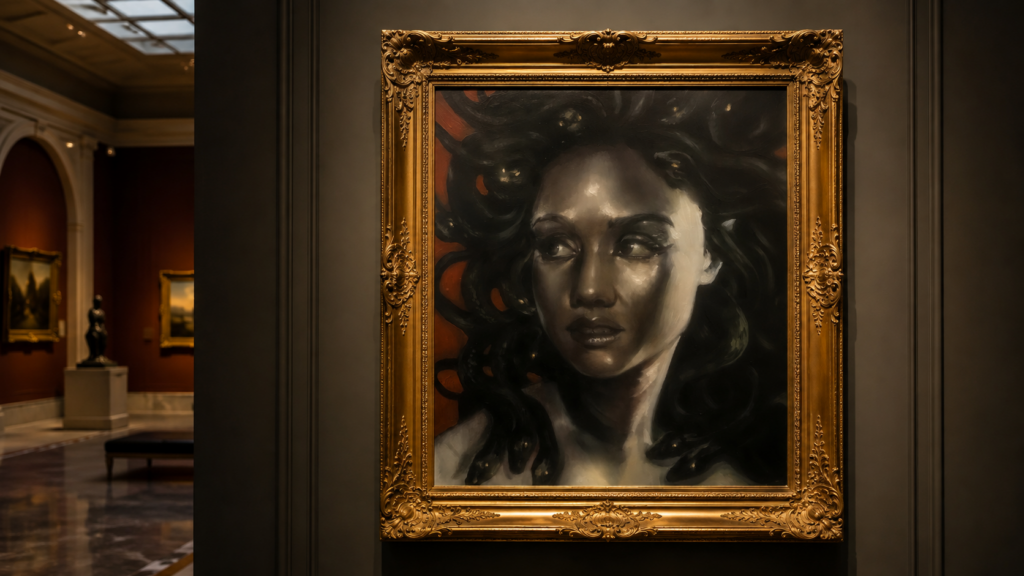
Chiaroscuro
Chiaroscuro therefore becomes one of the principal instruments of the Neo-Stilnovist sacred.
Shadow is not simply the absence of light.
It is the space of the invisible.
The figure emerges from it.
Never entirely.
Something remains concealed.
This relationship between apparition and darkness produces tension.
The sacred may arise from what is not shown.
From absence.
From limitation.
From mystery.
Light reveals.
Shadow preserves.
The Face
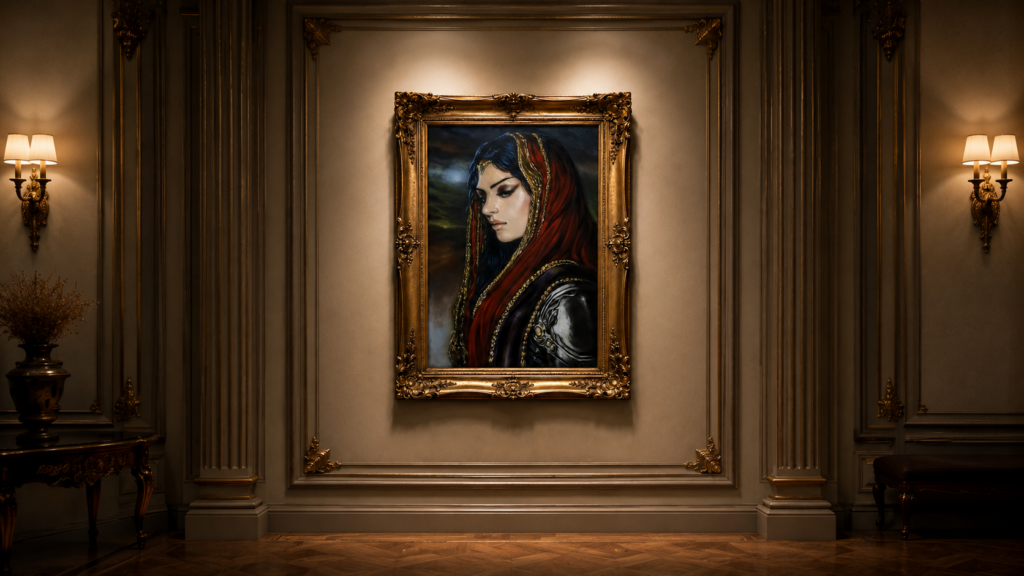
Within Neo-Stilnovism, the face is one of the principal locations of presence.
The face may be beautiful.
Severe.
Wounded.
Dark.
Regal.
Maternal.
But it must possess inner force.
It should not appear merely as a technically accomplished surface.
It must suggest history.
Memory.
Consciousness.
From this perspective, the face becomes almost iconic.
Not necessarily religiously iconic.
Iconic in a deeper sense: an image before which the viewer does not merely observe.
The viewer feels observed.
The Eyes
The gaze intensifies this relationship.
Eyes may look directly forward.
Downward.
Remain closed.
Turn upward.
Disappear beyond the frame.
Each choice radically changes meaning.
Within Neo-Stilnovism, the gaze frequently becomes a threshold between visible and invisible.
When the figure looks at the viewer, the distance between artwork and public decreases.
When the gaze withdraws, mystery increases.
In both cases, the eyes may become a site of sacredness.
Not because they represent something religious.
Because they generate relationship.
The Donna Angelo
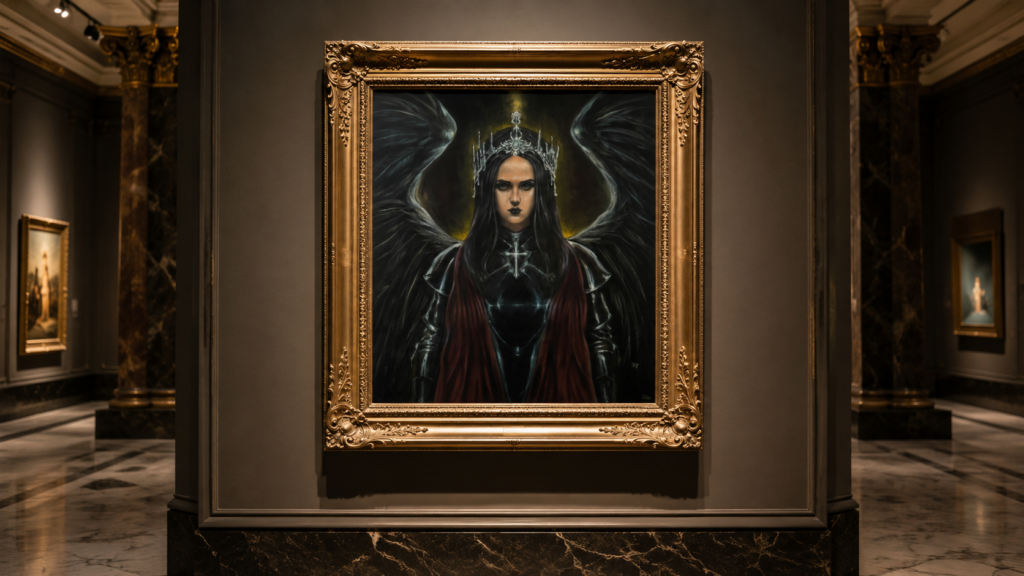
The sacred finds one of its most important expressions in the Donna Angelo.
The Donna Angelo does not coincide with the perfect woman.
She is not an aesthetic ideal without contradiction.
She is an archetype.
She may be luminous.
Dark.
Maternal.
Warrior-like.
Regal.
Wounded.
Sensual.
Spiritual.
Her function is to move beyond the individuality of the subject.
A model may provide the face.
But painting must transform her.
The person becomes figure.
The figure becomes symbol.
The symbol becomes presence.
The Mother
Motherhood possesses one of the oldest forms of sacredness.
Madonna and Child.
Ancient mothers.
Mother goddesses.
Pietà.
Protective figures.
The relationship between mother and child crosses religions and cultures.
Within Neo-Stilnovism, motherhood may be understood not only as a Christian subject but as an archetype of protection, sacrifice, vulnerability and continuity.
A mother may be sacred without a halo.
Because sacredness may reside in gesture.
In the way she holds.
Protects.
Looks.
Endures.
Sacrifice
The sacred is also deeply connected with sacrifice.
Not necessarily ritual sacrifice.
Sacrifice may mean loss.
Pain.
Renunciation.
Resistance.
A wounded figure may possess sacred force because the body carries history.
Pain becomes a sign.
Suffering, when it is not turned into spectacle, may become memory.
This dimension prevents the Neo-Stilnovist sacred from becoming merely decorative spirituality.
Light matters because darkness exists.
The Body as Temple
Religious traditions have often oscillated between celebration and suspicion of the body.
Neo-Stilnovism may instead understand the body as a place of presence.
Not merely flesh.
Not merely sensuality.
But a space in which identity, fragility, strength and memory become visible.
A hand may be sacred.
A back.
A face.
A wound.
Motherhood.
An ageing body.
A warrior body.
Sacredness does not necessarily emerge from the denial of matter.
It may emerge through matter itself.
The Veil
The veil possesses extraordinary symbolic force.
It hides.
Protects.
Separates.
Partially reveals.
Religious painting has used it for centuries.
Yet its symbolic function extends far beyond religion.
The veil suggests that something is not completely accessible.
Within Neo-Stilnovism it may become a metaphor for the distance between what we see and what we understand.
The veiled figure is not simply covered.
She becomes more mysterious.
The Crown
The crown may signify royalty.
Power.
Martyrdom.
Knowledge.
Authority.
Sacredness.
Within a contemporary symbolic language, however, it may above all become a sign of identity.
A crowned Donna Angelo does not necessarily represent a historical queen.
She may embody dignity.
Awareness.
Inner sovereignty.
The crown moves the figure away from the everyday and towards the archetypal.
Gold
Gold accompanied the sacred for centuries.
Byzantine mosaics.
Icons.
Medieval altarpieces.
Gothic backgrounds.
Gold did not simply imitate reality.
It suspended natural space.
It created another dimension.
Neo-Stilnovism may use gold in a similar way: not merely as decoration or luxury, but as a sign of otherness.
A golden detail may interrupt realism.
It may suggest that the figure belongs simultaneously to physical reality and to a symbolic space.
Black
If gold often represents revelation, black represents mystery.
Black may signify mourning.
Depth.
Silence.
Fear.
Power.
Protection.
Within Neo-Stilnovism, the dark figure is not necessarily negative.
Shadow may protect.
Preserve.
Transform.
For this reason, the sacred does not coincide exclusively with luminosity.
There is also a sacredness of night.
The Sibyl
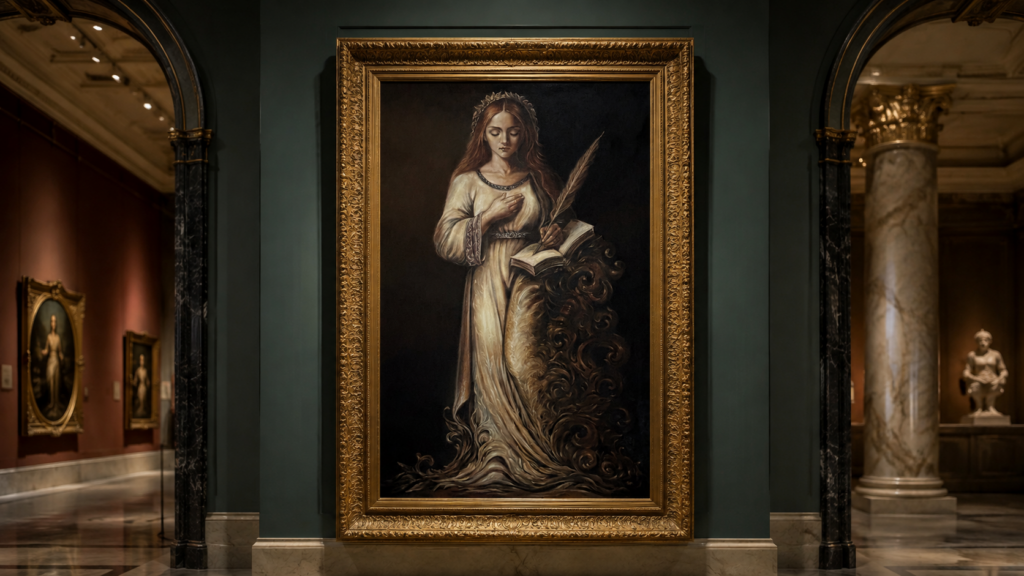
The sibyl is one of the most fertile archetypes for a sacred art that is not strictly confessional.
She is not necessarily a saint.
She is a figure of knowledge.
Prophecy.
Threshold.
A word arriving from elsewhere.
During the Renaissance, sibyls could coexist with prophets and Christian figures.
This demonstrates how historically the Western sacred absorbed symbols from different traditions.
Within Neo-Stilnovism, the sibyl may return as an image of inner knowledge.
The Warrior
A warrior may also become sacred.
Not because war itself is sacred.
But because the figure may embody protection, courage, resistance and sacrifice.
Armour becomes symbolic.
It need not serve only for combat.
It may represent the defence of identity.
The capacity to endure.
The strength required to cross pain.
In this sense, the warrior fully enters the grammar of the Donna Angelo.
The Queen
The queen offers another possibility.
Not merely political authority.
She may embody inner sovereignty.
Awareness.
Dignity.
Responsibility.
Throughout history, the regal portrait was often constructed to manifest power.
Within Neo-Stilnovism, it may be transformed into an image of presence.
The crown does not merely say: “I rule.”
It may say: “I know my worth.”
The Dark Figure
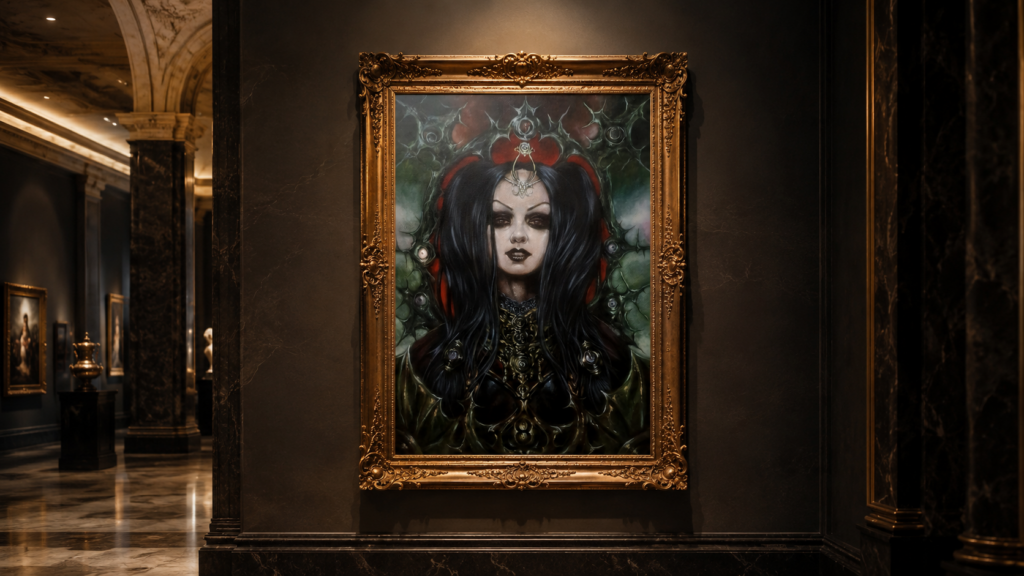
One of the most interesting aspects of the Neo-Stilnovist sacred is its ability to include the dark figure.
Western culture has frequently separated light and darkness.
Good and evil.
Pure and impure.
Yet contemporary psychology has taught us that identity is more complex.
The dark figure may represent what must be recognised.
Fear.
Desire.
Pain.
Anger.
Memory.
Shadow.
In this sense, darkness itself may become a path towards knowledge.
Myth and Sacredness
Myth possesses a similar function.
Persephone.
Medea.
Circe.
Ariadne.
Lilith.
Mythological and legendary figures may no longer belong to active contemporary religions.
Yet they preserve sacred force.
Because they embody archetypes.
Descent.
Transformation.
Loss.
Rebirth.
Knowledge.
Desire.
Myth allows the image to leave historical time and enter a universal dimension.
The Middle Ages
The relationship with the Middle Ages is fundamental.
Within medieval culture, the religious image did not possess only an aesthetic function.
It had a purpose.
It educated.
Remembered.
Mediated.
Made the invisible visible.
Neo-Stilnovism cannot reproduce that world.
But it may recover one essential question:
Can an image still exist before which the viewer behaves differently?
Not simply consuming it.
But remaining before it.
The Renaissance
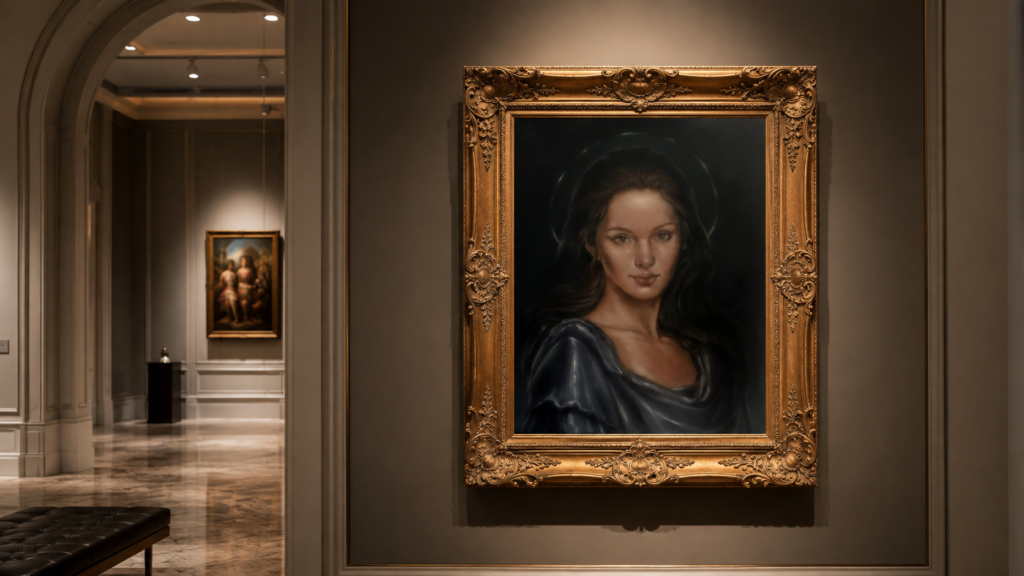
The Renaissance introduced a new centrality of the human being.
The body became measure.
Space became rational construction.
Yet the sacred did not disappear.
It became humanised.
Madonnas, saints and biblical figures acquired weight.
Flesh.
Emotion.
Psychology.
This lesson is particularly significant for Neo-Stilnovism.
The spirituality of the image does not require the denial of physicality.
It may pass through a believable body.
The Baroque
With the Baroque, the sacred becomes theatre.
Light.
Movement.
Drama.
Participation.
The distance between viewer and scene decreases.
The image involves.
Caravaggesque chiaroscuro demonstrates how spirituality may emerge from physical reality.
Real bodies.
Dirty feet.
Wrinkles.
Wounds.
Darkness.
Light.
The sacred no longer belongs exclusively to the ideal.
It enters matter.
This lesson remains profoundly contemporary.
Contemporary Sacredness
Within the contemporary world, the word “sacred” may appear problematic.
We live within plural societies.
Different religions.
Different philosophical positions.
Believers and non-believers.
For this reason, a contemporary artistic language cannot necessarily depend on one single definition.
Neo-Stilnovism may instead conceive the sacred as an experience.
A quality of attention.
A moment in which an image changes the rhythm of the viewer.
It does not necessarily demand faith.
It demands presence.
The Sacred in the Digital Age
Never before have we seen so many images.
And never before have so many images lasted so little.
We scroll.
Move on.
Forget.
The sacred represents almost the opposite dynamic.
It requires time.
Attention.
Repetition.
Return.
A sacred image, in the broadest sense, does not merely want to be seen.
It wants to be remembered.
It seeks to enter memory.
From this perspective, Neo-Stilnovist research may also be read as a reaction to digital speed.
Artificial Intelligence and Presence
Artificial intelligence has made visible how rapidly images can now be produced.
But this raises an even more important question:
What makes an image meaningful?
Technical difficulty?
Time of production?
Intention?
Physical presence?
History?
Its relationship with the person who created it?
Neo-Stilnovist sacredness cannot be reduced to craftsmanship.
Yet craftsmanship matters because it preserves traces.
Revisions.
Glazes.
Errors.
Corrections.
Time.
A painting becomes a deposit of actions.
Contemplation
Perhaps the word closest to Neo-Stilnovist sacredness is contemplation.
To contemplate does not simply mean to look.
It means to remain.
To allow the image to continue working.
To return to a detail.
To change interpretation.
To accept that something may not be understood immediately.
An artwork capable of generating contemplation constructs a different relationship with the viewer.
It is within this relationship that the sacred may emerge.
Beauty and the Sacred
Beauty plays a decisive role here.
It does not decorate the sacred.
It attracts the gaze towards it.
Beauty holds.
But then it must open a question.
If it remains only beauty, it risks becoming surface.
If it contains mystery, tension, memory and symbol, it may become access.
Within Neo-Stilnovism, beauty is therefore not the conclusion of the process.
It is the threshold.
The Sacred Is Not Always Reassuring
Authentic sacredness need not be pleasant.
It may disturb.
Generate respect.
Create distance.
Remind the viewer of something they might prefer to avoid.
Death.
Fragility.
Time.
Pain.
Responsibility.
For this reason, a Neo-Stilnovist figure may be extraordinarily beautiful and simultaneously unsettling.
The two qualities do not exclude one another.
They may reinforce one another.
From Representation to Presence
This leads to a fundamental distinction.
Representing a saint is not enough to create sacredness.
Representing a queen is not enough to create authority.
Representing a warrior is not enough to create strength.
Subject matter is only the beginning.
Painting must transform it.
Through composition, light, material, gaze, gesture and symbol, the figure must acquire another kind of life.
It must become presence.
At that moment, the image moves beyond what it represents.
Beyond Religion
Neo-Stilnovist sacredness does not seek to replace religion.
Nor does it attempt to merge all religions.
It operates on another level.
It concerns the ability of an image to generate a different mental and perceptual space.
It may arise from a Madonna.
A sibyl.
A mother.
A queen.
A warrior.
An unknown face.
Even a dark figure.
What matters is not only whom we see.
It is what happens while we are looking.
Toward Presence
Perhaps this is the most precise definition.
Within Neo-Stilnovism, the sacred is a movement from representation toward presence.
The artwork begins with a figure.
But it must exceed that figure.
It begins with matter.
But it must transform matter.
It begins with beauty.
But it must go beyond beauty.
If it succeeds, the painting stops being merely an image.
It becomes place.
Threshold.
Memory.
Silence.
Presence.
In Neo-Stilnovism, the sacred does not depend on what the figure represents, but on the presence it is capable of generating.

Other Articles