
When an Image Stops Being Merely an Image
A painting may be technically correct, elegant, well constructed and even fascinating.
And yet it may remain still.
It may never move beyond its own surface.
It may be seen, admired and immediately forgotten.
Within Neo-Stilnovism, however, the objective is not simply to represent a figure.
It is to make that figure exist.
Not literally, but perceptually.
The artwork should acquire a presence capable of altering the relationship with the person who encounters it.
The distinction is subtle but decisive.
Representation shows a figure.
Presence makes us feel that the figure is there.
From Resemblance to Presence
Figurative painting has often measured its success through resemblance.
How closely does a face resemble the model?
Is the body anatomically correct?
Is the light believable?
These questions matter.
But they are not enough.
A face may be perfectly recognisable and communicate nothing.
It may be correct yet devoid of interiority.
Within Neo-Stilnovism, resemblance is not the destination.
It is only one possible foundation.
The true passage occurs when the face moves beyond description.
When it stops being merely “that face” and becomes presence.
When the Painting Looks Back
There are artworks before which we experience a particular sensation.
We are not the only ones looking.
It almost seems as though the image is looking back.
This perception emerges above all through the face.
The eyes.
Posture.
Silence.
Frontality.
The figure acquires autonomy.
It no longer appears merely as an object being observed.
It becomes a subject.
At that moment, the relationship changes.
The viewer no longer completely controls the image.
The image begins to return the gaze.
This is one of the central dimensions of Neo-Stilnovist presence.
The Face as Threshold
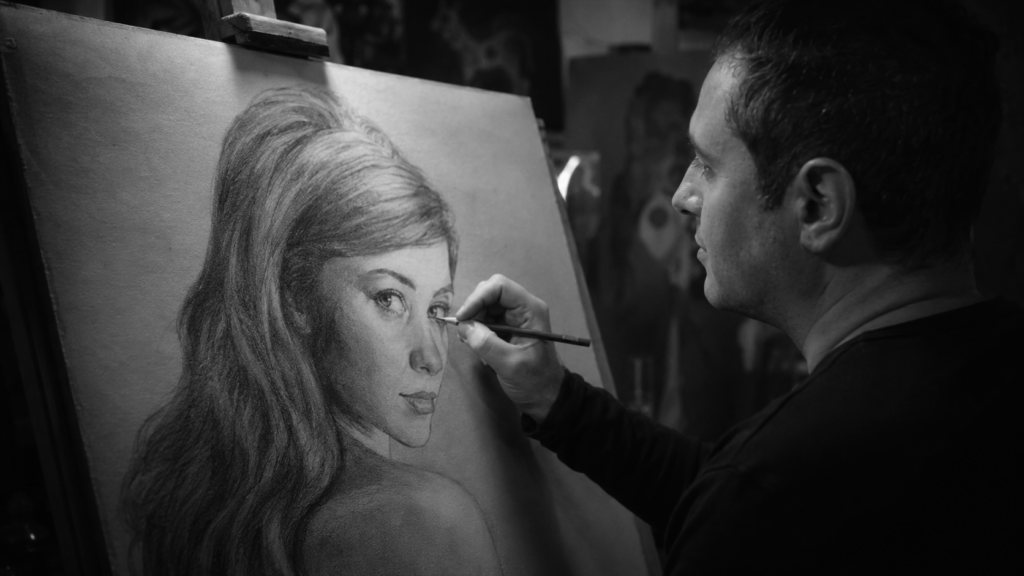
The face is where this transformation occurs most intensely.
A tiny variation may change everything.
The inclination of the head.
The tension of the mouth.
The weight of the eyelids.
The direction of the gaze.
A figure may appear open.
Or closed.
Welcoming.
Or inaccessible.
The strength of the face therefore does not depend solely upon beauty.
It depends upon the amount of interiority it is capable of suggesting.
Within Neo-Stilnovism, the face becomes a threshold.
On one side lies the painted surface.
On the other, something the viewer cannot directly see but can nonetheless perceive.
The Eyes
The eyes inevitably become central to this process.
Not because they must always be large or emphasised.
But because they are the point through which the figure establishes a relationship.
A direct gaze may question.
A lowered gaze may create distance.
A gaze directed beyond the frame may suggest memory.
Closed eyes may transform the figure into a meditative presence.
The effect changes.
The principle remains.
The gaze does not merely define the face.
It constructs a relationship.
Technique Is Not Enough
Presence requires technique.
But technique alone is insufficient.
Anatomy.
Drawing.
Proportion.
Chiaroscuro.
Colour.
Material.
These are necessary instruments.
They allow the figure to become believable.
But credibility is not the same as life.
A painter may master all of these elements and still create a cold image.
Because technique constructs structure.
The soul of the artwork comes from elsewhere.
Emotion
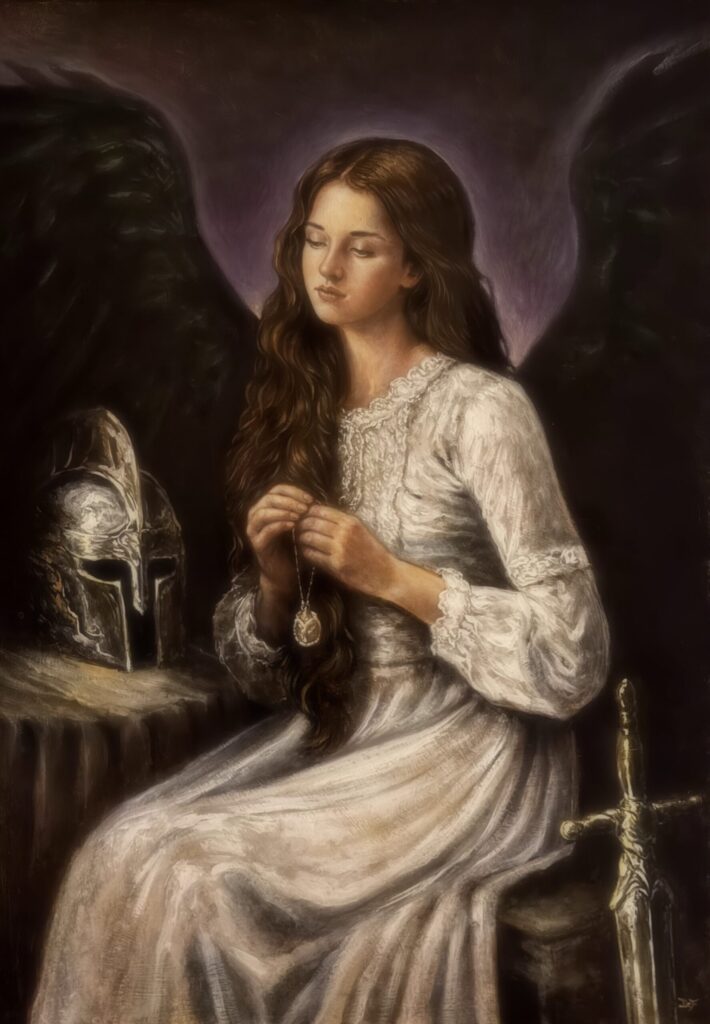
Emotion is one of the decisive elements.
This does not mean painting without control.
It means that the artwork must begin from something the artist truly feels.
Loss.
Memory.
Presence.
Tension.
Desire.
Fear.
A form of beauty.
Technique exists to translate that emotion.
Without emotion, technique risks becoming pure exercise.
When emotion enters the construction of the image, however, the figure acquires a different vibration.
And that vibration may reach the viewer.
The Soul of the Artwork
Within Neo-Stilnovist language, it is possible to speak of the soul of the artwork.
Not as a metaphysical claim.
But as a way of describing that difficult-to-measure quality that allows an image to enter into dialogue.
A painting may possess soul when it preserves tension.
When its meaning is not exhausted at first sight.
When it seems to continue speaking after repeated encounters.
The soul of the artwork emerges from the union of vision, emotion and technique.
Not from any one of them alone.
Silence
Presence also needs silence.
Contemporary images often shout.
They demand attention.
Multiply stimuli.
Neo-Stilnovism seeks a different kind of force.
A figure may be extraordinarily powerful precisely because nothing is happening.
She does not speak.
Does not gesture.
Does not explain everything.
She simply exists.
Silence slows the viewer.
It forces us to remain.
And within that slower time, presence begins to emerge.
Light
Light contributes to giving presence a body.
It does more than illuminate.
It selects.
Reveals.
Conceals.
Part of the face emerges.
Another remains in shadow.
A hand appears.
The rest of the body dissolves.
This balance creates density.
Light tells the viewer where to look.
Shadow reminds us that not everything can be known.
Presence also emerges from this tension.
Chiaroscuro
Chiaroscuro therefore becomes one of the most important instruments.
The figure emerges from darkness.
Not simply as theatrical effect.
But almost as apparition.
Darkness separates the figure from ordinary reality.
It places her within a mental space.
Almost outside time.
Light constructs the body.
Shadow constructs mystery.
Together they create presence.
The Archetype
Presence becomes even stronger when the figure exceeds individual identity.
A woman may be a particular person.
But she may also become mother.
Queen.
Warrior.
Sibyl.
Donna Angelo.
The archetype does not erase the real face.
It expands it.
It allows the figure to speak not only about the individual represented, but about broader human experiences.
This passage is fundamental within Neo-Stilnovism.
The figure must be capable of belonging simultaneously to one person and to many.
The Model as Portal
Here the concept of the Model as Portal also becomes relevant.
The model offers a real presence.
A face.
A gaze.
A gesture.
But the artist does not merely record them.
Through her, the artist may perceive a character that does not yet exist.
The model becomes the point of entry.
The archetype emerges beyond it.
The figure that appears on canvas is no longer simply the person who posed.
It has become something new.
This transformation is one of the ways in which representation may become presence.
Sculptural Projection
Sculptural Projection also participates in this process.
Before painting, the artist must learn to sense the figure within mental space.
Not as outline.
But as mass.
Volume.
Weight.
Presence.
The figure must exist inwardly before appearing on canvas.
This prevents painting from remaining merely surface.
The body acquires weight.
The face acquires volume.
Presence becomes almost physical.
The Velatio Method
The Velatio Method introduces another dimension.
A controlled suspension of visual dominance.
For brief moments, the artist allows memory, gesture and inner perception to enter more directly into construction.
This may introduce something less predictable.
A line.
A shadow.
A tension.
The result is not random.
It is the product of technique willing not to control everything.
And this small area of risk may produce vitality.
Presence Is Not Perfection
This point is essential.
An artwork does not need to be perfect in order to possess presence.
At times absolute perfection may even weaken it.
An excessively controlled mark may become sterile.
An overly polished surface may lose energy.
Presence may emerge from a small imperfection.
A gesture.
A tension.
A trace of material.
Something reminding the viewer that the work was made.
Not automatically generated.
Constructed.
Corrected.
Lived.
The Artwork Must Survive the Artist
When the painting leaves the atelier, a second life begins.
The artist is no longer there to explain.
Cannot describe the origin of every symbol.
Cannot narrate every emotion.
The artwork must stand alone.
It must continue to speak.
This is where presence is tested.
If a painting constantly requires its author’s explanation, perhaps it has not yet become fully autonomous.
If instead it can establish a relationship with people who know nothing about its history, then it has acquired a life of its own.
Dialogue With the Viewer
Presence does not mean imposing a single meaning.
Quite the opposite.
A living artwork leaves space.
The viewer brings personal memory.
Experience.
Sensitivity.
The same figure may appear maternal to one person.
Unsettling to another.
Sacred to someone else.
This plurality does not weaken the artwork.
It enriches it.
Dialogue begins precisely in the encounter between what the artist has placed within the work and what the viewer brings before it.
Memory
Strong presence leaves memory.
The viewer may forget many details.
But remember the face.
The gaze.
The sensation.
The light.
Presence is therefore not merely an immediate effect.
It may continue afterwards.
The image remains within us.
And this may be one of the most important distinctions between an effective figure and one that feels truly alive.
In the Age of Rapid Images
Today this research becomes even more important.
We live within a continuous stream of images.
We scroll.
Look.
Move on.
Forget.
Painting cannot compete with this speed.
But it can do the opposite.
It can slow us down.
Demand time.
Construct a physical presence that does not disappear with the movement of a finger.
Material.
Surface.
Scale.
Light.
Time.
Painting still preserves this possibility.
Presence Against Consumption
One of Neo-Stilnovism’s central questions therefore concerns the relationship between image and consumption.
A consumable image must be immediate.
It must be understood quickly.
Presence, however, requires duration.
It does not offer everything at once.
It asks us to return.
For this reason, Neo-Stilnovist painting does not seek impact alone.
It seeks permanence.
The artwork should be capable of being seen today and again tomorrow.
And ideally, of changing each time.
From Figure to Being
The final passage is this.
At first there is a figure.
Then that figure is constructed.
Illuminated.
Transformed.
Animated.
At a certain point, if the process succeeds, it stops appearing merely as representation.
It seems to acquire an identity of its own.
It remains painting.
Pigment.
Canvas.
Matter.
Yet perceptually it has become something more.
It has become presence.
Representation shows a figure. Presence makes us feel that the figure exists.
And perhaps this is one of the deepest aims of Neo-Stilnovist painting:
not merely to make an image visible, but to give it enough soul to continue living before those who encounter it.

Other Articles

The Model as Portal: When a Real Face Awakens the Archetype