
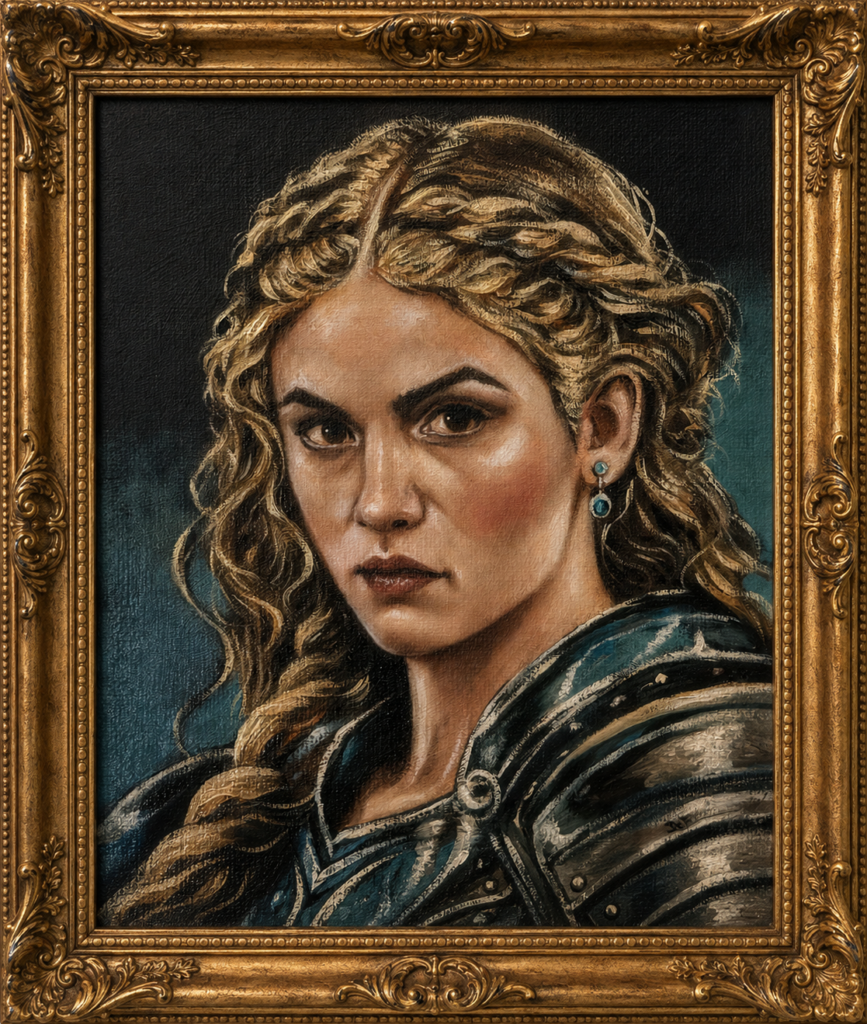
Carmelo Fabio D’Antoni, 2025
Oil on jute canvas
27 × 31 cm
A Face Before the Battle
In The Gaze of Brunhild, Carmelo Fabio D’Antoni concentrates the entire narrative tension of the work within a small format.
No complex scene is required.
No battle needs to be shown.
The myth does not need to be narrated through action.
A face is enough.
Brunhild appears frontally, enclosed within armour, her gaze steady and alert. She seems to exist not during combat, but within a more difficult moment to define: the instant in which strength has not yet become action, but remains consciousness.
It is precisely this suspension that gives the painting its intensity.
Beyond the Mythological Character
The name Brunhild inevitably evokes an entire legendary universe of war, heroism, destiny, love and tragedy.
Yet the painting does not remain an illustration of mythology.
D’Antoni’s Brunhild becomes primarily an archetype of the female warrior.
What matters is not simply what she has fought.
It is what her face appears to remember.
The warrior is removed from the spectacle of action and returned to a psychological dimension.
Armour protects the body.
The gaze reveals presence.
The Eyes as the Centre of the Painting
Within Neo-Stilnovist language, the gaze occupies a central position.
The eyes are not treated merely as anatomical details.
They create contact.
In Brunhild, this relationship with the viewer is immediate.
The figure does not seem simply available to be observed.
She seems aware of being observed.
This distinction is fundamental.
The painting ceases to behave like a passive surface and begins to establish a dialogue.
The viewer looks at Brunhild, but Brunhild returns the gaze.
The Warrior and the Donna Angelo
Within the grammar of Neo-Stilnovism, the Donna Angelo is not exclusively luminous, fragile or spiritualised.
She may also be a warrior.
She may wear armour.
She may contain severity.
She may pass through the darker dimensions of experience.
Strength does not erase femininity.
It expands it.
Brunhild therefore enters a conception of the feminine archetype in which woman may simultaneously embody beauty, defence, memory and resistance.
Her armour does not represent war alone.
It may also be understood as protection.
The Materiality of Jute
The choice of jute canvas is particularly significant.
Its surface does not possess the polished regularity of smoother supports.
Its weave remains perceptible.
It participates in the painting.
This material quality creates an interesting contrast with the face.
The flesh seeks softness and presence.
The support retains physical roughness.
The result strengthens the character of the image.
Brunhild does not inhabit an entirely idealised surface.
She remains connected to matter.
To support.
To the physical construction of painting.
Small Scale, Concentrated Presence
The dimensions, 27 × 31 cm, provide another significant element.
Monumentality does not necessarily depend upon physical size.
Here the artist works through concentration.
The face occupies most of the space.
The distance between figure and viewer is reduced.
The painting almost assumes the function of a private icon.
An image intended to be encountered closely.
This scale makes the importance of the gaze even more evident.
There are few narrative distractions.
Everything leads back to the face.
Colour
The cooler tones of the armour and background contrast with the warmer flesh.
Blue-green accompanies the metallic construction without becoming merely decorative.
The reflections of the armour suggest weight and hardness.
The face remains alive.
This opposition between metal and flesh creates an important part of the work’s tension.
The exterior protects.
The body remains vulnerable.
It is a contradiction deeply connected with the warrior archetype.
Beauty Without Decorative Fragility
The figure is beautiful, but beauty is not used to make her reassuring.
The face retains severity.
The eyebrows are pronounced.
The mouth remains firm.
The gaze does not seek approval.
This allows the painting to move away from a purely decorative representation of femininity.
Beauty becomes an instrument of presence.
It attracts the viewer and then confronts them with a personality that does not entirely surrender itself.
Memory Behind the Armour
One of the most intriguing aspects of the painting lies in what is not narrated.
What has Brunhild seen?
What is she about to face?
Has the battle already happened?
Is she remembering?
The painting does not answer.
And it is precisely this absence of explanation that allows the artwork to remain alive.
The viewer must complete the story.
The face becomes a space of projection.
The figure preserves a past we cannot know.
Yet we may sense its weight.
From Representation to Presence
The Gaze of Brunhild offers a clear example of one of the central ideas of Neo-Stilnovist painting: the distinction between representation and presence.
To represent Brunhild would mean showing her attributes.
Armour.
Mythological identity.
Legendary reference.
To give her presence means allowing the viewer to sense that something exists behind those attributes.
Character.
Memory.
Tension.
An inner life.
It is precisely within this transition that the painting ceases to be a simple narrative image.
It becomes an encounter.
The Strength of Silence
Brunhild does not fight.
She does not shout.
She does not raise a weapon.
She performs no spectacular action.
Yet tension remains.
This demonstrates how silence can become one of the strongest instruments in figurative painting.
Strength is not described through gesture.
It is contained.
And perhaps it is precisely this contained force that makes the face convincing.
An Artwork About Identity
Ultimately, Brunhild may also be read beyond mythology.
As an image of resistance.
Awareness.
Protection.
The capacity to pass through conflict without losing identity.
Neo-Stilnovist painting frequently uses historical, literary or mythological figures as starting points.
But the objective is to move beyond biography and reach something broader.
An archetype.
In this sense, Brunhild does not belong only to legend.
She may belong to anyone who has had to construct an armour without surrendering their inner self.
In The Gaze of Brunhild, the battle is not represented. It is already contained within the eyes.
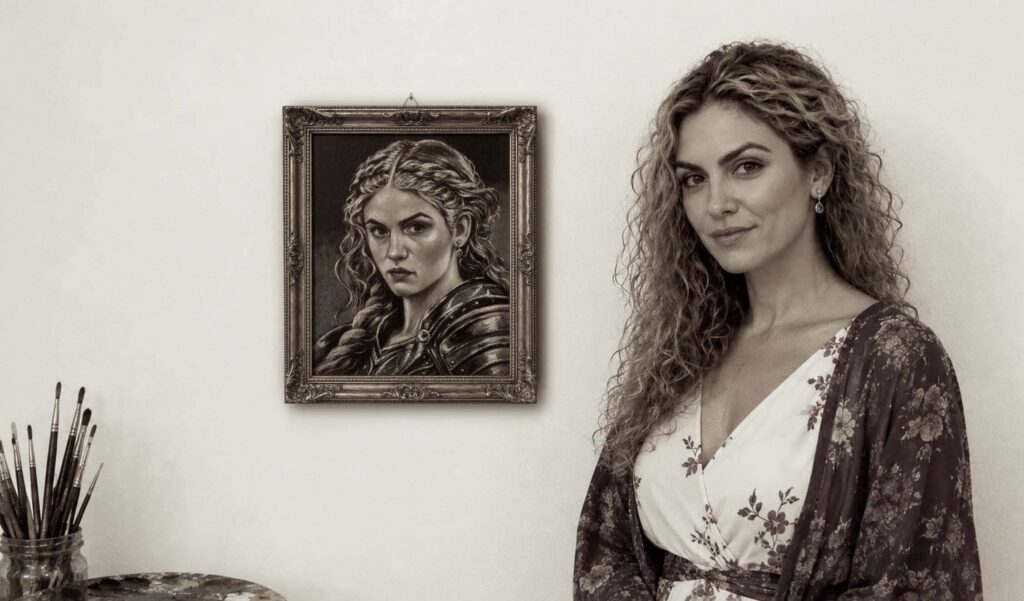
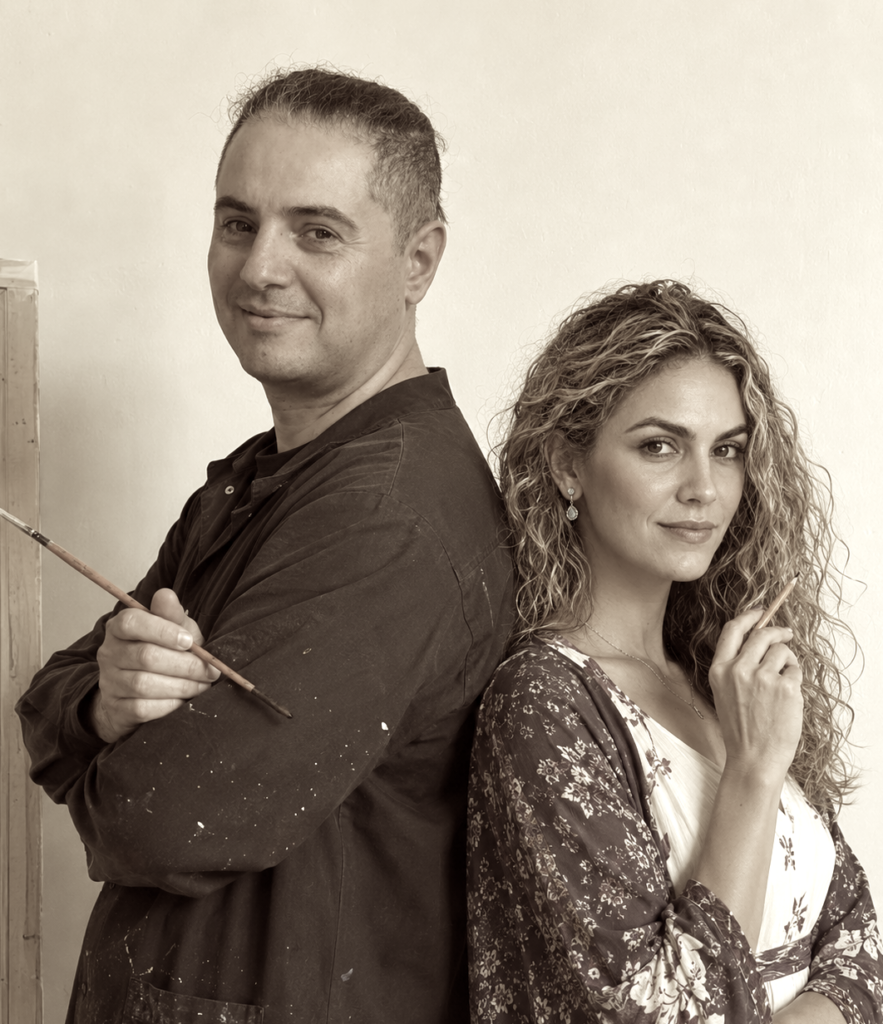
The artist extends his special thanks to Maria Teresa, model for The Gaze of Brunhild. Her presence did not simply provide the features of the figure; it became the threshold through which Brunhild could emerge as an archetype. From the real face came the vision, and from that vision the soul of the work.

Other Articles