

Carmelo Fabio D’Antoni, 2023
Oil on canvas
50 × 70 cm
A Presence That Does Not Need to Assert Itself
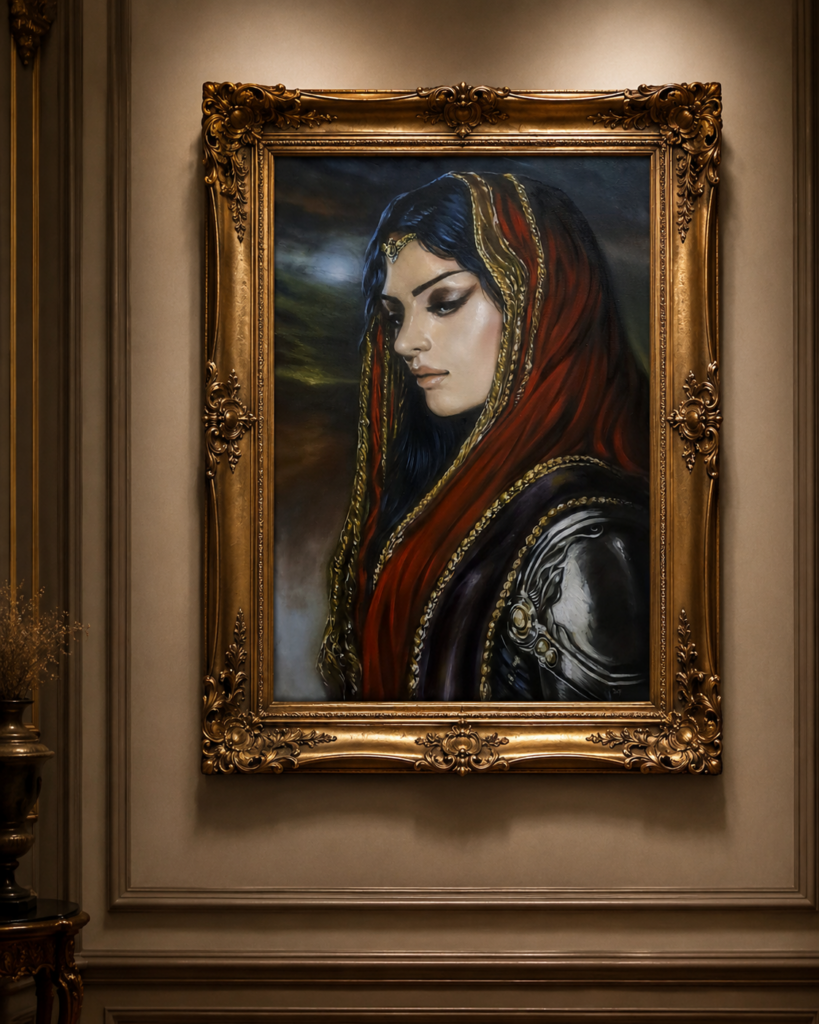
Morgana does not look directly at the viewer.
She does not challenge us.
She does not seek confrontation.
Her face is inclined, her eyes lowered, her expression contained.
And yet she completely dominates the painting.
In Morgana, Carmelo Fabio D’Antoni constructs power through something apparently opposite to force: inner stillness.
The woman does not need to demonstrate her authority.
She possesses it.
This silence transforms the painting from a fantasy portrait into an archetypal image.
Beyond the Sorceress of Legend
Morgana has crossed centuries of Arthurian imagination under many identities.
Healer.
Enchantress.
Sister.
Adversary.
Wise woman.
Ambiguous presence.
To reduce such a complex figure to the stereotype of the “evil witch” would mean losing precisely what continues to make her fascinating.
D’Antoni’s Morgana suggests another interpretation.
She does not appear governed by aggression.
She is a woman who knows.
Her strength arises not from action, but from knowledge inaccessible to the viewer.
The Woman Who Keeps Something Within
One of the painting’s strongest characteristics is its sense of interiority.
The lowered eyes interrupt immediate contact with the external world.
Morgana does not reveal everything she thinks.
She retains.
Guards.
And it is precisely what remains concealed that generates mystery.
Within symbolic painting, concealment may be as powerful as revelation.
A figure that explains everything is quickly exhausted.
A figure that preserves something invites us to return.
The Withheld Gaze
In many Neo-Stilnovist works, the eyes establish direct contact with the observer.
Morgana operates differently.
The gaze is almost withheld.
Her eyes do not seek us.
This increases the psychological distance.
We may see Morgana.
Morgana seems to be looking elsewhere.
Or perhaps inward.
The result is a presence that remains difficult to access.
And this inaccessibility creates much of the work’s fascination.
The Red Veil
The great red veil forms one of the principal chromatic structures of the composition.
It descends beside the face and body as a warm mass, contrasting with the cooler metallic tones of the armour.
Red may suggest many things.
Passion.
Blood.
Authority.
Sacrifice.
Desire.
Danger.
Yet here it does not explode.
It is contained.
Like Morgana herself.
Intensity exists, but remains disciplined by composition.
Emotion is present without becoming spectacle.
The Veil as Threshold
The veil is more than costume.
It performs a symbolic function.
It conceals and reveals simultaneously.
It frames the face.
Separates it from the surrounding space.
It becomes almost a frame within the frame.
Within Neo-Stilnovist language, the veil may represent that which cannot be completely accessed.
Morgana appears before us, yet something within her remains protected.
Visible without being fully knowable.
Armour
Against the softness of the face stands armour.
Metal suggests defence, strength and distance.
But its meaning need not be exclusively military.
Armour may represent what a person constructs around themselves to protect an inner world.
The woman therefore appears simultaneously exposed and defended.
The face remains open.
The body is protected.
This tension between vulnerability and protection becomes one of the work’s central psychological elements.
Inner Sovereignty
Morgana does not necessarily carry the obvious attributes of a queen.
Yet she possesses regality.
Not political rule.
Inner sovereignty.
Her posture, profile and stillness suggest someone who does not require external approval to define her own value.
This is an important theme within Neo-Stilnovist feminine archetypes.
A queen is not merely a woman who rules others.
She may be a woman who has learned to rule herself.
Dark Beauty
Morgana’s beauty is not reassuring.
The face retains harmony, while the atmosphere surrounding her remains unsettled.
The sky is dark.
The space remains partially undefined.
Colour seems to emerge from an unstable dimension.
This relationship between beauty and unease prevents the artwork from becoming merely decorative.
The figure attracts.
But she never reveals everything.
Shadow Is Not Evil
This may be one of the painting’s most important ideas.
Western culture has frequently used light and darkness as visual equivalents of good and evil.
A contemporary archetypal language can be more complex.
Shadow may represent what remains unknown.
What has been hidden.
Memory.
Pain.
Intuition.
Desire.
The part of identity that remains invisible to the external world.
Morgana does not necessarily belong to shadow because she is negative.
She may belong to it because she knows how to cross it.
Morgana and the Donna Angelo
Within Neo-Stilnovism, the Donna Angelo should not be imagined exclusively as a luminous figure.
Such an interpretation would reduce the archetype to stereotype.
The Donna Angelo may contain darkness.
She may know suffering.
She may be warrior.
Sorceress.
Queen.
Sibyl.
Mysterious figure.
Her capacity for elevation does not necessarily come from the absence of darkness.
It may emerge from the ability to recognise it.
Morgana therefore becomes one possible manifestation of the dark Donna Angelo: a figure in whom knowledge and mystery coexist.
The Symbolist Dimension
The painting inevitably enters into dialogue with the long European tradition of the symbolic woman.
Symbolist female figures.
Priestesses.
Sphinxes.
Enchantresses.
Silent queens.
The enigmatic women of Pre-Raphaelite and fin-de-siècle imagination.
Yet the relationship is not one of stylistic imitation.
It is a continuation of a question:
How can a visible face become the vessel of something invisible?
Morgana answers through presence.
From Character to Archetype
The title identifies the woman.
Morgana.
Yet the painting can continue to function even for viewers unfamiliar with Arthurian legend.
This is important.
The artwork does not depend entirely upon literature.
The figure may be read as the image of a woman who guards knowledge.
A woman who does not completely surrender herself.
A person who has transformed darkness into strength.
At that point Morgana ceases to belong only to legend.
She becomes archetype.
Presence Through Silence
Compared with The Gaze of Brunhild, this painting employs an almost opposite strategy.
Brunhild establishes frontal tension.
Morgana withdraws.
Yet both possess presence.
This demonstrates that Neo-Stilnovist painting need not depend upon a fixed formula.
Presence may arise from direct gaze.
But also from its absence.
It may interrogate.
Or force the viewer to search.
Morgana belongs to the second possibility.
An Image That Does Not End
The most compelling works rarely explain themselves completely.
They leave a space open.
In Morgana, that space lies precisely within what the woman appears to be thinking.
We cannot enter it.
We can only imagine it.
And this distance keeps the painting alive.
The artwork does not offer an answer.
It offers a presence before which we are compelled to ask questions.
Morgana does not belong to shadow because she hides within it. She belongs to shadow because she has learned to see what light cannot reveal.

The artist extends his special thanks to Ida, model for Morgana. Her presence became the threshold through which the archetype could reveal itself. From her face came the first emotion; from that emotion, the vision; and from the vision, Morgana. In this sense, Ida was not simply the model of the work, but its Model as Portal — the human presence through which the character found its form and soul.


Other Articles