

When Strength Takes a Female Form
The warrior woman crosses centuries of art, mythology and literature.
She belongs to no single culture.
She does not originate from one story.
She continually returns.
Goddess.
Queen.
Amazon.
Valkyrie.
Warrior saint.
Heroine.
Her power does not simply consist in “doing what men do.”
The warrior woman constructs another model.
Protection.
Discipline.
Sacrifice.
Strategy.
Resistance.
Sovereignty.
This is why she continues to reappear within Western imagination.
War is only the surface.
The archetype reaches much deeper.
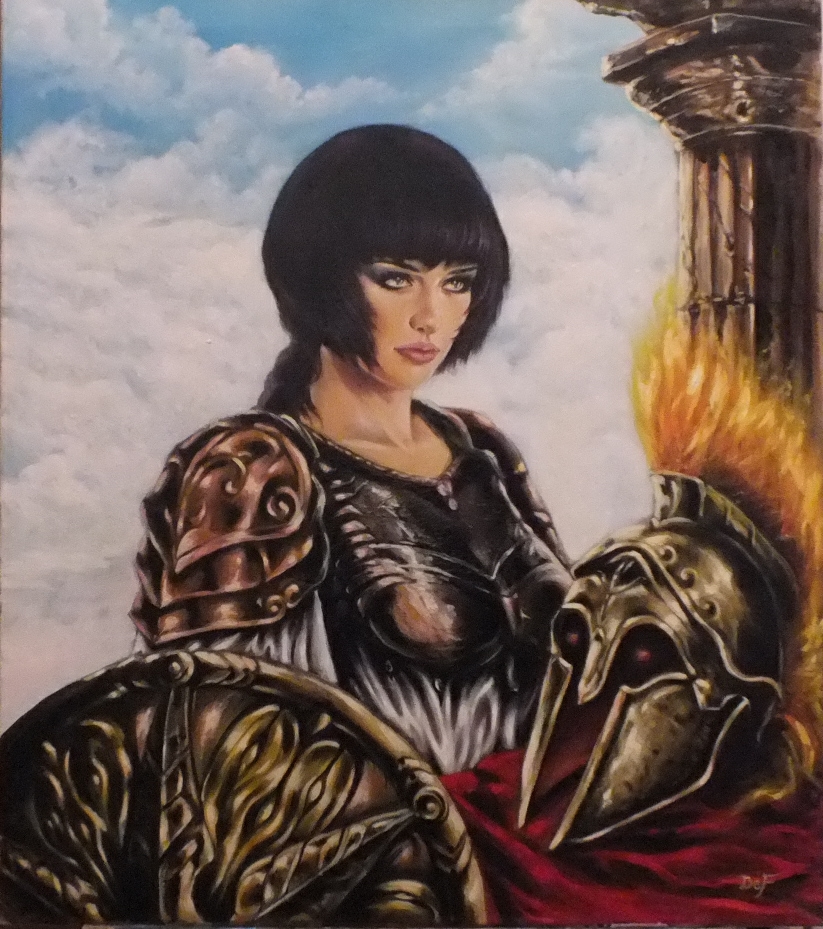
Athena: Strength Governed by Intelligence
Among the oldest and most powerful images of the warrior woman stands Athena.
An armed goddess, but not one ruled by fury.
Her strength is strategic.
Rational.
Controlled.
Helmet, spear and aegis indicate not merely the ability to fight.
They represent authority.
Protection.
Knowledge.
Athena already establishes a fundamental distinction.
Female strength need not always be explosive.
It may be lucid.
It may manifest through decision.
This principle would pass through many later representations of the warrior woman.
The Amazons: The Body That Refuses Limitation
The Amazons constitute another major ancient archetype.
Women warriors.
Autonomous.
Outside the traditional structures of Greek society.
For precisely this reason, they were both fascinating and disturbing.
Their bodies broke a rule.
Woman appeared not only as mother, wife or object of desire.
She could ride.
Use weapons.
Fight.
Command space.
Within ancient art, conflict with the Amazons therefore also represents cultural tension.
The armed woman forces the viewer to reconsider power.
Artemis: Autonomy and Defence
Artemis is not strictly a goddess of war.
Yet she possesses many qualities that nourish the warrior-woman imagination.
The bow.
The hunt.
Independence.
Distance.
Her relationship with nature.
The defence of her own space.
Her strength derives from autonomy.
She does not need to enter a masculine structure in order to exist.
This becomes fundamental in later representations of female strength: the ability to protect one’s territory, whether physical or inner.
The Valkyrie
Within the Nordic world, the archetype changes.
The Valkyrie is not merely a fighter.
She mediates between battle and destiny.
She chooses.
Selects.
Accompanies.
War therefore enters into relationship with an almost sacred dimension.
The Valkyrie belongs simultaneously to violence and transcendence.
She represents more than physical power.
She represents passage.
Between life and death.
Earth and myth.
Individual and destiny.
This complexity makes the Valkyrie one of the most fertile figures of European imagination.
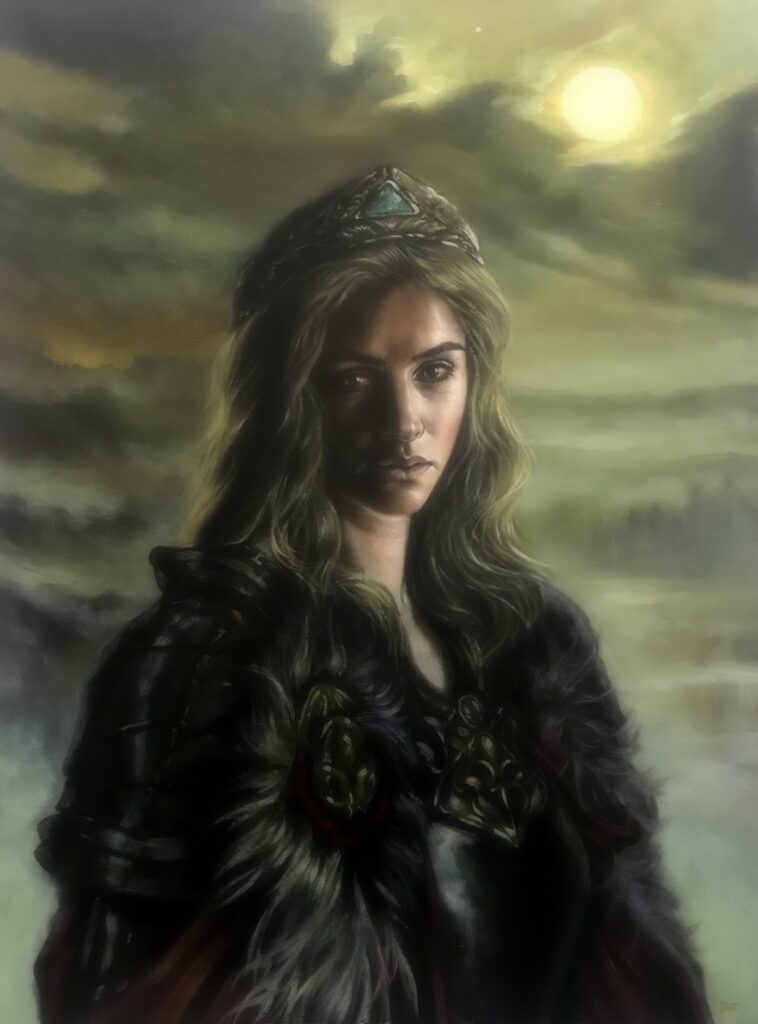
Brunhild: Woman, Destiny and Tragedy
Among the Valkyries, Brunhild assumes particular power.
Across different literary and musical traditions, the character changes.
Yet several essential elements remain.
Strength.
Pride.
Loyalty.
Love.
Conflict.
Destiny.
Brunhild is not compelling merely because she fights.
She becomes compelling because strength collides with feeling.
The warrior becomes tragic figure.
Armour cannot protect her from everything.
It is here that the archetype acquires depth.
Strength and Vulnerability
One of the most superficial interpretations of the warrior woman is to make her invulnerable.
But invulnerability eliminates conflict.
And without conflict, the archetype loses much of its power.
The warrior woman becomes truly compelling when she contains both poles.
Strength and fragility.
Discipline and fear.
Protection and wound.
Courage and loss.
Vulnerability does not destroy heroism.
It makes it human.

Joan of Arc
In the passage from legend to history, Joan of Arc represents an extraordinary case.
Woman.
Warrior.
Visionary.
Religious figure.
Political character.
Martyr.
Her image has crossed painting, sculpture and literature because it contains apparently incompatible elements.
Armour and faith.
Youth and authority.
Fragility and determination.
Here the warrior is not simply a fighter.
She carries a mission.
The body becomes the instrument of a conviction greater than itself.
Armour as Symbol
Armour is one of the most important elements in representations of the warrior woman.
Naturally, it protects the body.
But within art it can take on broader meanings.
Defence.
Distance.
Identity.
Trauma.
Control.
Authority.
A figure in armour immediately tells us that a boundary exists.
Something must be protected.
This interpretation can be especially powerful today.
Armour becomes a metaphor for psychological defences.
For what a person constructs in order to move through the world.
The Body Within Metal
The contrast between body and armour generates extraordinary visual tension.
Metal is hard.
Flesh is vulnerable.
Armour reflects.
Skin absorbs.
Metal protects.
The body feels.
Within the female figure, this contrast is often intensified because Western tradition has long associated the woman’s body with softness, beauty and sensuality.
Armour breaks that expectation.
Yet it does not erase the body.
It complicates it.
The Warrior Woman in the Imagined Middle Ages
Nineteenth-century Europe rediscovered the Middle Ages with extraordinary intensity.
Arthurian legends.
Knights.
Ladies.
Queens.
Religious visions.
And alongside this return, the warrior woman reappeared.
The Middle Ages of nineteenth-century painters were not always historically accurate.
They were frequently imagined.
A territory upon which the present projected desires, nostalgia and archetypes.
The warrior woman could therefore become timeless.
No longer belonging only to history.
Belonging to myth.
Pre-Raphaelite Women and Female Strength
Within the Pre-Raphaelite world, woman frequently acquires intense presence.
Not always armed.
Yet often capable of symbolic authority.
Queens.
Legendary figures.
Women belonging to Arthurian cycles.
Tragic characters.
These images contribute to the construction of femininity as something more than passivity.
Woman becomes protagonist.
Bearer of history.
Destiny.
Choice.
The transition toward the warrior archetype becomes natural.
Symbolism and the Powerful Woman
With Symbolism, the female figure becomes even more complex.
She may become sphinx.
Salome.
Judith.
Priestess.
Queen.
Dark creature.
Strength no longer necessarily depends upon weapons.
It becomes psychological.
Erotic.
Mysterious.
A powerful woman may dominate through gaze.
Silence.
Knowledge.
This becomes essential for understanding the contemporary warrior.
Battle may now be inward.
Judith: Strength and Ambiguity
Judith offers a particularly revealing example.
Her action is violent.
Yet within religious tradition it is connected with liberation and courage.
Across time, art transformed her image.
Sacred heroine.
Determined woman.
Femme fatale.
Sensual figure.
Symbol of autonomy.
The archetype therefore demonstrates a fundamental characteristic: it changes according to the period.
Every culture sees in the warrior what it needs.
The Inner Battle
In contemporary art, the warrior woman may be represented without war.
This is a decisive transformation.
Armour may remain.
The sword may remain.
But the true conflict may be invisible.
Memory.
Loss.
Responsibility.
Trauma.
A struggle against oneself.
Painting may express this tension through the face.
A battlefield is no longer necessary.
Sometimes the eyes are enough.
From Gesture to Gaze
Here portraiture becomes particularly powerful.
When the warrior woman is deprived of action, the face remains.
What is left of battle when the battle itself cannot be seen?
What it has left behind.
Concentration.
Fear.
Awareness.
Determination.
Exhaustion.
Memory.
The gaze may therefore contain an entire narrative without illustrating it.
This capacity for concentration makes the warrior face particularly powerful in figurative painting.
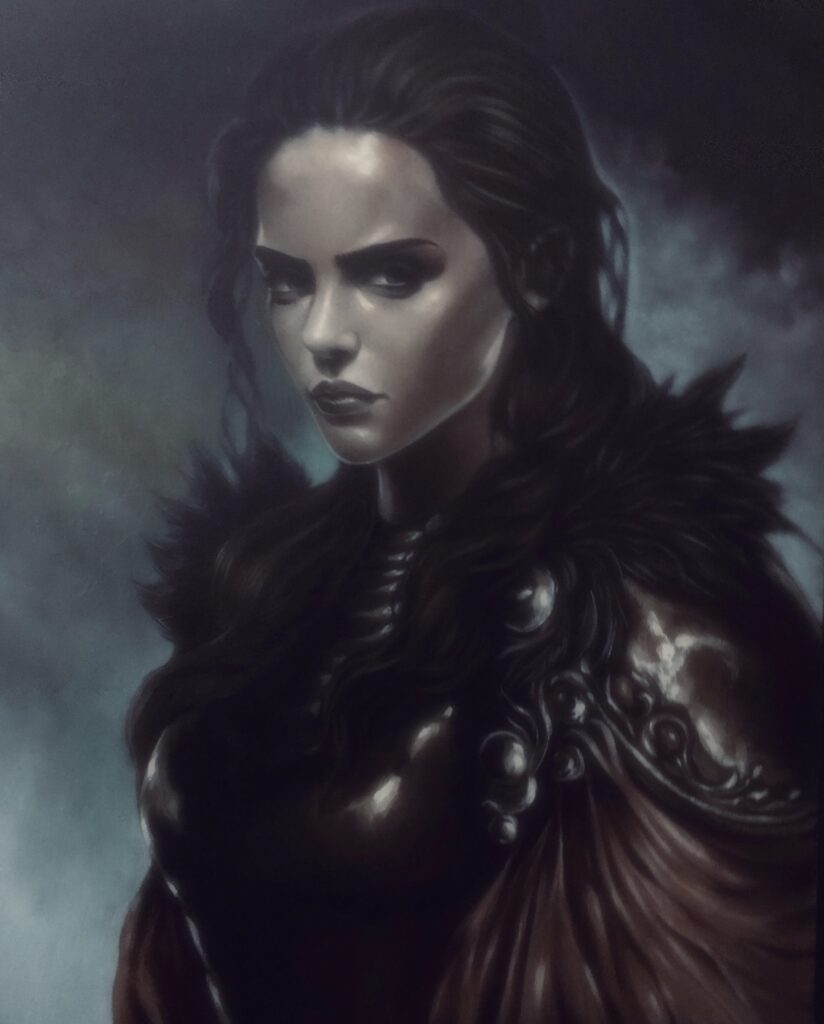
Brunhild in Neo-Stilnovism
This principle enters directly into the Neo-Stilnovist painting of Carmelo Fabio D’Antoni.
In the 2025 work The Gaze of Brunhild, Brunhild is not shown fighting.
She raises no weapon.
Performs no heroic gesture.
The image is concentrated in the face.
The armour.
The gaze.
Myth becomes internalised.
The battle is no longer before the woman.
It has already passed through her.
This transformation allows the figure to move beyond simple mythological illustration.
The Warrior Donna Angelo
Within Neo-Stilnovism, the Donna Angelo need not be fragile or ethereal.
She may be a warrior.
This possibility expands the archetype.
The capacity to elevate does not arise only from gentleness.
It may emerge from courage.
Protection.
Resistance.
Sacrifice.
The Warrior Donna Angelo does not abandon femininity in order to become strong.
Strength itself assumes a female form through her.
Protection
One element that distinguishes the warrior archetype from the simple desire to dominate is protection.
One may fight in order to preserve.
A person.
A principle.
A community.
One’s identity.
One’s dignity.
In this sense, the warrior woman may become a profoundly ethical figure.
Armour does not signify only the willingness to attack.
It may signify the decision not to allow something to be destroyed.
Inner Sovereignty
There is finally another form of battle.
To govern oneself.
The contemporary warrior woman may embody precisely this capacity.
Not to dominate the world.
Not to defeat an enemy.
But to remain whole.
To preserve identity.
To cross loss without disappearing within it.
To defend a deep part of the self.
It is here that the warrior archetype meets that of the queen.
Power becomes inner sovereignty.
From Athena to Brunhild
The path from Athena to Brunhild crosses millennia.
It is, of course, not linear.
Cultures change.
Religions change.
Images change.
Yet something returns.
An armed woman, or a woman symbolically prepared to fight, repeatedly challenges our understanding of strength.
Strength may be intelligence.
Autonomy.
Protection.
Vision.
Sacrifice.
Resistance.
Knowledge.
This is why the archetype continues to be reinterpreted.
Not because it always tells the same story.
But because every age must redefine what it means to be strong.
The warrior woman does not become powerful because she abandons femininity: she becomes powerful because strength assumes another form through her.
From Athena’s helmet to Brunhild’s armour, art has transformed the warrior woman into something more than a fighter: a figure capable of embodying protection, memory and sovereignty.

Other Articles

Imagination as the Origin of the Artwork: Creating Before Seeing
Morgana: The Sovereignty of Shadow in Neo-Stilnovist Painting