
Craftsmanship as Knowledge, Identity and the Construction of the Artwork
In an age in which images can be produced, altered and distributed with unprecedented speed, speaking about painting technique may almost seem countercultural.
Yet precisely today, technique can recover profound significance.
Not as simple virtuosity.
Not as nostalgia.
But as material knowledge, discipline, identity and the capacity to construct an artwork intended to endure.
Contemporary painting may incorporate digital tools, photography, projection, visual references and advanced technologies. But whenever an artist chooses to work directly with surface, pigment, matter and gesture, every technical decision also becomes a cultural decision.
This is where the atelier returns to the centre.
The Atelier Is Not an Ancient Place
The word “atelier” often evokes the Renaissance.
Masters.
Apprentices.
Ground pigments.
Hand-prepared canvases.
Drawings.
Cartoons.
Models.
Yet the atelier is not simply a historical system.
It is primarily a method.
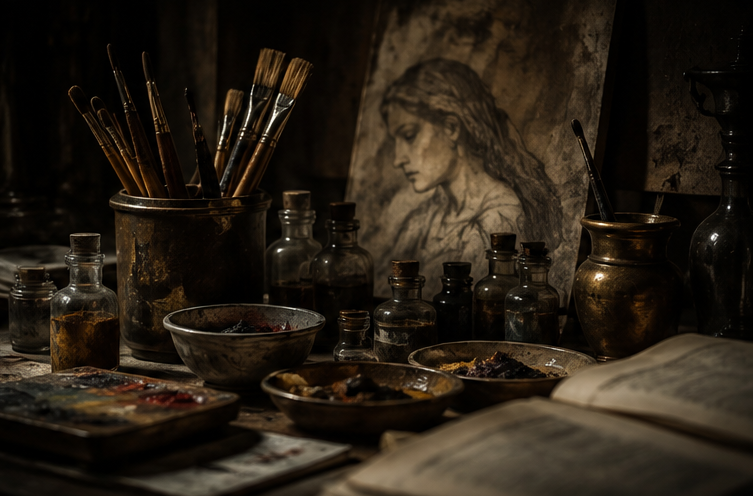
A physical and intellectual place in which the artist studies, experiments, corrects, fails, repeats and constructs knowledge.
The atelier is the opposite of permanent improvisation.
It does not mean rigidity.
It means possessing enough tools to make meaningful choices.
Technique as Freedom
One of the greatest misunderstandings is the idea that technique restricts creativity.
Very often the opposite is true.
The deeper an artist understands:
material;
drawing;
perspective;
composition;
colour;
light;
anatomical structure;
support preparation;
the greater the freedom to distort, simplify, exaggerate or transform.
Knowledge does not impose.
It enables.
A technically conscious artist can choose to break a rule.
An artist who does not know the rule can merely ignore it.
The difference is fundamental.
The Support Before the Image
Every painting begins before painting itself.
It begins with the support.
Canvas.
Linen.
Jute.
Wood.
Panel.
Or other materials.
The support affects surface, durability, absorbency, pigment response and even the final perception of the artwork.
Preparation is equally decisive.
A surface that absorbs too much may reduce colour luminosity.
A ground that is too closed may affect adhesion.
A coloured preparation can radically alter the character of the final image.
Preparation is therefore not secondary.
It is already painting.
Drawing and Construction
Drawing remains one of the most powerful tools of the atelier.
Not necessarily as a visible outline.
It may exist as mental structure.
Drawing allows the artist to understand:
proportion;
balance;
weight;
movement;
relationships between positive and negative space;
direction of the gaze;
rhythm of composition.
Within figurative painting, drawing does not simply make the figure “correct.”
It gives the figure presence.
A hand may be anatomically accurate and still appear visually weak.
A face may possess perfect proportions and remain psychologically empty.
Drawing therefore becomes psychological construction as much as formal construction.
Anatomy and Volume
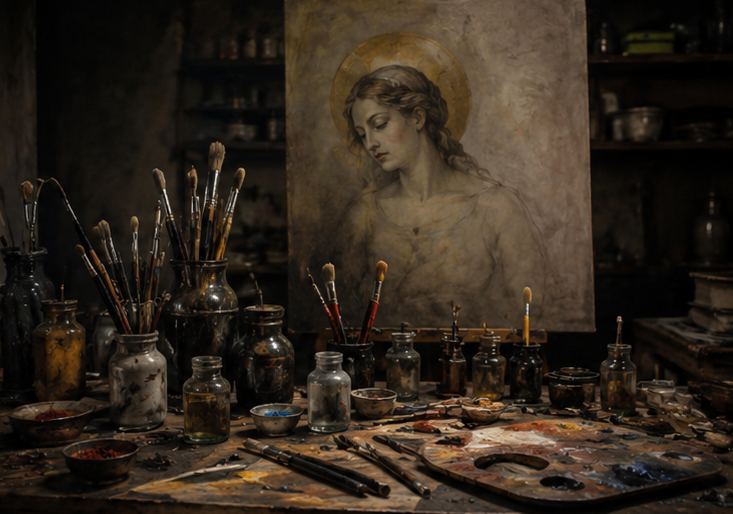
When the human figure occupies the centre of the image, anatomical understanding becomes especially important.
Not to transform the painter into a physician.
But to understand how the body occupies space.
Bone.
Muscle.
Weight.
Torsion.
Balance.
Gravity.
The figure must appear to exist.
Even when idealised.
Even when distorted.
Even when transformed symbolically.
The credibility of the figure often emerges through the perception of volume.
Sculptural Projection
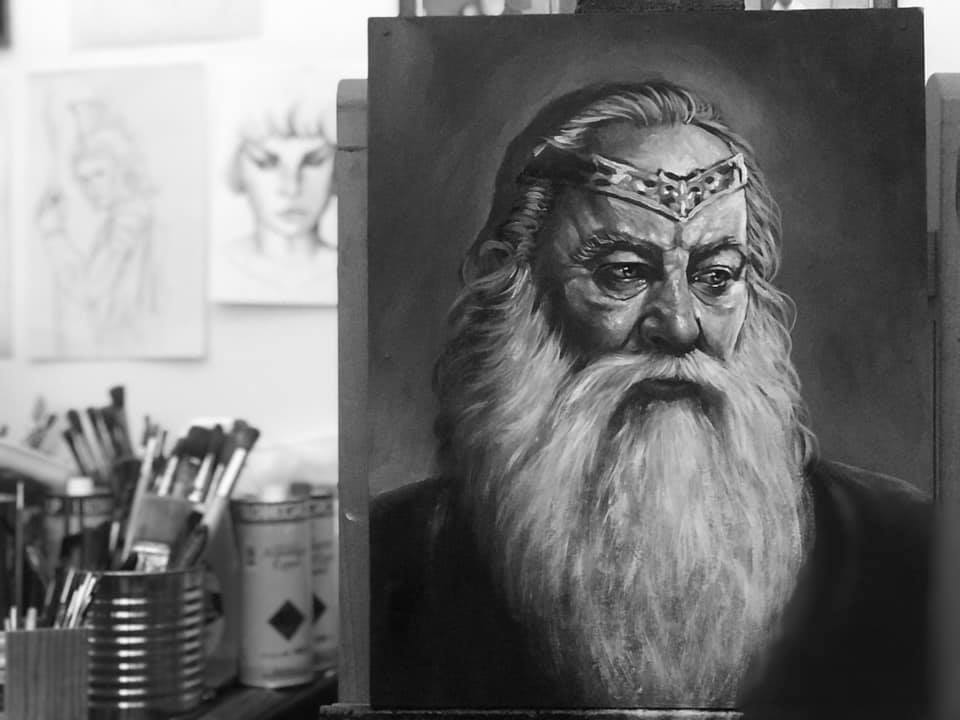
Within Neo-Stilnovism, the construction of the figure may be understood through the concept of sculptural projection.
The figure is not conceived as a flat silhouette.
It is mentally constructed as though it were sculpture.
Head.
Face.
Shoulders.
Hands.
Body.
Every element must possess volume.
The painter imagines form before definitively placing it onto the surface.
This approach can create greater presence, solidity and physical credibility.
Painting almost becomes modelling through light.
Light and Chiaroscuro
Chiaroscuro is not merely dramatic effect.
It is a system of construction.
Light defines.
Selects.
Conceals.
Creates volume.
Builds hierarchy.
Within an effective composition, light guides the viewer’s eye.
It determines what must be seen first.
What should emerge.
What may remain within shadow.
Within Neo-Stilnovism, chiaroscuro may also acquire symbolic meaning.
Light can suggest:
knowledge;
presence;
revelation;
the sacred;
consciousness.
Shadow may become:
mystery;
interiority;
pain;
limit;
transformation.
Technique and symbolism meet.
Layering
One of oil painting’s deepest qualities lies in layering.
Every layer alters the previous one.
Covers.
Reveals.
Glazes.
Strengthens.
Suppresses.
Illuminates.
Layering allows the painter to construct not only spatial depth but chromatic depth.
Colour may become more complex precisely because it has not been produced in a single passage.
The painting is built through time.
Glazing
Glazing is one of the most refined instruments within traditional painting.
A thin transparent layer can radically change the light of a surface.
Warm it.
Cool it.
Unify it.
Deepen it.
Transform it.
Glazing is not simply a method for making a painting appear “old.”
It is an optical system.
It allows light to pass through different pigment layers and produce a depth that a uniform application of colour rarely achieves.
Material and Surface
Every painting possesses a skin.
Smooth.
Rough.
Dense.
Transparent.
Glossy.
Matte.
Material contributes to perception.
An extremely polished surface creates a different relationship from a heavily textured one.
There is no universally superior solution.
There is only the solution that serves the image.
Technique becomes narrative choice.
Colour Is Not Decoration
Colour is emotional structure.
Red.
Blue.
Black.
Gold.
White.
Purple.
Every colour carries cultural, psychological and symbolic associations.
Within Neo-Stilnovism, colour may be used not simply to create harmony but to strengthen an archetype.
Red may become passion, blood, power or sacrifice.
Gold may evoke sacredness, royalty or transcendence.
Black may become darkness, elegance, silence or death.
Colour does not simply accompany the figure.
It interprets it.
The Importance of Waiting
One of the great differences between painting and digital production lies in waiting.
Oil paint must dry.
Certain layers must stabilise.
Some corrections require time.
Painting forces the artist to interrupt action.
Return.
Look again.
This temporal distance may improve the work.
It allows errors to become visible that were invisible during execution.
Slowness becomes part of critical judgment.
Understanding Error
Technique does not eliminate mistakes.
It helps the artist recognise them.
An error may become:
correction;
variation;
discovery;
a new solution.
But to transform error into choice, the artist must be capable of identifying it.
This is where technical discipline becomes valuable.
Not to produce perfection.
But to produce awareness.
Virtuosity and Emptiness
Technique can also become dangerous.
An artist may paint impeccably and still produce an unnecessary artwork.
Precision does not guarantee depth.
Virtuosity does not guarantee meaning.
The issue is therefore not simply how well something is painted.
The issue is why it is painted in that way.
Technique must serve a vision.
When it becomes demonstration alone, it risks turning into exercise.
Technique and Identity
One of the most interesting aspects of technique is the way it contributes to artistic recognisability.
Brushwork.
Construction of faces.
Management of light.
Treatment of shadows.
Preparation of surfaces.
Rendering of fabrics.
Composition.
Over time, these elements become part of the artist’s visual signature.
Not merely the written signature.
The painterly signature.
The Velatio Method
Within Neo-Stilnovist practice, the Velatio Method introduces a particular dimension.
Technique is not understood exclusively as control.
It may also include moments of suspension.
Moments in which gesture is partially removed from rational surveillance.
The artist may work through memory, rhythm, bodily perception and imagination.
Technique is not abandoned.
It is internalised.
Only someone possessing structure can, at a certain point, suspend it.
Atelier and Transmission
Technique also possesses a generational dimension.
The atelier is a place of transmission.
Not necessarily in the old model of master and apprentice.
It may be:
studio;
laboratory;
workshop;
academy;
demonstration;
lesson;
technical archive.
Every artist develops personal solutions over time.
Recipes.
Methods.
Sequences.
Choices.
When such knowledge is documented, it becomes part of the artist’s legacy.
Technique as Heritage
An artist leaves artworks.
But may also leave a method.
Notes.
Drawings.
Recipes.
Tools.
Preparations.
Studies.
Photographs.
Videos.
Texts.
Demonstrations.
Such materials allow future generations to understand not only what was painted, but how it was constructed.
Technique becomes heritage.
Conservation and Duration
Technical quality also affects conservation.
Poorly prepared supports.
Incompatible materials.
Fragile layers.
Unsuitable varnishes.
All may compromise an artwork over time.
Experimental freedom remains fundamental.
But every experiment also carries material responsibility.
An artwork intended to endure must be conceived in relation to time.
The Atelier in the Age of Artificial Intelligence
Artificial intelligence makes these questions even more significant.
Today complex images can be generated rapidly.
The ability to produce an impressive image is no longer necessarily rare.
What becomes rare is:
process;
material;
presence;
construction;
manual knowledge;
time invested.
Painting does not need to compete with artificial intelligence through speed.
It can compete through physicality.
The Future of Technique
Technique does not belong to the past.
It belongs to every artist who chooses to deepen the relationship between idea and material.
It may be traditional.
Experimental.
Mixed.
Digital.
Analogue.
The fundamental question always remains the same:
Does this technique truly serve the artwork?
When the answer is yes, technique becomes language.
From Atelier to Legacy
The atelier is therefore much more than a place where painting happens.
It is where an image acquires a body.
Where material becomes thought.
Where gesture is disciplined.
Where error becomes knowledge.
Where time enters the artwork.
And where an individual practice may eventually become heritage.
This is why technique still matters.
Not because the present must return to the past.
But because without knowledge of material, it is difficult to construct something capable of crossing into the future.

Other Articles