
The Return of the Image as Presence, Knowledge and Cultural Resistance
For decades, a significant part of the contemporary art debate regarded beauty with suspicion.
To be beautiful could appear too easy.
To be figurative could seem conservative.
To possess visible technical skill could appear less intellectually significant than constructing a conceptual device, a provocation or an investigation into the art system itself.
Yet history rarely moves in only one direction.
Today, in a world saturated with digital images, photography, video, algorithms and artificial intelligence, figurative painting is asking an unexpected question:
Can beauty become radical again?
Not as nostalgia.
Not as imitation of the past.
But as resistance to speed, superficiality and the increasing replaceability of contemporary images.
When Beauty Became Suspicious
For centuries, beauty represented one of the great categories through which Western art investigated the world.
It was not necessarily reassuring beauty.
Beauty could contain tragedy.
Death.
Violence.
Sacrifice.
Eros.
Religion.
Power.
Think of Renaissance painting.
The Baroque.
Caravaggio’s theatricality.
Michelangelo’s tension.
Pre-Raphaelite melancholy.
Beauty did not eliminate conflict.
It made conflict visible.
With the historical avant-gardes and many later developments of the twentieth century, however, the relationship between art and beauty changed profoundly.
The artwork increasingly began to question its own status.
What is art?
Who decides what art is?
How important is the artist’s hand?
How important is the idea?
How important is the object?
These questions produced some of the most important experiences of modern culture.
But they also helped create, within parts of the art system, the impression that beauty, figurative representation and craftsmanship inevitably belonged to the past.
The Figure Was Never the Problem
The real issue has never simply been “figuration versus contemporaneity.”
Modern and contemporary art history contains extraordinary figurative artists.
The deeper question has always been:
Can the human figure still produce thought?
If a painting merely repeats an old language without transforming it, it becomes an exercise.
But the same is true of conceptual art.
An idea-based work is not automatically profound simply because it avoids figurative representation.
Every language can become academic.
Even anti-academicism.
The real question therefore concerns necessity.
Why this figure?
Why this face?
Why this material?
Why this light?
What is the artwork attempting to tell us?
The Revolution of Slowness
Painting possesses one quality that has become particularly significant today: time.
Digital culture continuously accelerates.
We scroll through images.
See them for seconds.
Forget them.
One image immediately replaces another.
Painting can still require slowness.
Preparing a canvas.
Drawing.
Constructing the figure.
Correcting.
Glazing.
Waiting.
Returning.
Observing.
Traditional technique can therefore acquire a surprisingly contemporary meaning.
Slowness becomes a cultural position.
Not because everything slow is automatically superior.
But because deliberately choosing a non-instantaneous process in a world that rewards immediacy means assigning value to time.
The Body Against the Immaterial
Painting also possesses something digital images do not possess in the same way:
a body.
A canvas has dimensions.
Weight.
Surface.
Material.
Pigment.
Thickness.
Imperfections.
Physical presence.
A digital photograph of a painting is not the painting.
It can document it.
Communicate it.
But it cannot replace the physical encounter with the work.
This becomes especially significant as more and more of our visual experience is mediated through screens.
Painting does not compete with the screen through speed.
It competes through presence.
The Human Figure After the Algorithm
Artificial intelligence makes the issue even more complex.
Highly elaborate figurative images can now be produced within seconds.
Faces.
Bodies.
Landscapes.
Fantastic scenes.
Stylistic references.
Technical visual impressiveness is no longer necessarily rare.
This changes the meaning of craftsmanship.
The value of painting cannot therefore reside simply in the ability to create a “beautiful” figure.
It must emerge from the relationship between gesture, material, intention, time and identity.
In other words:
It is no longer enough to represent well.
The artist must have something to represent.
And a reason to represent it.
Beauty and Unease
One of the most interesting possibilities for contemporary figuration comes from breaking the equation:
beauty = decoration.
Beauty can disturb.
It can unsettle.
It can conceal.
A beautifully constructed face may contain pain.
An elegant figure may suggest death.
A Madonna can appear simultaneously sacred and fragile.
A queen may become a symbol of solitude.
Beauty does not need to resolve conflict.
It can intensify it.
This ambiguity runs through many contemporary figurative practices.
The Return of Symbolism
Symbolism is also acquiring renewed importance.
Much contemporary visual culture has become extremely direct.
Advertising.
Social media.
Communication.
Information.
Everything must be immediately understandable.
Symbols operate differently.
They do not reveal everything.
They suggest.
Conceal.
Demand interpretation.
A crown may represent power or imprisonment.
A veil may suggest protection, mystery, death or transformation.
A rose may become love, eros, blood or mortality.
Symbolism returns temporal depth to the image.
It allows viewers to return.
Painting as Contemplative Space
There is another almost forgotten dimension: contemplation.
Not necessarily religious contemplation.
To contemplate means giving time to something.
Remaining.
Observing.
Allowing an image to produce thought before it is fully understood.
A powerful figurative work can create this condition.
The viewer immediately recognises the subject.
A face.
A body.
A figure.
Yet this familiarity may become an entrance into something more complex.
The recognisable leads towards the invisible.
Neo-Stilnovism and the Recovery of Beauty
It is within this context that Neo-Stilnovism positions its research.
Beauty is not recovered as ornament.
It is recovered as an instrument.
The human figure is not employed simply to demonstrate technical ability.
It becomes a field of symbolism, spirituality, memory and psychological investigation.
Tradition is not treated as a museum from which forms may be borrowed.
It becomes a grammar through which new sentences can be constructed.
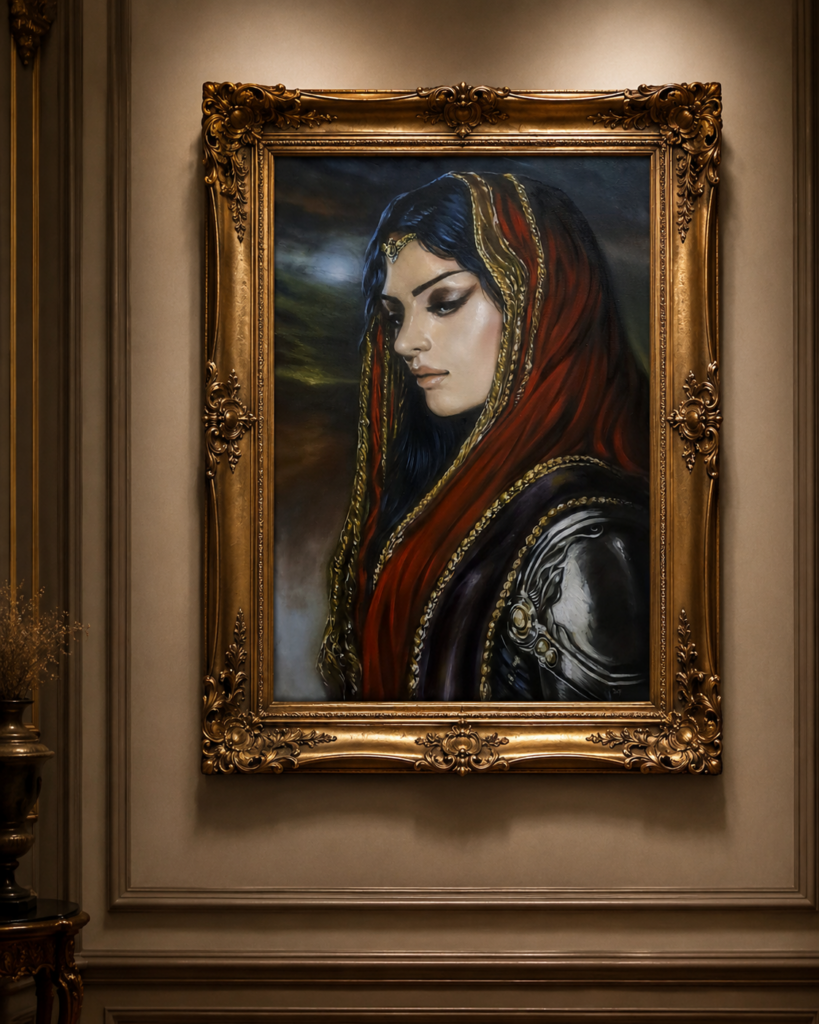
Within Neo-Stilnovism, the Donna Angelo embodies precisely this possibility.
An apparently recognisable figure carries a wider universe:
femininity;
strength;
fragility;
the sacred;
eros;
motherhood;
knowledge;
shadow;
elevation.
The figure becomes contemporary not by abandoning tradition, but by placing new questions before it.
Being Contemporary Does Not Mean Resembling the Present
One of the most persistent misunderstandings concerns the meaning of contemporaneity.
To be contemporary does not necessarily mean using the dominant visual language of one’s time.
An artist may be profoundly contemporary precisely because the work resists certain aspects of the present.
Contemporaneity is a historical condition.
Not a style.
A painter employing slow techniques, historical iconography or figurative composition may speak very precisely about digital society.
Everything depends on how those tools are used.
The past can become a lens through which the present is examined.
The Risk of Nostalgia
There is, naturally, a danger.
Every return to figuration, technique and beauty can fall into nostalgia.
This occurs when painting stops questioning history and begins simply to imitate it.
Reproducing a Caravaggesque effect does not make an artist Caravaggio.
Copying Pre-Raphaelite elegance does not reproduce its cultural tension.
Using a crown, veil or sacred symbol does not automatically create depth.
Tradition implies responsibility.
The stronger the historical reference, the greater the need to transform it.
Technique and Thought
The same principle applies to technique.
Extraordinary technical skill can produce an empty artwork.
Elementary technique can produce an extraordinarily powerful one.
Technique is not an absolute value.
It is possibility.
It allows the artist to choose.
To distort consciously.
Control light.
Construct or destroy form.
Technique becomes significant when it serves thought.
This principle allows us to escape the false opposition between “conceptual art” and “technical art.”
Every great painting contains a concept.
And every great concept requires a form capable of sustaining it.
A New Radicalism
What might radical figurative painting mean today?
Not simply painting well.
Not simply using historical imagery.
Not simply opposing contemporary art.
It may mean constructing images that reject superficiality.
Defending time.
Material.
Complexity.
Ambiguity.
Symbol.
Presence.
It may mean returning to the painting as something more than a surface to be crossed quickly.
A place into which we enter.
Beauty as Question
The most interesting beauty does not provide answers.
It generates questions.
Why does this image attract me?
Why does it disturb me?
Why do I continue looking?
What do I recognise?
What remains inaccessible?
When beauty produces this kind of tension, it ceases to be decoration.
It becomes knowledge.
After Conceptualism?
Perhaps the title itself contains a mistake.
We are not truly “after” conceptualism.
Art does not advance by permanently replacing one language with another.
Conceptual, figurative, digital, performative, abstract and installation practices will continue to coexist.
The more interesting question is not which language will win.
It is which artworks will possess necessity.
Figurative painting does not need to defeat conceptual art.
It needs to demonstrate why it still needs to exist.
And when it succeeds, beauty may once again become one of its most powerful forms of radicalism.

Other Articles
What Makes an Artist Collectible?