
From a collective place of production to a space of individual identity, the workshop, studio and atelier have evolved alongside the changing role of the artist.
When we enter an artist’s studio, we rarely see only a room.
We see canvases leaning against walls, worn brushes, unfinished drawings, pigments, books, photographs, collected objects and works that may never be exhibited.
The studio is the place where an image exists before it becomes public.
Yet the space that today seems almost inseparable from our idea of the artist did not always resemble the romantic image of the private atelier.
For centuries, art was produced primarily within organised workshops, where production, training, commerce and technical knowledge existed together.
The history of the artist’s studio is therefore also the history of a deeper transformation:
from craftsman to author, from master to cultural personality, and from place of production to space of artistic identity.
Before the studio: the workshop
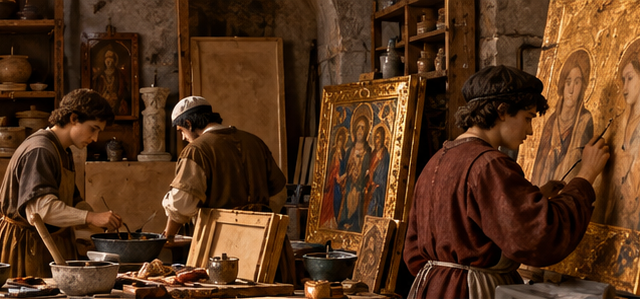
In the Middle Ages, what we might now call an artist’s studio was primarily a workshop.
It was not necessarily private or solitary.
It was a place of work.
The master might be surrounded by apprentices, assistants and specialised craftsmen.
The creation of a major work could involve many hands.
Panels had to be prepared.
Pigments ground.
Surfaces treated.
Grounds applied.
Drawings transferred.
Decorative elements completed.
The final work might be associated with the master’s name, but behind it often stood a complex system of production.
The artist within a system
To understand the medieval workshop, we must temporarily set aside the modern idea of the independent artist.
Artistic activity existed within networks of guilds, religious patronage, confraternities and civic institutions.
An artwork was often produced in response to a specific commission.
An altarpiece.
A fresco.
A decorative cycle.
A liturgical object.
The working environment therefore had to satisfy practical and organisational needs as well as artistic ones.
Art was intellectual activity.
But it was also craft.
Learning by watching
The workshop had another essential purpose:
the transmission of knowledge.
A young apprentice did not necessarily begin by painting major figures.
He learned by observing.
Preparing materials.
Copying drawings.
Studying details.
Repeating gestures.
Gradually understanding how an artwork was constructed.
Artistic knowledge passed directly from one generation to another through practice.
It was not merely theory.
It was the memory of the hand.
The Renaissance and the changing artist
During the fifteenth and sixteenth centuries, the social and intellectual position of the artist gradually changed.
The workshop remained fundamental.
But certain artists achieved a new cultural status.
They were increasingly understood not only as highly skilled makers, but also as inventors, thinkers and intellectual personalities.
Growing interest in drawing, perspective, anatomy and artistic theory helped transform perceptions of artistic work.
The artist could increasingly be considered the author of an idea, not merely its material executor.
The Renaissance workshop
This did not mean that the Renaissance suddenly abolished collaborative workshop practice.
Quite the opposite.
Many great masters continued to work with assistants and pupils.
The workshop functioned simultaneously as a place of education, production and management of commissions.
A master could design the principal composition while collaborators executed secondary passages.
Maintaining stylistic coherence became part of the organisation of the workshop.
Something resembling an atelier identity emerged.
Drawing at the centre
Drawing occupied a crucial position within these environments.
It allowed the artist to plan.
Study.
Correct.
Communicate ideas to assistants.
Transfer compositions.
Drawing became almost a language through which the master’s conception could circulate within the workshop.
That principle remains relevant today.
Before becoming material, an artwork must often first become mentally organised.
From workshop to studio
Over time, the artist’s working environment gradually changed.
Alongside collective production, the individual dimension became increasingly important.
The studio became a place in which artists could work, receive patrons, display paintings and construct aspects of their public identity.
It was no longer simply the place where art was produced.
It increasingly became part of how the artist was perceived.
The studio as a place of prestige
For successful artists, especially between the seventeenth and eighteenth centuries, the studio could acquire an almost ceremonial dimension.
Princes entered.
Collectors visited.
Diplomats arrived.
Intellectuals and potential patrons were received.
To see the master within his working environment meant entering symbolically into the place where images came into existence.
The studio therefore acquired a double function:
workplace and theatre of representation.
The academies
At the same time, artistic academies became increasingly influential.
Training no longer depended exclusively upon a master’s workshop.
Life drawing, anatomy, perspective, theory and the study of antiquity entered organised systems of education.
The academy did not destroy the studio.
It changed its role.
An artist might receive formal training and later develop an individual language within a private atelier.
Technical transmission was expanding from an exclusively craft-based model into an intellectual and cultural one.
The nineteenth century and the myth of the atelier
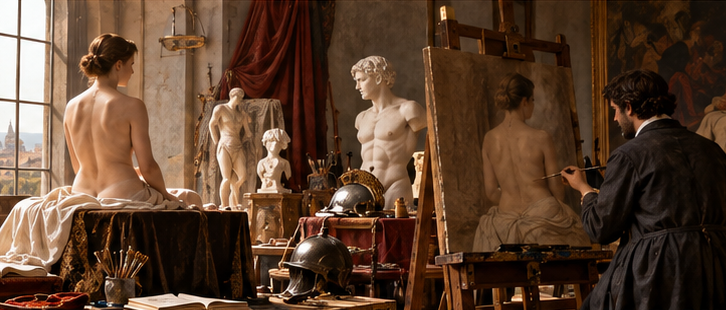
Much of the studio image still familiar today took shape during the nineteenth century.
Large windows.
Easels.
Plaster casts.
Fabrics.
Models.
Canvases stacked against walls.
Books.
Sculptures.
Costumes.
Unusual objects.
The atelier became a world in itself.
For figurative painters, it could also operate as a complex machine for constructing images.
A model was positioned.
Light was studied.
Objects selected.
Costumes arranged.
An entire imagined world could be assembled physically before being translated onto canvas.
Atelier light
Light became one of the studio’s fundamental tools.
Many studios were designed around large windows capable of providing relatively stable illumination.
Northern light became particularly valued by many painters because it reduced the strong changes caused by direct sunlight during the day.
But there was never one universal formula.
Artists adapted their environment to their method.
The studio itself had become an instrument.
The model
Within the figurative atelier, the human model often occupied a central role.
The body could be studied from life.
Drapery observed.
Poses corrected.
Lighting adjusted.
Yet the model did not necessarily determine the final identity of the figure.
A real face might become a mythological character.
A contemporary pose might become a medieval heroine.
A specific person could become an archetype.
The studio as theatre
This made many nineteenth-century studios resemble small theatres.
The artist could construct a scene.
Move a piece of fabric.
Change a costume.
Adjust a lamp.
Reposition a chair.
Ask the model to turn.
The artwork was not merely discovered in the visible world.
The world required by the artwork could be partially constructed inside the studio.
The Romantic atelier
Another image developed alongside this professional environment.
The solitary artist.
The disordered room.
Poverty.
Night.
Obsession.
Distance from bourgeois society.
Part of the bohemian mythology of the artist was born here.
The studio began to be represented not simply as a workplace but as an extension of artistic personality.
The studio as indirect self-portrait
A studio can almost be read as a form of self-portrait.
Extreme order communicates something.
Apparent chaos communicates something else.
Books, tools, unfinished works and accumulated objects create a mental geography.
What an artist chooses to keep nearby may reveal aspects of that artist’s visual universe.
Photography and modernity
Photography changed the studio again.
It could record models, poses, artworks and stages of production.
Artists increasingly incorporated photographs into their working processes.
The studio became a place where direct observation and technological mediation could coexist.
That process would continue throughout the twentieth and twenty-first centuries.
The twentieth century breaks the traditional atelier
Modern and contemporary art radically expanded the idea of what a studio could be.
Not every artist needed the same environment.
Painters required canvases and pigments.
Sculptors worked with volume and specialised tools.
Conceptual artists could work through plans and texts.
Installation demanded enormous spaces.
Photography introduced cameras and darkrooms.
Video introduced monitors and editing.
The studio no longer possessed a single form.
From atelier to factory
Some artists transformed their studios into large productive organisations.
Assistants.
Technicians.
Administration.
Archives.
Fabrication spaces.
Industrial buildings.
In a completely different form, something reminiscent of the historical workshop returned.
The contemporary artist could once again direct a group of people involved in the material realisation of a project.
History had partially turned in a circle.
Yet the hand remains
At the same time, another tradition continues.
One painter before one canvas.
A drawing on a table.
Colours being prepared.
A brush.
Silence.
Art history does not simply replace one practice with another.
Practices overlap.
The contemporary factory and the intimate painter’s atelier can exist at the same historical moment.
The studio in the digital age
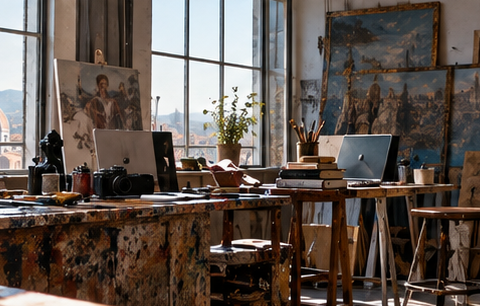
Today the same working space may contain:
canvases;
pencils;
brushes;
computers;
photographs;
tablets;
digital archives;
projectors;
printers;
software;
reference imagery.
Digital technology has not necessarily destroyed the physical studio.
It has expanded it.
The contemporary atelier can exist simultaneously on the wall and on the screen.
The place where the artwork is not yet an artwork
One characteristic nevertheless runs through much of the studio’s history.
It is the territory of the unfinished.
Here the artwork does not yet have to present itself to the public.
It can fail.
Change.
Be destroyed.
Begin again.
Be abandoned.
The studio protects a fragile stage of creation.
The artist is not yet presenting.
The artist is searching.
The atelier as a living archive
Studios inevitably accumulate memory.
Old drawings.
Photographs.
Pigments.
Experiments.
Unfinished canvases.
Sketches.
Annotated books.
Objects used years earlier.
This is not necessarily a professional archive.
But it is frequently the first place in which the material memory of an artist begins to accumulate.
Every object may carry a history.
Transmission
The studio can also remain a place of transmission.
A younger artist observes a master.
Sees how a surface is prepared.
How a face is constructed.
How the brush is held.
How errors are corrected.
How the artist looks.
Certain aspects of practice can be described in books.
Others become fully understandable only when the gesture itself is observed.
In this sense, the contemporary atelier still preserves something of the ancient workshop.
The atelier and Neo-Stilnovism
Within Neo-Stilnovist Painting, the atelier may be understood as more than a room devoted to production.
It is the place in which imagination, emotion and technique enter into dialogue.
The image can arise internally.
The model may provide a face or presence.
Drawing searches for structure.
Sculptural Projection mentally constructs volume.
Painting transforms that construction into matter.
The studio therefore becomes a passage between two worlds:
the invisible world of imagination and the visible world of the artwork.
Not a museum of the artist
This does not mean that the studio should become artificial scenery.
An authentic atelier is first of all a place where work occurs.
Tools are used.
Materials are consumed.
Order or disorder serves a function.
Experiments happen.
Mistakes remain.
The fascination of the studio comes precisely from this.
Not from decoration.
From the presence of work.
The artwork before the artwork
A painting displayed in a museum appears complete.
Inside the studio we may encounter what came before.
Uncertainty.
Research.
Construction.
And perhaps this is precisely why the atelier continues to fascinate us.
It allows us to approach not only an artwork.
It allows us to approach the moment when the artwork does not yet completely exist.
Conclusion
From the medieval workshop to the Renaissance atelier, from the nineteenth-century studio to contemporary production spaces, the artist’s workplace has changed form repeatedly.
It has been a laboratory.
A school.
A business.
A reception room.
A refuge.
An archive.
A theatre.
A workshop.
Yet one function has remained remarkably consistent.
The studio is the place where thought is tested against matter.
Here imagination encounters tools.
Technique encounters error.
Vision encounters time.
The studio is not merely the place where an artist keeps artworks.
It is the place where artworks learn how to exist.

Other Articles