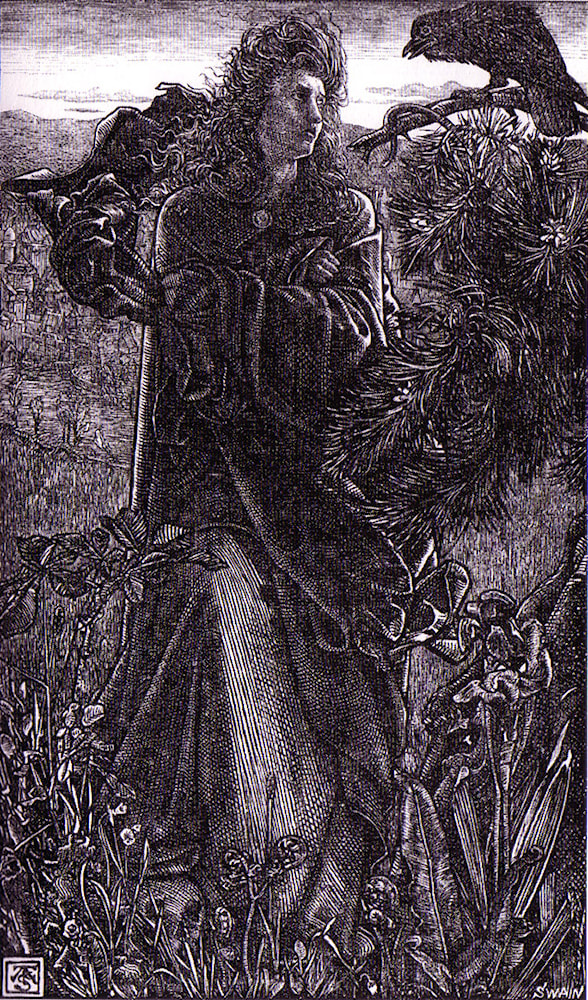

Between medieval legend, myth, sensuality and psychological tension, Frederick Sandys created some of the most disturbing and magnetic female figures of Victorian painting.
Frederick Sandys occupies a singular position within the Pre-Raphaelite world.
He was not one of the original members of the Pre-Raphaelite Brotherhood founded in 1848, but he became closely associated with its wider circle and with the movement’s later development. Art UK includes him among the artists linked to the Pre-Raphaelite tradition after the Brotherhood’s first phase.
What distinguishes Sandys is not simply his technical refinement.
It is the psychological temperature of his images.
His women are rarely passive.
They watch.
They calculate.
They remember.
They threaten.
They seduce.
They suffer.
They seem to possess a private world that remains inaccessible to the viewer.
For this reason, Sandys represents one of the most compelling bridges between Pre-Raphaelitism, Symbolism and the later image of the woman as archetype.

Beyond the Brotherhood
Pre-Raphaelitism is often associated with Dante Gabriel Rossetti, John Everett Millais and William Holman Hunt.
But the movement quickly expanded beyond its original structure.
Artists such as Edward Burne-Jones, William Morris and Frederick Sandys participated in a broader visual culture shaped by medievalism, literature, intense colour, symbolic detail and a renewed fascination with myth and legend.
Sandys entered this world with a language that was recognisably Pre-Raphaelite, but never derivative.
His surfaces are precise.
His colours can be jewel-like.
His figures often emerge against richly patterned or symbolically charged backgrounds.
Yet there is something darker in his work.
A greater sense of danger.
A stronger psychological pressure.
The Woman as Enigma
Sandys repeatedly returned to female figures.
But these women are rarely decorative presences.
They possess agency.
They are often linked to stories of betrayal, magic, revenge, desire or prophecy.
The viewer does not simply look at them.
The viewer is made to confront them.
This is especially evident in works such as Morgan le Fay, Medea, Vivien, Queen Eleanor and Love’s Shadow.
The same basic mechanism returns again and again:
beauty attracts.
Then psychology destabilises.

Morgan le Fay
One of Sandys’s most famous works is Morgan le Fay, painted in 1863–1864 and now associated with Birmingham’s collection. The subject comes from Arthurian legend, and Sandys presents Morgan as an active sorceress rather than a passive medieval beauty.
The figure is caught in action.
Her body turns.
Her arms rise.
Her mouth opens.
The painting is charged with ritual energy.
But what makes it powerful is the ambiguity.
Morgan is beautiful.
But she is not safe.
Her beauty does not neutralise her power.
It intensifies it.
This is crucial.
In Sandys, the feminine is frequently not an object to be possessed.
It is a force to be interpreted.
The Medieval Past as Psychological Theatre
Like many artists associated with the Pre-Raphaelites, Sandys drew heavily on medieval and legendary subjects.
But his Middle Ages are not archaeological.
They are psychological.
Arthurian legend becomes a theatre for jealousy, magic, betrayal and desire.
Historical queens become symbolic figures.
The past is transformed into emotional material.
This is one of the reasons his work remains so modern.
The historical costume may belong to another century.
The psychological conflict does not.
Medea
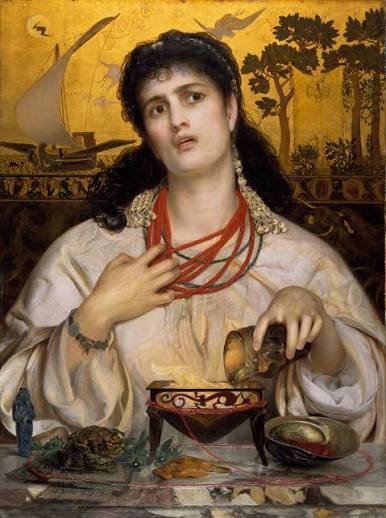
If Morgan le Fay is one of Sandys’s most magical figures, Medea is one of his most psychologically intense.
Painted in 1868, the work represents the mythological sorceress preparing the poisonous instruments of revenge. Art UK notes that Sandys submitted the painting to the Royal Academy, where it was initially rejected before later being exhibited, and that the work provoked strong reactions even among contemporary critics.
Medea is not shown after the crime.
Sandys chooses the moment before.
This makes the painting more disturbing.
The violence is still internal.
Potential.
Concentrated.
Her hands pull at her necklace.
Her face is tense.
Objects of ritual and poison surround her.
The entire image becomes a psychological chamber.
Beauty and Destruction
Sandys was repeatedly drawn to women whose beauty coexists with destructive potential.
Art UK has specifically discussed this recurring fascination, linking figures such as Medea and Queen Eleanor to the Victorian image of the powerful or dangerous woman.
This duality is central to his art.
Beauty does not mean innocence.
Sensuality does not mean submission.
Femininity does not mean passivity.
The woman can be beautiful and threatening.
Elegant and violent.
Magnetic and inaccessible.
This complexity distinguishes Sandys from more sentimental Victorian painting.

Queen Eleanor
In Queen Eleanor, Sandys again transforms a legendary woman into a figure of controlled menace.
The subject is linked to the medieval legend of Queen Eleanor and Rosamund Clifford.
The visual drama does not require action.
The threat already exists in the objects, posture and intention.
This is another recurrent Sandys strategy.
The painting often captures the moment before the event.
Before revenge.
Before betrayal.
Before violence.
The viewer is forced to imagine what comes next.

Vivien
Sandys’s Vivien of 1863 draws upon Arthurian material associated with Tennyson’s Idylls of the King. Art UK identifies the work directly within the Victorian fascination with Tennysonian subjects.
Vivien belongs to the same family of women who destabilise power through intelligence, seduction and manipulation.
But Sandys does not reduce her to a moral lesson.
Her fascination lies precisely in ambiguity.
She is neither simple villain nor idealised muse.
She is psychologically active.
This is perhaps the most important characteristic of Sandys’s women.
They act mentally before they act physically.
Love’s Shadow
In Love’s Shadow, painted around 1867, Sandys turns sensuality itself into tension. The work presents a young woman whose relationship with flowers, colour and gesture creates an image that is both beautiful and uneasy.
The title already contains contradiction.
Love.
Shadow.
Desire is not presented as pure fulfilment.
It contains jealousy.
Possession.
Fragility.
Potential loss.
Sandys repeatedly refuses emotional simplicity.
Mary Magdalene
Sandys could also approach sacred femininity.
His Mary Magdalene, dating to around 1859 and held by the Delaware Art Museum, presents the saint with the traditional ointment jar, surrounded by sumptuous detail characteristic of Pre-Raphaelite painting. The Delaware Art Museum emphasises both Sandys’s extraordinary attention to detail and the richness of the patterned setting and costume.
The work is important because it shows another side of his female archetype.
The woman is still sensuous.
Still psychologically present.
But here sensuality exists together with spiritual memory and redemption.
This tension between physical beauty and moral depth would become one of the great themes of nineteenth-century British painting.
Detail as Psychological Instrument
Pre-Raphaelite detail is often discussed technically.
Flowers.
Textiles.
Jewellery.
Hair.
Furniture.
Pattern.
But in Sandys, detail is rarely neutral.
It contributes to psychology.
An object may indicate poison.
A necklace may suggest tension.
A textile may create sensuous density.
A symbol may connect the figure to myth or ritual.
The environment does not simply decorate the woman.
It extends her.
The Face
The face is central to Sandys’s power.
His women often possess sharply defined features.
Strong eyes.
Controlled mouths.
Heavy or expressive hair.
The face becomes almost sculptural.
But unlike academic portraiture, Sandys rarely allows it to become merely elegant.
There is tension beneath the surface.
The viewer senses withheld thought.
This is precisely where his work moves beyond simple portraiture.
The face becomes a threshold.
The Gaze
The gaze in Sandys is particularly important.
His women frequently appear to know more than the viewer.
This creates asymmetry.
We see them.
But they do not fully reveal themselves.
That imbalance produces fascination.
The image becomes active because the viewer must interpret.
What does she know?
What is she planning?
What has already happened?
What is about to happen?
The gaze becomes narrative.
Hair as Symbolic Form
Hair is another recurring element in Sandys.
Long.
Dense.
Highly controlled.
Sometimes decorative.
Sometimes almost serpentine.
Within nineteenth-century visual culture, female hair could suggest sensuality, vitality, danger or freedom.
Sandys uses it compositionally, but also symbolically.
It frames the face.
Extends movement.
Strengthens identity.
In his most powerful women, hair almost becomes part of the character’s aura.
Colour and Sensual Density
Sandys’s palette frequently combines deep reds, greens, blacks, golds and flesh tones.
This creates a kind of visual richness that is sensuous without becoming soft.
Colour has weight.
The reds can suggest blood, desire, danger.
Green may become magical or poisonous.
Gold can elevate or corrupt.
Black creates depth and secrecy.
The chromatic world reinforces psychological meaning.
Sandys and Rossetti
Sandys is often discussed alongside Dante Gabriel Rossetti.
The comparison is unavoidable.
Both were fascinated by female beauty.
Both developed strong, memorable female types.
Both used medieval and literary themes.
But they differ profoundly.
Rossetti often transforms the woman into a dream.
Sandys frequently transforms her into a problem.
Rossetti’s women may appear suspended in sensual reverie.
Sandys’s women often appear alert.
Dangerous.
Internally active.
This distinction gives Sandys a particularly modern psychological edge.
A Pre-Raphaelite Moving Toward Symbolism
Sandys remains rooted in Pre-Raphaelitism.
But his work often anticipates Symbolism.
The figure is no longer important only because of her story.
She becomes the embodiment of a mental state.
Medea is not merely Medea.
She is revenge.
Morgan is not merely Morgan.
She is occult power.
Vivien becomes seduction and strategy.
Mary Magdalene becomes sensuality transformed by spiritual memory.
This transition from character to archetype is central.
The Femme Fatale Before the Fin de Siècle
Later nineteenth-century Symbolism and Decadence would make the femme fatale one of their great obsessions.
Salome.
Judith.
Medusa.
Sphinx.
Enchantress.
Sandys reaches this territory early.
His women already contain the qualities that would later define that archetype:
beauty;
autonomy;
mystery;
sexual power;
danger;
knowledge.
But Sandys’s treatment remains more psychologically controlled than many later Symbolist interpretations.
He does not need spectacle.
The danger can exist in a face.
Why Sandys Matters Today
Sandys matters because contemporary figurative painting is once again asking questions that his work understood deeply.
Can beauty contain unease?
Can a face tell a story without narrative action?
Can historical myth become contemporary psychology?
Can the woman be represented as subject rather than ornament?
Can technical precision coexist with mystery?
Sandys answers all of these questions affirmatively.
From Pre-Raphaelitism to Neo-Stilnovism
For The Stilnovist, Sandys is particularly significant because several elements of his research enter into dialogue with Neo-Stilnovist concerns.
The centrality of the female figure.
The woman as archetype.
The gaze as psychological threshold.
Historical memory transformed rather than copied.
Myth.
Sacred and profane tension.
Beauty that contains darkness.
The relationship between technical refinement and emotional depth.
This does not make Sandys a Neo-Stilnovist, of course.
He belongs fully to the nineteenth century.
But he represents one of those historical figures whose work helps us understand the genealogy of a contemporary symbolic figurative language.
The Woman Is Not Decoration
Perhaps the most important lesson Sandys leaves behind is simple.
The painted woman does not need to exist for the viewer’s pleasure alone.
She can resist.
Question.
Threaten.
Remember.
Judge.
Desire.
Transform.
Her beauty can attract the gaze while her psychology refuses possession.
This is why his paintings remain alive.
Frederick Sandys and the Darker Face of Beauty
Frederick Sandys transformed Pre-Raphaelite beauty into something less comfortable.
He preserved colour.
Detail.
Myth.
Sensuality.
But introduced psychological danger.
His figures are beautiful because they are complex.
Not because they are harmless.
This is the key.
In Sandys, beauty is not the end of the image.
It is the beginning of interpretation.
His women do not simply ask to be admired. They ask to be understood.
And precisely because they never reveal themselves completely, they continue to look back at us from the nineteenth century with extraordinary force.