


Exhibition, loan, deposit, donation, acquisition and permanent collection: understanding the institutional life of an artwork.
An artwork does not physically change when it enters a museum.
The canvas remains the same.
The pigment remains the same.
The signature remains the same.
Yet something profound changes.
Its biography changes.
From that moment onward, the artwork may enter a system of documentation, conservation, cataloguing, research and institutional memory that adds a new chapter to its history.
To understand this process correctly, however, it is necessary to distinguish between terms that are often treated as though they were interchangeable.
They are not.
Being exhibited in a museum does not necessarily mean belonging to the museum.
Being donated to an institution does not necessarily mean being permanently displayed.
Belonging to a permanent collection does not necessarily mean being visible every day in the galleries.
Within museum practice, precision of language is part of the precision of history.
Entering a museum can mean very different things
When someone says that an artwork “has been in a museum,” the statement may describe completely different situations.
The work may have been:
temporarily exhibited;
loaned;
placed on deposit;
donated;
acquired;
inventoried;
included in a permanent collection.
Each situation creates a different institutional relationship.
Artists, collectors, curators and archives should understand these distinctions.
Temporary exhibition
The simplest situation is a temporary exhibition.
A museum may include an artwork in an exhibition for several days, weeks or months.
The work may belong to the artist.
A collector.
A gallery.
Another institution.
At the end of the exhibition, it is generally returned to its owner.
This experience can nevertheless become an important part of the artwork’s history.
If the exhibition is documented through catalogues, photographs, invitations, institutional records or publications, the work acquires a verifiable exhibition history.
But this remains different from entering the museum’s collection.
Loan
A loan is a temporary arrangement through which the owner allows an institution to hold or display an artwork for a defined period.
The period may be brief.
Or it may last several years.
Ownership, however, does not necessarily change.
This is the essential point.
An artwork may physically remain inside a museum without legally belonging to the museum’s collection.
The loan may still become highly significant within the work’s exhibition history.
But it should be described accurately.
Deposit
A deposit may take different forms depending upon institutional practice and contractual arrangements.
Generally, an artwork is entrusted to an institution for custody, conservation or use without necessarily transferring ownership.
The artwork may remain in storage.
It may be displayed.
It may be available for study.
But its legal status remains governed by the deposit arrangement.
For this reason, a professional record should clearly state:
“Artwork on deposit at…”
rather than using language that could imply acquisition.

Donation
Through donation, ownership of the artwork is transferred to the institution without a purchase price, according to the terms of the gift and its formal acceptance.
This creates a much more significant change in the work’s biography.
Ownership changes.
The donation becomes part of provenance.
The museum or institution may enter the work into its registers and collection according to its internal procedures.
But one distinction remains essential.
Donation does not automatically guarantee permanent display.
Museums often possess far more works than they can exhibit at any one time.
A work may belong to the collection while remaining in storage.
Acquisition
Acquisition refers to the process through which an artwork enters the ownership or collection of an institution.
This may occur through:
purchase;
donation;
bequest;
transfer;
allocation;
or other procedures recognised by the institution.
Once formally acquired, the artwork may enter the museum’s inventory system.
This is important because the work becomes part of the heritage administered by the institution.
Permanent collection
This is one of the most widely used and misunderstood expressions.
When an artwork enters a museum’s permanent collection, it generally means that it belongs to the institution’s enduring holdings rather than being present only for a temporary exhibition.
However, “permanent” does not necessarily mean:
“permanently on display.”
A permanent collection may contain hundreds, thousands or even millions of objects.
Only a proportion can be displayed at any given time.
Other works may remain in storage, be loaned, researched, restored or selected for future exhibitions.
This distinction is fundamental to the accurate communication of an artwork’s history.
Inventory
One of the most important stages in the institutional life of an artwork is registration.
The museum may assign:
an inventory number;
a catalogue record;
technical data;
a photograph;
provenance information;
mode of acquisition;
condition information;
location.
At this point, the artwork becomes part of a documentary system.
It is no longer simply “a painting inside the building.”
It becomes an object with an institutional identity.
The inventory number
An inventory number may appear bureaucratic.
In reality, it is fundamental.
It distinguishes one artwork from every other object.
It connects the work with:
documents;
photographs;
condition records;
provenance;
movements;
publications.
Over time, it may become one of the principal tools through which researchers and curators locate the artwork.
Condition reports
When an artwork enters a museum environment, particularly through a loan or exhibition, a condition report may be prepared.
It records the physical state of the work.
Cracking.
Paint loss.
Scratches.
Deformation.
Previous restorations.
Frame condition.
Characteristics of the support.
The document helps identify changes over time.
It is one of the ways institutions protect artworks materially.
Conservation
Entry into a museum system also introduces another dimension:
professional conservation.
Light.
Humidity.
Temperature.
Handling.
Packaging.
Security.
Restoration.
Museums develop procedures designed to reduce risks associated with the physical life of objects.
The biography of an artwork therefore concerns not only what happened culturally.
It also concerns how the work was preserved.
Provenance and the institution
When an artwork enters an institutional collection, that transition becomes part of provenance.
For example:
Artist’s collection → private collection → donation to museum.
Or:
Artist’s studio → direct institutional acquisition.
The artwork therefore acquires another documentable segment in its history.
This may become important to future historical research.
Exhibition history continues
The institutional life of the artwork does not end after acquisition.
It can continue through:
museum exhibitions;
loans to other institutions;
retrospectives;
thematic exhibitions;
publications;
research;
educational projects.
Acquisition is not the end of the story.
It may be the beginning of another one.
Museum publication
When an artwork appears in a museum catalogue, official database, monograph or scholarly publication, it acquires another documentary trace.
Title.
Date.
Medium.
Artist.
Provenance.
Bibliography.
Such data may become important references for future studies.
Museum publication is not merely promotion.
It is cultural documentation.
Museum entry does not automatically change artistic quality
This distinction is essential.
A museum does not magically transform a weak artwork into a masterpiece.
Institutional presence does not replace artistic quality.
It does not replace research.
It does not replace the artist’s career.
It does not replace the market.
But it adds something real:
a documented institutional context.
That context may become part of the biography of both artwork and artist.
A museum does not create artistic value
Artistic value emerges from the work.
From research.
Technique.
Vision.
Its capacity to survive time.
The institution operates at another level.
It recognises.
Preserves.
Catalogues.
Contextualises.
Makes available for study.
Places within cultural memory.
This distinction matters.
Documentary value
A well-documented institutional relationship adds documentary strength to the history of an artwork.
Not necessarily an automatic, quantifiable financial increase.
But something verifiable.
An acceptance letter.
An inventory number.
A catalogue.
A museum database entry.
An installation photograph.
A publication.
These are facts.
Professional communication should be constructed around facts.
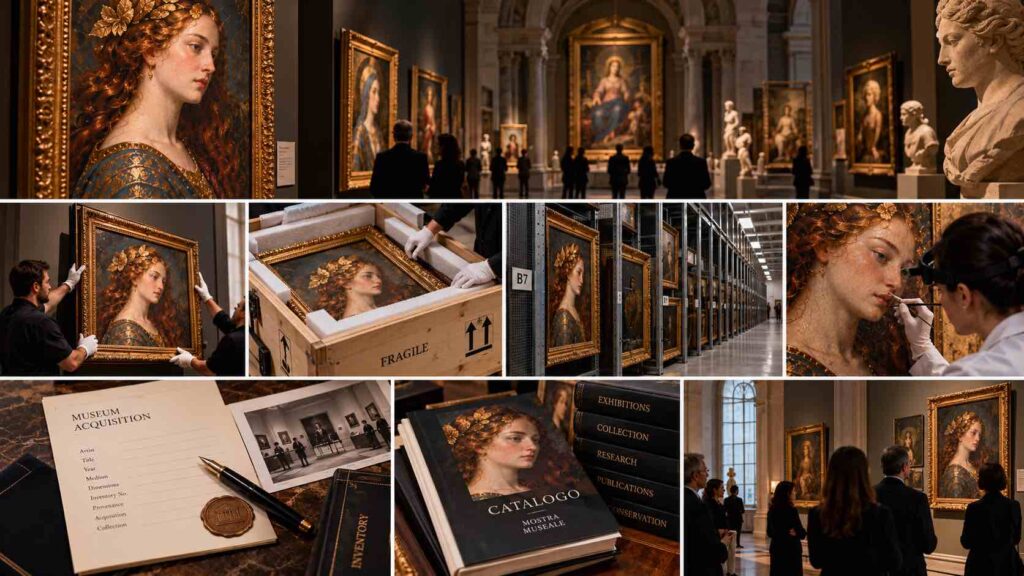
Why terminology matters
In the art world, certain expressions are sometimes used too casually.
“Museum artwork.”
“Held by a museum.”
“Permanent collection.”
“Acquired by a museum.”
“Permanently displayed.”
These phrases describe different realities.
If a work was temporarily exhibited, say that it was exhibited.
If it was donated, state that it was donated.
If it is inventoried within the permanent collection, state that precisely.
Accuracy does not reduce prestige.
It makes prestige credible.
The artist’s role
Artists should carefully preserve documentation concerning institutional relationships.
Letters.
Emails.
Acceptance documents.
Contracts.
Minutes.
Photographs.
Catalogues.
Inventory numbers.
Press releases.
Official database links.
Future careers are reconstructed through these materials.
The collector’s role
When a collector lends an artwork to a museum, the following should be preserved:
loan agreement;
condition report;
insurance documentation;
exhibition records;
catalogue;
installation photographs;
correspondence.
These materials become part of the artwork’s history.
The artist archive
An artist archive should register every significant institutional relationship.
Artwork.
Date.
Institution.
Type of relationship.
Exhibition.
Loan.
Donation.
Acquisition.
Inventory number, where available.
Bibliography.
This prevents history from becoming fragmented.
Museums and cultural memory
Museums perform an essential function:
they organise memory.
They do not preserve objects alone.
They preserve relationships.
Between artworks.
Artists.
Periods.
Societies.
An artwork entering this system is positioned within a broader structure.
It does not lose its individuality.
It gains context.
When an artwork becomes an object of study
Institutional entry may also lead to research.
Curators.
Historians.
Conservators.
Students.
Researchers.
The work may become an object of analysis.
This is one of the most important stages in the transformation of artistic production into cultural heritage.
A studied artwork generates knowledge.
The permanent collection as responsibility
Entering a museum collection is not only recognition.
It also creates institutional responsibility.
Conservation.
Inventory.
Protection.
Management.
Documentation.
Accessibility according to institutional purpose.
A permanent collection is not simply a wall.
It is a system.
Displayed or stored?
Artists and collectors are sometimes surprised to learn that works belonging to major museums may spend long periods in storage.
This does not necessarily diminish their importance.
It is a natural consequence of the size of museum collections.
A museum may own thousands of works while having space to show only a small proportion.
The artwork nevertheless remains part of the collection.
Museums within the artist’s biography
When multiple works by an artist enter different institutions, these events may become significant elements of a professional biography.
But again, precision is essential.
Which artwork?
Which institution?
Which year?
Under what arrangement?
Donation?
Acquisition?
Deposit?
Accurate data creates a readable career.
From painting to documented cultural object
A painting begins as an artwork.
It may later become:
a catalogued object;
a studied object;
a conserved object;
a published object;
an institutional object.
The painting has not physically changed.
But the amount of history that can be reconstructed around it has increased.
What matters is what can be documented
The rule should remain simple.
Do not inflate.
Do not diminish.
Document.
If the work was exhibited, record the exhibition.
If it was donated, record the donation.
If it was acquired, record the acquisition.
If it belongs to a permanent collection, document that status.
Institutional strength emerges from the ability to verify facts.
Conclusion
When an artwork enters into a relationship with a museum, its image remains unchanged.
But its history may change profoundly.
Documents emerge.
Inventories.
Catalogues.
Provenance.
Bibliography.
Conservation.
Research.
Memory.
A museum does not create the artistic value of an artwork. It gives that value a new institutional context, a new documentary layer and a place within cultural memory.
And it is precisely this memory — built through verifiable facts and preserved documentation — that allows an artwork to continue speaking long after the moment in which it was created.

Other Articles

The Pencil: From Graphite to the Artist’s Hand
How to Build a Serious Figurative Art Collection
